Why Machine Learning Financial Auditing Is Reshaping How Firms Manage Risk
Machine learning financial auditing is the use of ML algorithms to analyze financial data, detect anomalies, and assess risk — replacing or augmenting traditional manual and sampling-based audit methods.
How it works in practice:
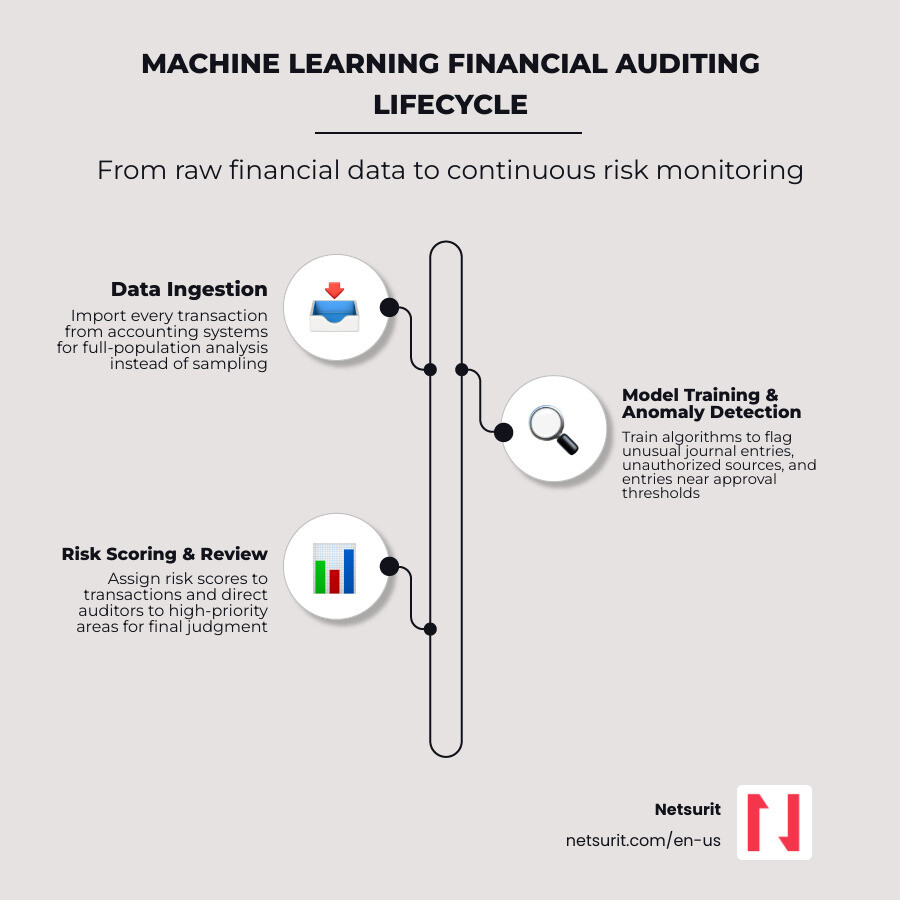
- Full-population analysis — ML models scan every transaction, not just a sample, eliminating sampling risk entirely.
- Anomaly detection — Algorithms flag unusual journal entries, unauthorized sources, or entries just below approval thresholds in real time.
- Predictive risk scoring — Models trained on historical data score current transactions by risk level, directing auditors to high-priority areas.
- Automated document review — Natural language processing (NLP) reads contracts, leases, and financial statements to surface key terms and outliers.
- Continuous monitoring — Instead of point-in-time audits, ML enables 24/7 transaction surveillance.
The result: faster audits, fewer missed irregularities, and auditors spending more time on judgment-intensive work — and less on manual data checking.
That said, ML in auditing is not a plug-and-play solution. Data quality, algorithmic bias, model transparency, and a shortage of professionals with data science skills are real barriers. According to a 2024 KPMG report, 72% of companies are already using AI in financial reporting — and adoption is projected to reach 99% within three years. Firms that delay risk falling behind on both accuracy and efficiency.
I’m Orrin Klopper, CEO of Netsurit, and over nearly three decades of guiding organizations through digital transformation — including IT strategy for financial and professional services firms — I’ve seen how machine learning financial auditing separates firms that scale confidently from those stuck in reactive, manual processes. This guide gives you a clear, practical path to implementation, whether you’re evaluating your first ML tool or looking to mature an existing program.
Related content about Machine learning financial auditing:
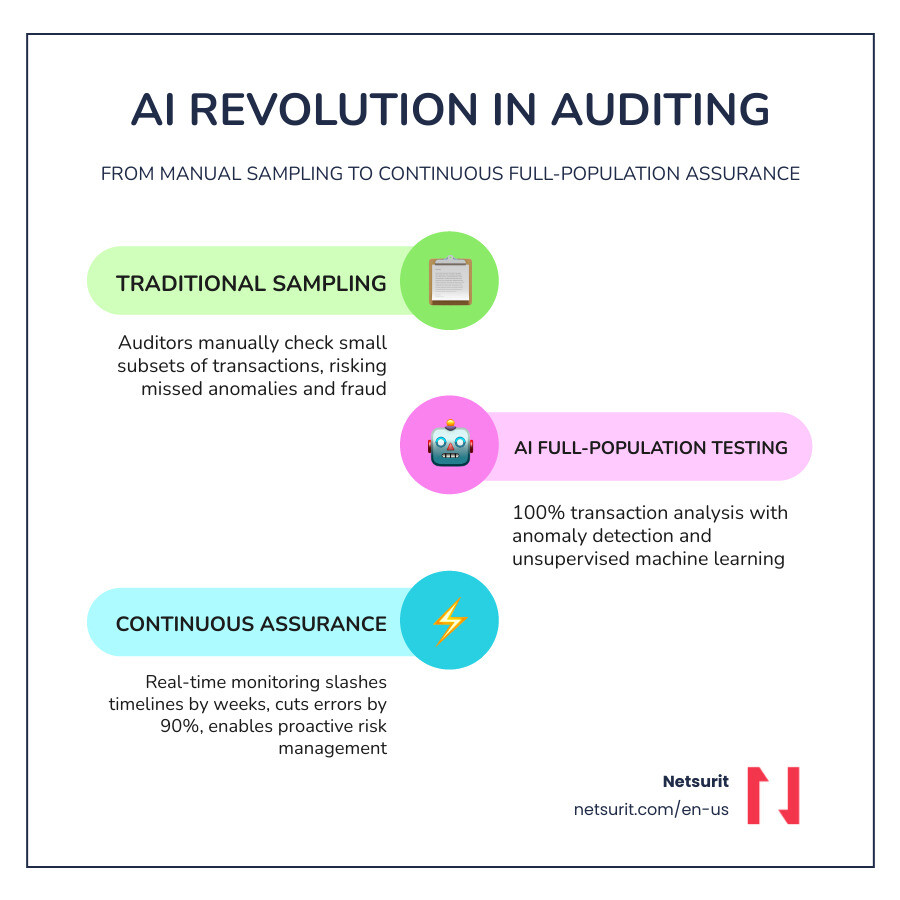
Transitioning from Sampling to Full-Population Machine Learning Financial Auditing
For decades, financial auditing relied on representative sampling. Auditors selected a small, statistically significant percentage of transactions, reviewed them manually, and extrapolated the results to the entire ledger. While this approach was necessary when physical ledgers and limited computing power restricted audit speed, it introduces inherent sampling risk—the very real possibility that material errors or fraudulent transactions slip through undetected because they were not part of the selected sample.
With modern enterprise databases processing millions of transactions annually, sampling is no longer a viable defense against complex corporate fraud. Transitioning to full-population testing allows auditors to analyze 100% of transaction data, eliminating sampling risk entirely and exposing subtle, distributed irregularities that traditional methods miss. To understand how this shift changes the daily workflow of modern audit teams, read our detailed breakdown on From Samples to Smarts: Revolutionizing Audits with Machine Learning.
Why Traditional Sampling Fails Modern Houston Accounting Firms
Traditional manual checks are structurally unsuited for the transaction volumes processed by businesses today. For CPA firms in the Houston, Texas metro area—including fast-growing business hubs like Sugar Land, Katy, and Conroe—the sheer scale of client financial data has outpaced manual capacity.
Consider a mid-sized accounting firm in Sugar Land auditing a regional oilfield services distributor. If the distributor processes 150,000 journal entries per year, a traditional manual audit might sample 150 to 200 transactions. If a rogue employee executes a billing scheme by splitting a single unauthorized $100,000 disbursement into twenty smaller payments of $5,000 spread across multiple vendor accounts, the probability of a manual sample catching even one of these transactions is remarkably low.
Manual sampling also creates a speed-quality tradeoff. To meet tight regulatory deadlines, auditors are often forced to limit the depth of their testing, leaving clients exposed to undetected material misstatements.
Implementing Full-Population Testing with Machine Learning Financial Auditing
To eliminate these blind spots, firms are deploying supervised classification models to run full-population analyses. A prime example of this methodology is detailed in the study A Full Population Auditing Method Based on Machine Learning, which demonstrates how a machine-learning model can autonomously learn accounting rules from historical data and apply them to every transaction.
In this research, a Classification and Regression Tree (CART) decision-tree model was developed using travel-expense records from a large enterprise. The implementation followed a structured, two-stage workflow:
- Model Training: The model was trained on 14,681 travel-expense samples from 2020. It mapped nine distinct business-feature inputs (such as department, employee role, and trip destination) to sixteen possible debit accounts, successfully learning the underlying accounting logic of the organization.
- Full-Population Testing: The trained model was then applied to audit the entire population of 10,738 travel-expense records from 2021. Instead of sampling, the algorithm evaluated every single transaction, comparing the model-predicted debit account against the actual manual bookkeeping entry.
Whenever the model’s prediction diverged from the recorded account, the system flagged the entry as an anomaly. For instance, if an employee’s travel expenses were manually booked under “Administrative Expenses” but the model—based on the employee’s department and historical patterns—predicted they belonged under “Main Business Cost,” the transaction was immediately isolated for human review. This approach allows a Katy-based enterprise audit team to screen thousands of transactions in seconds, capturing rare account misclassifications and eliminating sampling risk.
Comparing Machine Learning Algorithms to Traditional Auditing Methods
To appreciate the impact of machine learning, we must compare its capabilities directly against traditional computer-assisted audit tools (CAATs). Traditional CAATs are deterministic; they rely on static, human-written rules (e.g., “flag any transaction over $10,000”). If a fraudulent transaction occurs at $9,950, a static rule misses it.
In contrast, machine learning models rely on pattern recognition and predictive analytics. They evaluate transactions across hundreds of variables simultaneously, identifying complex, non-linear relationships that no human auditor could write a rule for. For a deeper look at this shift, see our analysis on AI and Auditing: The Future of Financial Assurance.
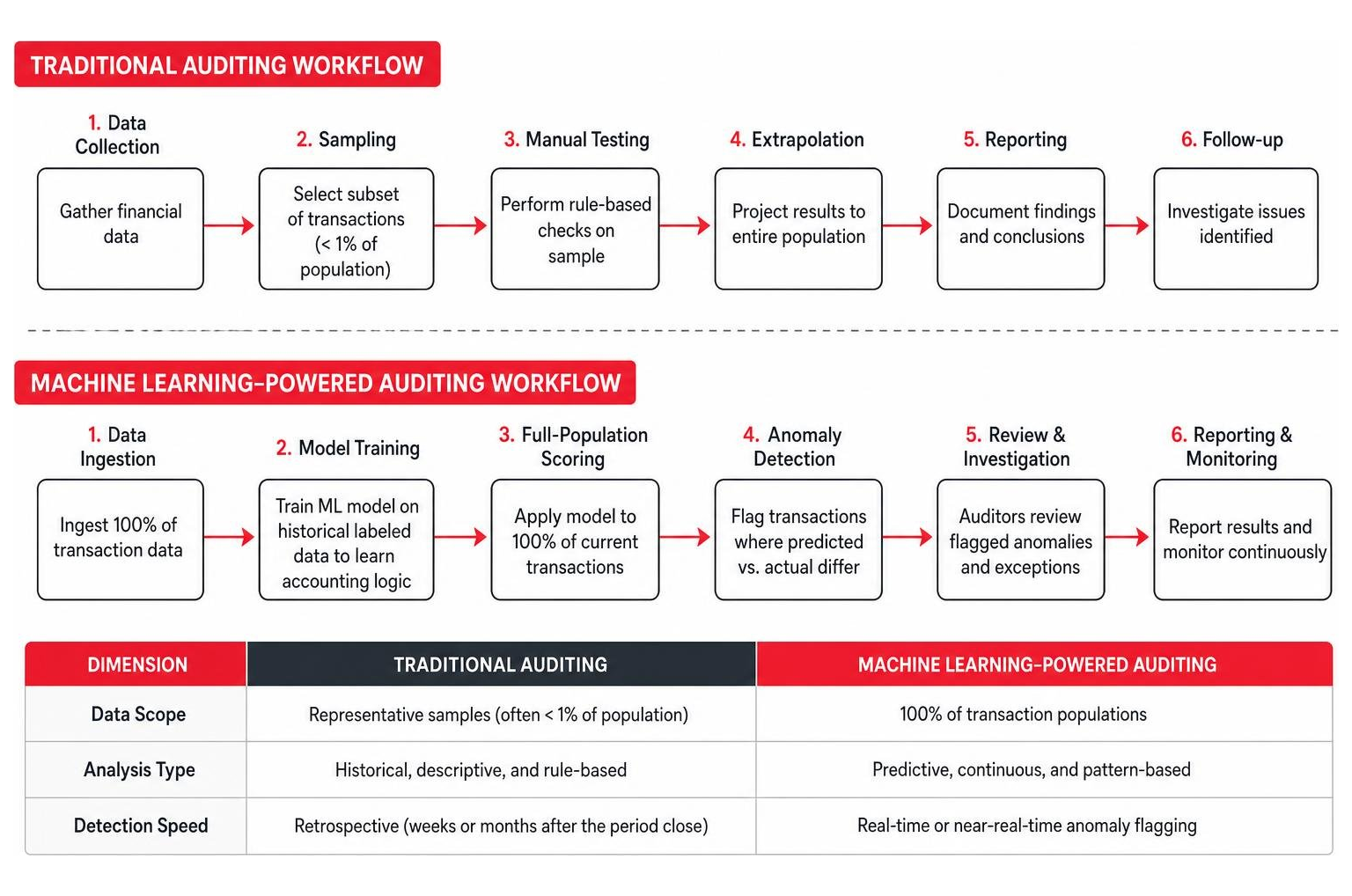
| Dimension | Traditional Auditing | Machine Learning-Powered Auditing |
|---|---|---|
| Data Scope | Representative samples (often < 1% of population) | 100% of transaction populations |
| Analysis Type | Historical, descriptive, and rule-based | Predictive, continuous, and pattern-based |
| Detection Speed | Retrospective (weeks or months after the period close) | Real-time or near-real-time anomaly flagging |
| Irregularity Capture | Misses distributed, complex, or split-transaction fraud | Detects non-linear anomalies and hidden correlations |
| Human Effort | High volume of manual data entry and repetitive verification | Focus on high-risk exceptions and strategic analysis |
Supervised vs. Unsupervised Learning in Fraud Detection
In machine learning financial auditing, algorithms generally fall into two categories: supervised and unsupervised learning.
- Supervised Learning: These models are trained on labeled historical datasets where the outcomes (e.g., “fraudulent” vs. “legitimate”) are already known. Common supervised algorithms include Support Vector Machines (SVM), Random Forest, and K-Nearest Neighbors (KNN). In journal entry testing, supervised models learn the specific characteristics of past accounting errors—such as posting times, user IDs, and account combinations—to classify new entries by risk level.
- Unsupervised Learning: These models analyze unlabeled data to find hidden patterns and natural clusters without prior instruction. Unsupervised techniques, such as deep autoencoders and clustering, are highly effective for advanced anomaly detection. For example, in a dataset of 307,457 journal entries, a deep autoencoder can learn the normal reconstruction pattern of standard transactions. Transactions that yield high reconstruction errors are flagged as anomalies. This is particularly valuable for identifying “unknown unknowns”—new fraud methods that have never occurred in the historical data.
Real-World Performance Metrics of Random Forest and SVM Models
When selecting an algorithm for enterprise financial audits, performance metrics like accuracy, recall, and F1-score are critical. Academic research comparing these models on Big Four accounting datasets reveals that ensemble methods consistently outperform simpler models:
- Random Forest: Achieved the highest F1-score of 0.9012, with an overall accuracy of 92.56% and a recall rate of 90.04%. Its ability to handle high-dimensional, non-linear accounting data makes it highly robust against overfitting.
- Support Vector Machine (SVM): Achieved an F1-score of 0.8756, with an accuracy of 88.16% and a recall of 89.25%.
- K-Nearest Neighbors (KNN): Achieved an F1-score of 0.8545, with an accuracy of 86.07% and a recall of 86.32%.
A major challenge in training these models is class imbalance; legitimate transactions outnumber fraudulent or erroneous ones by thousands to one. To address this, data scientists use Synthetic Minority Over-sampling Technique (SMOTE) during the preprocessing phase to generate synthetic examples of high-risk transactions, ensuring the model learns to identify rare anomalies effectively.
Conroe Manufacturing Audit Example: An auditor in Conroe, Texas, is tasked with verifying inventory valuations for a manufacturing client with 80,000 SKU records. A traditional audit would sample 50 SKUs. By deploying a Random Forest model trained on historical regional material costs, shipping logs, and production run times, the auditor scans all 80,000 SKUs. The model flags 12 SKUs where the recorded valuation is highly inconsistent with current supply chain variables. The auditor investigates only those 12, resolving a potential $300,000 valuation error in hours instead of weeks.
Overcoming the Practical Challenges of Machine Learning Financial Auditing
While the benefits of ML-driven audits are clear, firms must navigate significant operational hurdles. Hasty implementation can lead to technology overload, where a firm spends more time managing complex software than delivering quality audits. To build a secure, defensible strategy, Texas businesses should review our guide on How to Audit-Proof Your Texas Business Using AI Software.
Managing Data Quality, Algorithmic Bias, and the Black Box Problem
The performance of any machine learning model depends entirely on the quality of its training data. If historical accounting ledgers contain manual errors, system workarounds, or inconsistent formatting, the model will codify these flaws, leading to inaccurate risk assessments.
Furthermore, many advanced models—particularly deep neural networks—suffer from the “black box” problem. They generate highly accurate risk scores but cannot easily explain why a specific transaction was flagged. This lack of model explainability makes it difficult for auditors to document their findings or defend their conclusions to regulators.
To manage these challenges, firms must implement rigorous data preprocessing, data cleaning, and validation controls before feeding ledger data into an ML pipeline.
Houston Energy Sector Audit Example: A CPA firm in Houston uses an unsupervised clustering model to audit the joint-interest billings of an independent oil and gas producer. Because energy joint-operating agreements are highly complex and subjective, the raw billing data is incredibly noisy. If the firm runs the model without preprocessing, the algorithm flags thousands of legitimate, complex transactions as “anomalies” simply because they do not fit standard patterns. By implementing a strict preprocessing phase that filters transactions by contract type and joint-venture partner, the firm reduces false positives by 84%, allowing the audit team to focus only on genuine billing discrepancies.
Navigating Regulatory Compliance and Algorithmic Audits
Auditing is a highly regulated profession governed by strict compliance standards, including the International Standards on Auditing (ISA) and regional privacy laws like the European Union’s General Data Protection Regulation (GDPR).
A key challenge is that current ISA standards are technology-neutral and do not provide explicit guidance on how to audit or rely on dynamic, learning algorithms. Unlike static algorithms that are deterministic and produce the same output every time, machine learning algorithms are dynamic; they continuously update their parameters and behaviors based on new data inputs.
As discussed in Chapter 4 Auditing Algorithms in the (Non-)Financial Audit: Status Quo and Way Forward, this dynamic nature makes it questionable whether learning algorithms can be audited as standard, standalone software. Under emerging regulations like the EU AI Act, firms must perform formal “algorithm audits” on high-risk AI systems. These audits assess the system’s fairness, robustness, explainability, and privacy controls, ensuring that the technology itself does not introduce systemic financial or ethical risks.
Best Practices for Deploying Machine Learning in Your Audit Workflow
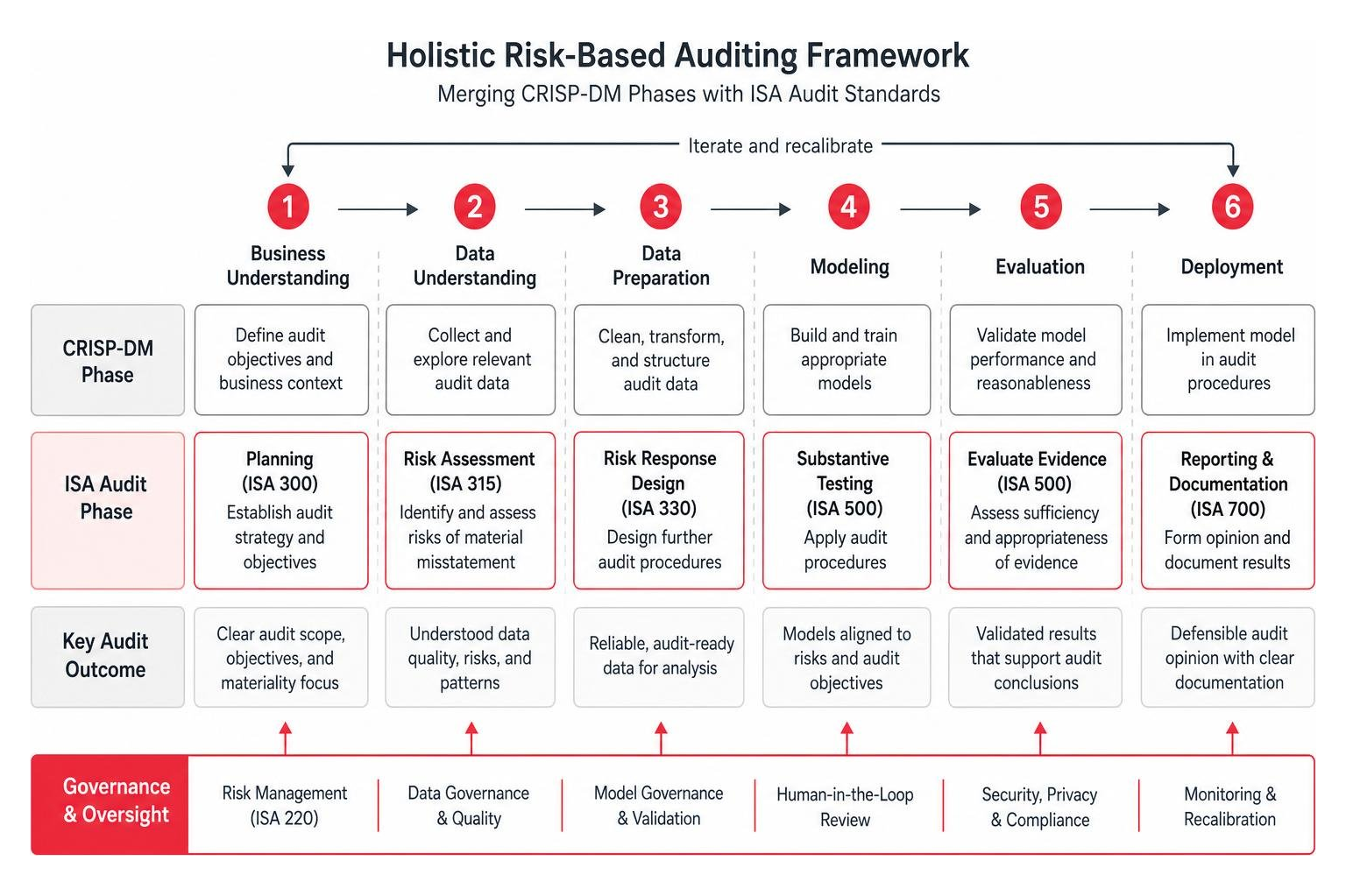
Successfully integrating machine learning into an audit workflow requires a structured approach that balances technical execution with human oversight. Rather than deploying standalone, disconnected tools, firms must embed ML functionalities directly into their risk-based auditing procedures.
An authoritative framework for this integration is outlined in Deep learning meets risk-based auditing: A holistic framework for leveraging foundation and task-specific models in audit procedures. This framework merges the Cross-Industry Standard Process for Data Mining (CRISP-DM) with the traditional phases of risk-based auditing defined by the ISAs. By aligning data preparation, model training, and evaluation directly with audit planning, risk assessment, and substantive testing, firms can ensure their ML applications remain compliant and technically sound.
Building a Robust Governance Framework and Addressing the Skills Gap
To oversee this technology, organizations must establish a robust IT governance framework. Because financial data is highly sensitive, security cannot be an afterthought. Firms must apply Zero Trust principles to their machine learning systems—enforcing strong authentication for model endpoints, restricting data access based on the principle of least privilege, and validating all model outputs before they are integrated into audit documentation.
At the same time, accounting firms face a significant CPA and data science talent shortage. Most traditional auditors are experts in accounting standards but lack training in statistics, data preprocessing, and machine learning fundamentals. To address this gap, firms should:
- Invest in Upskilling: Provide structured training programs that teach auditors how to interpret machine learning outputs and exercise professional skepticism when reviewing algorithmic results.
- Build Cross-Functional Teams: Pair experienced financial auditors with data scientists and IT security professionals to design, deploy, and monitor audit models.
- Establish Clear IT Controls: Implement general and application controls around the software development lifecycle of internal audit models, ensuring all code changes and training runs are documented and auditable.
Real-World Case Studies from the Big Four and Mid-Market Firms
The practical viability of machine learning financial auditing is demonstrated by its successful deployment across the professional services sector:
- Deloitte’s Argus: This cognitive tool uses natural language processing (NLP) and machine learning to read, analyze, and extract key terms from thousands of complex contracts, leases, and sales agreements. By automating document review, Argus allows audit teams to quickly identify trends, outliers, and contract risks across entire populations of documents.
- PwC’s Halo: This platform analyzes journal entries to identify problematic transaction patterns, such as entries posted at unusual times, unauthorized sources, or transactions that sit just below authorized limits. Halo evaluates 100% of a client’s journal entries, providing a visual representation of transaction flows and highlighting high-risk exceptions.
- KPMG’s Watson Integration: KPMG leverages advanced cognitive computing to analyze structured and unstructured data across audit engagements, improving the accuracy of risk assessments and anomaly detection.
- MindBridge AI: Mid-market CPA firms use platforms like MindBridge AI | The Leader in Autonomous Financial Oversight to run multi-dimensional risk scoring on client ledgers. MindBridge uses a combination of rules, statistical methods, and machine learning to analyze 100% of financial transactions, providing an explainable risk score for every entry.
Frequently Asked Questions about Machine Learning in Auditing
Can machine learning completely replace human financial auditors?
No. Machine learning is designed to augment, not replace, human auditors. While algorithms excel at processing large volumes of data, identifying patterns, and flagging anomalies, they lack the capacity for cognitive reasoning, contextual understanding, and professional skepticism.
Human auditors are essential for interpreting model outputs, understanding complex business risks, evaluating subjective management estimates, and conducting fraud interviews. The technology transforms the auditor’s role from a compliance-focused data checker into a strategic advisor.
How do machine learning models handle unstructured financial data?
Machine learning models handle unstructured data—such as PDF contracts, emails, meeting minutes, and invoice scans—using Natural Language Processing (NLP) and Large Language Models (LLMs). As explored in the research paper Automating Financial Statement Audits with Large Language Models, state-of-the-art LLMs can automatically review financial tables, identify missing rows or numerical inconsistencies, and compare disclosures against accounting standards.
However, the study also highlights that current LLMs still struggle with complex joint reasoning across tables and text and can fail to generate accurate citations of specific accounting standards. Therefore, human oversight remains critical when using LLMs for financial statement verification.
What are the initial steps for a mid-sized CPA firm to adopt machine learning?
For a mid-sized CPA firm in locations like Houston or Albuquerque, the roadmap to machine learning adoption should follow a phased approach:
- Conduct a Technology Assessment: Evaluate your current IT infrastructure, data storage capabilities, and team skill sets. Identify where manual bottlenecks are most severe.
- Leverage Cloud-Based Platforms: Instead of building custom models from scratch, adopt established, cloud-based auditing software (such as MindBridge AI) that has built-in machine learning capabilities.
- Launch a Pilot Program: Select a single, low-risk client engagement with clean, structured data. Run the ML tool parallel to your traditional audit procedures to compare results and train your staff.
- Develop a Governance Policy: Establish clear guidelines on data security, client confidentiality, and how model outputs must be validated and documented by the engagement team.
Conclusion
Machine learning financial auditing is no longer a futuristic concept; it is an operational necessity for firms that want to remain competitive, accurate, and secure. By moving from manual sampling to full-population testing, accounting and finance teams can eliminate sampling risk, catch sophisticated fraud schemes, and deliver higher-value insights to their clients.
However, deploying these advanced technologies requires a careful balance of data quality management, strict compliance governance, and robust cybersecurity controls.
At Netsurit, we act as an elite technology partner for professional services and accounting firms across New York, New Jersey, Texas, and Seattle. We provide the managed IT, cybersecurity, and AI solutions needed to support your digital transformation, crush downtime, and protect your clients’ sensitive financial data.
To learn how we can help your firm safely implement and manage the IT infrastructure required for modern, machine-learning-driven auditing, explore our specialized accounting firm IT services.