Manual Reconciliation Is Costing Texas Businesses Up to $500,000 a Year — AI Changes That
AI reconciliation services in Texas are helping mid-sized businesses eliminate one of their biggest hidden costs: manual data matching. If your finance team spends hours every week chasing bank statement discrepancies, reconciling intercompany transactions across subsidiaries, or manually closing the books at month-end, this guide is for you.
Here is what Texas businesses need to know right now:
- What it is: AI reconciliation software automatically matches transactions across bank statements, ERPs, and general ledgers — replacing spreadsheet-based manual work.
- Who it’s for: Texas SMBs and enterprises in energy, manufacturing, distribution, and financial services dealing with high transaction volumes.
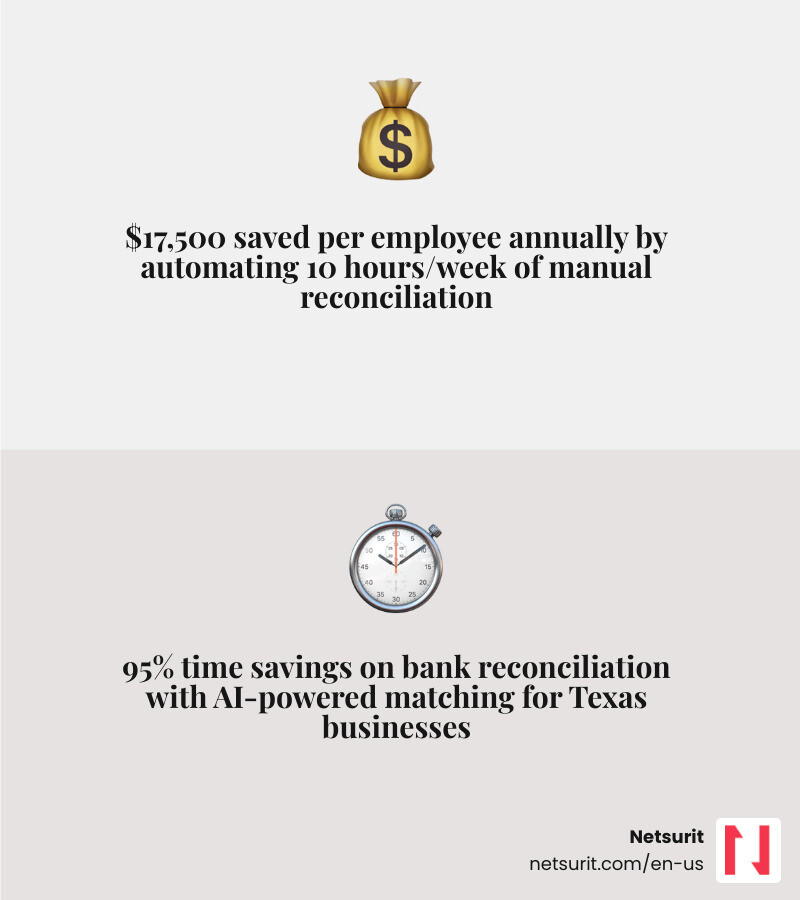
- What it delivers: Up to 90% automation of cash matching, 95% time savings on bank reconciliation, and measurable ROI within 3 to 6 months.
- Top providers serving Texas: Trintech (headquartered in Plano), Arvexi, Reconcilr, HighRadius, and Numeric.
- Bottom line: A single employee spending 10 hours per week on manual reconciliation costs your business $17,500 per year. Mid-sized Texas firms carry between $100,000 and $500,000 in annual labor costs tied to tasks AI handles today.
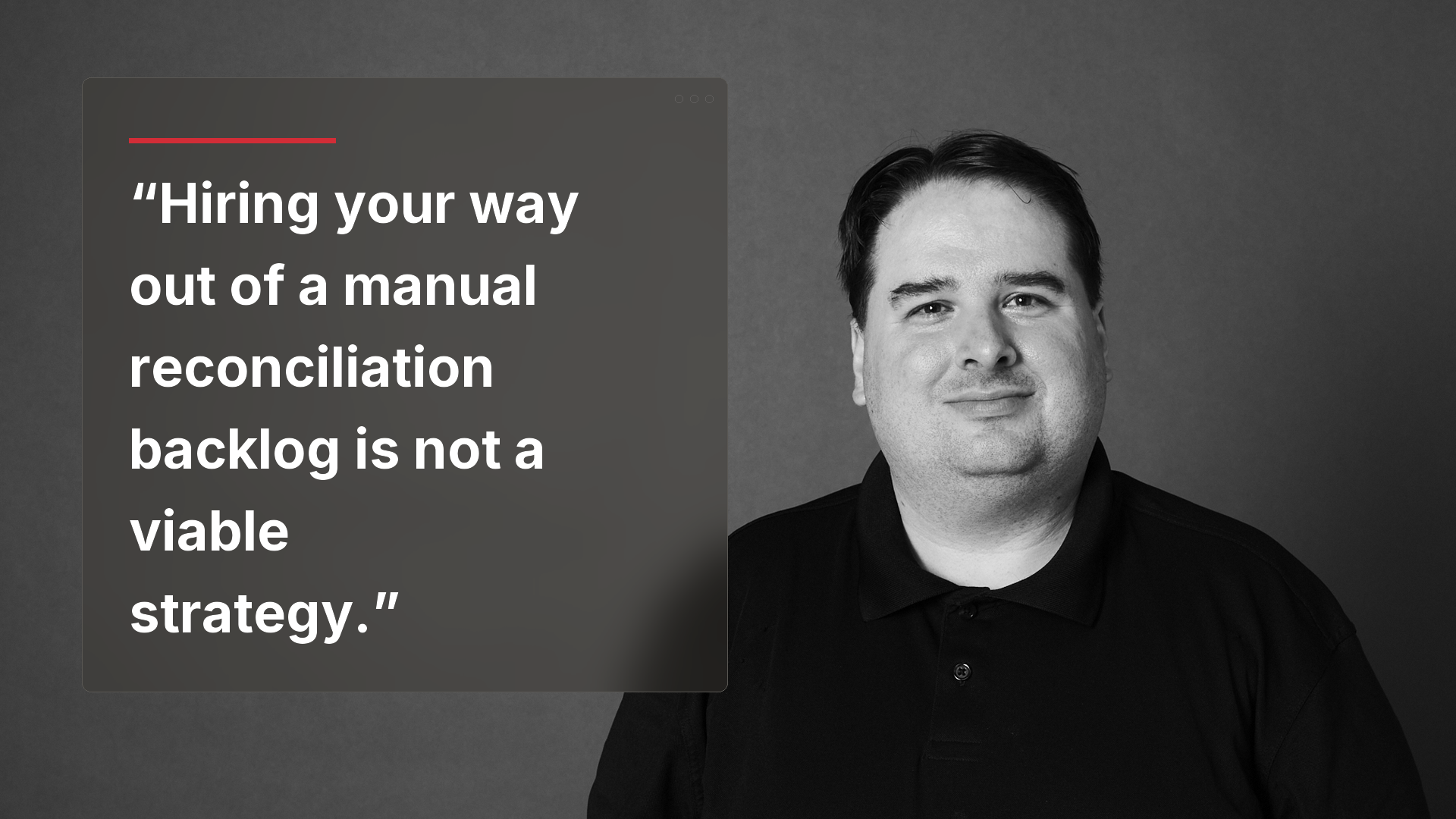
Texas businesses face a compounding problem in 2026. The talent market in Dallas-Fort Worth, Houston, and San Antonio is tight. Hiring your way out of a manual reconciliation backlog is not a viable strategy. AI is.
This guide compares the leading AI reconciliation platforms, explains how to handle complex intercompany and multi-entity matching, and gives you a clear implementation path — including security, compliance, and realistic ROI expectations.
I’m Orrin Klopper, CEO and co-founder of Netsurit, a global IT services and digital transformation company that has helped businesses across Texas and North America cut through the noise on AI adoption — including deploying AI reconciliation services in Texas for clients in regulated, high-volume industries. At Netsurit, we have seen which implementations deliver measurable returns and which ones stall in the pilot phase.
Solving the Texas-Sized Manual Data Bottleneck
In the Texas Triangle, the pace of business often outstrips the capacity of back-office teams. We see finance departments spending roughly 30% of their time simply collecting and reconciling data between disparate systems. This isn’t just a productivity drain; it’s a profitability problem. For a $25 million business in Houston or Dallas, the aggregate impact of well-executed AI initiatives across finance can deliver a 3% to 8% boost in annual profit.
The challenge is that manual matching is inherently unscalable. When a business grows, transaction volume grows exponentially, but your accounting team doesn’t. This leads to the “manual bottleneck,” where the month-end close stretches into the second or third week of the following month. By the time you see the numbers, they are already outdated.
To break this cycle, you need to move beyond No More Manual Matching A Guide To Automated Reconciliation. AI-powered tools don’t just follow “if-then” rules; they use machine learning to understand patterns, such as identifying that a payment from “AMZN” on a bank statement corresponds to an “Amazon Web Services” invoice in the ledger. This is why we tell our clients: Dont Mess With Texas Algorithms Why You Need Ai Audit Assistance to ensure your data remains clean and audit-ready.
High-Volume Banking Challenges in the Energy Sector
Texas energy companies, particularly those in Houston and the Permian Basin, face unique reconciliation hurdles. These firms often manage hundreds of entities, each with its own bank accounts and intercompany billing cycles. Reconciling these manually is a nightmare of “many-to-many” matching where one wire transfer might cover fifty different invoices across three subsidiaries.
AI reconciliation platforms excel here by automating the elimination of intercompany balances. This ensures that consolidated financials aren’t inflated by internal transactions. If you want to How To Audit Proof Your Texas Business Using Ai Software, you must automate these high-volume streams to eliminate the human error that typically leads to audit findings.
The Real Cost of Manual Errors in 2026
In May 2026, the fully loaded labor cost for a finance professional in Texas metros is approximately $35 per hour. If one employee spends just 10 hours a week on manual reconciliation, that is $17,500 per year essentially wasted on low-value data entry. Across a mid-sized team, this figure balloons to between $100,000 and $500,000.
Beyond the salary, manual errors create “leakage”—unmatched invoices that never get paid, or bank fees that go unnoticed. By utilizing Managed It Services Houston, businesses can integrate AI tools that flag these anomalies in real-time, preventing small errors from becoming six-figure losses.
Example: A distribution client in Katy, TX, was struggling with a three-day accounts payable cycle. Their team was manually matching 4,000 invoices a month to purchase orders. By deploying AI reconciliation services in Texas, they reduced the manual workload to just four hours of exception handling. The AI matched 92% of the invoices instantly, leaving the team to only focus on the few items where the data was truly ambiguous.
Trade-offs: AI Reconciliation Implementation
- Works best when: Transaction volumes exceed 5,000 lines per month and data exists in structured digital formats like CSV or via direct API bank feeds.
- Avoid when: You are dealing with highly subjective, one-off legal settlements or complex partnership distributions that require nuanced human judgment and legal interpretation.
- Risks: There is a danger of “black box” logic where teams stop questioning the data. If the AI is poorly configured, it could match items incorrectly without anyone noticing.
- Mitigations: We recommend setting strict confidence thresholds. For example, any match with a confidence score below 95% should automatically trigger a “human-in-the-loop” review queue.
Comparing Top AI Reconciliation Services Texas Providers
Choosing the right tool depends on your company’s size and the complexity of your ERP environment. Texas is home to some of the world’s leaders in this space, particularly in the Dallas-Fort Worth “Silicon Prairie.”
| Provider | Best For | Key Strength | Match Accuracy |
|---|---|---|---|
| Trintech | Large Enterprises | Agentic AI & SAP Integration | 99% (Rule + AI) |
| Arvexi | Mid-Market | “Cortex” Investigation Engine | 95%+ |
| Reconcilr | SMBs / Accountants | Hyper Fuzzy Matching & Setup Speed | 95% |
| HighRadius | Enterprise R2R | Automated Amortization & Global Scale | 98% |
For businesses in the Houston metro area, including Sugarland and Conroe, the choice often comes down to how well the software integrates with existing systems like NetSuite, Sage, or Microsoft Dynamics. AI-Powered Account Reconciliation Software | Arvexi is a strong contender for firms that need autonomous investigation, while AI-Powered Financial Reconciliation | ReconcileAI offers a “bring your own key” model for power users.
Enterprise-Grade AI Reconciliation Services Texas
Trintech, headquartered in Plano, is the heavyweight in this category. Their Beacon platform uses “agentic AI”—AI agents that don’t just suggest matches but actually perform tasks like drafting journal entries or writing flux analysis commentary. This is ideal for Texas-based global corporations that need to strengthen controls and operate with leaner teams.
By using AI Account Reconciliation & Substantiation Software – Trintech, enterprises can achieve a “continuous close.” Instead of a frantic week at the end of the month, the AI reconciles transactions daily, identifying risks before they impact the final numbers.
SMB-Focused AI Reconciliation Services Texas
For smaller businesses in Katy or Sugarland, enterprise platforms might be overkill. Tools like Reconcilr focus on “hyper fuzzy matching.” This technology is designed to handle messy bank data and cryptic abbreviations that standard rule-based systems fail to catch.
Reconcilr can save up to 95% of the time previously spent on bank reconciliations. This is a vital part of The Ultimate Guide To Houston Ai Accounting Software, as it allows small finance teams to act like much larger departments. Setup often takes as little as two minutes, making it accessible for firms without a massive IT budget.
Navigating Complex Intercompany and Bank Matching
As Texas businesses scale, they often move from simple two-way matching (bank vs. ledger) to complex four-way reconciliation. This involves matching the bank statement, the general ledger, the sub-ledger (like accounts receivable), and external data like shipping logs or merchant gateway reports.
For banks and financial institutions in Texas, Reconciliator – Ai Powered Reconciliation Software | Levarus is often used to handle the high-volume ecosystem of SWIFT systems and ATM switches. This level of automation is critical for maintaining regulatory compliance in a state with such a massive financial services sector. We believe that Deploying Ai In Houston A Roadmap For Modern Accounting must include a strategy for these multi-way data streams.
Automating Intercompany Eliminations
One of the most tedious tasks for multi-entity Texas firms is intercompany elimination. When Subsidiary A in Dallas bills Subsidiary B in Houston for shared services, those transactions must be eliminated during consolidation. AI tools like AI Powered Expense Reconciliation Software | HighRadius automate this by identifying the counterparty entries and flagging any disputes or currency conversion errors immediately.
Anomaly Detection and Predictive Insights
Modern AI doesn’t just look backward; it looks forward. By analyzing historical patterns, AI can flag a “variance” (a difference between expected and actual numbers) before the month even ends. This “flux analysis” traditionally takes days of manual digging through ERP details.
AI can now draft up to 80% of the commentary for these variances, explaining why a number is off based on transaction history. This is the cornerstone of Ai Accounting Optimization Houston The Future Of Financial Efficiency, shifting the finance team’s role from data entry to strategic analysis.
Example: A Houston-based energy firm managing 50+ global subsidiaries used Arvexi Cortex to investigate 224 accounts. The AI completed the task in 32 minutes—a job that previously took the team a full week. During the process, the AI identified a $12,000 currency spot rate discrepancy that had been missed for two quarters because it was buried in a high-volume intercompany account.
Implementation Strategy: From Pilot to 2026 ROI
Moving to AI reconciliation services in Texas is not an overnight process, but it is faster than you might think. Most implementations follow a 3-to-6 month timeline from pilot to full ROI. The key is starting with your highest-volume, most “painful” accounts first.
Successful deployment requires tight integration with your Managed IT provider to ensure your ERP (NetSuite, SAP, etc.) and bank feeds are communicating securely. This is why Managed It Services And Support Texas is often the foundation of any AI accounting project.
Security and Compliance for Regulated Texas Industries
For businesses in healthcare, finance, or oil and gas, data privacy is non-negotiable. You cannot simply upload financial data to a public AI. You need “business-grade” AI that offers isolated storage and encryption.
Top providers like AI-Powered Reconciliation Automation Software – FloQast meet strict compliance standards, including SOC 1 Type 2 and SOC 2 Type 2. They also offer data masking, ensuring that sensitive information like PINs or card numbers are never visible to the AI models or unauthorized staff.
Best Practices for Finance Teams
To get the most out of AI, Texas finance teams should follow these three rules:
- Set Materiality Thresholds: Don’t waste AI (or human) time on a $0.05 discrepancy. Set thresholds that align with your audit requirements.
- Maintain Audit Trails: Ensure the software logs every match, especially those that were manually overridden by a human.
- Focus on “Substantiation”: Use Balance Sheet Reconciliation Automation – Trintech to not just match numbers, but to attach the supporting work papers automatically. This makes your year-end audit significantly faster and cheaper.
Example: A manufacturing plant in Sugarland implemented an AI cash-matching system that automated 90% of their daily bank-to-ledger reconciliations. This saved their controller 15 hours a week. Instead of hiring another clerk to handle their 10% annual growth, they used that saved time to build predictive cash-flow models, contributing to an 8% increase in annual profit impact through better capital allocation.
Frequently Asked Questions about Texas AI Reconciliation
How long does it take to implement AI reconciliation software?
Most Texas mid-market firms see full deployment and ROI realization within 3 to 6 months. The “setup” of the software often takes only a few days, but the time is spent refining the matching rules and ensuring the API integrations with your specific ERP (like NetSuite or SAP) are pulling data accurately.
Is my financial data secure when using AI providers?
Yes, provided you select enterprise-grade providers. Top-tier AI reconciliation services in Texas utilize isolated, private storage for each client. Your data is encrypted both in transit and at rest. Always look for providers that are SOC 1 Type 2 and SOC 2 Type 2 compliant to ensure they meet the rigorous standards required for regulated industries.
Can AI handle messy bank data and cryptic abbreviations?
This is actually where AI shines compared to old-school automation. Modern tools use “hyper fuzzy matching” and machine learning to recognize patterns. They can learn that “TFL” stands for Transport for London or that “TXU ENRG” is your utility provider, matching them to the correct ledger entries with over 95% accuracy, even when dates and amounts don’t align perfectly.
Conclusion
At Netsurit, we believe that technology should be a competitive advantage, not a source of downtime or frustration. As a leading provider of Managed It Services And Support Texas, we help businesses in Houston, Sugarland, Katy, and Conroe navigate the complexities of AI adoption.
Texas businesses must transition from manual record-keeping to AI-driven intelligence to survive the economic pressures and talent shortages of 2026. The firms that automate their reconciliation today will have the data clarity and the capital to lead their industries tomorrow.
Next Step: Schedule an AI readiness assessment with our team to identify which manual workflows are currently eroding your firm’s profitability and how to start your pilot program.