Why AI Financial Analysis Tax Houston Is Reshaping How Local Businesses File and Plan
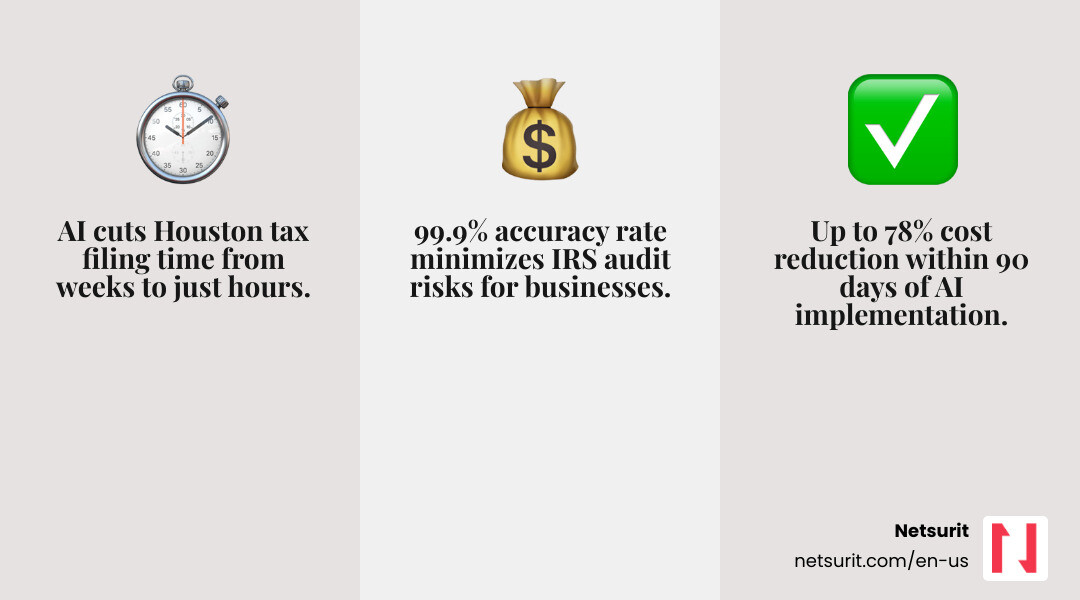
AI financial analysis for tax in Houston is cutting filing time from weeks to hours, reducing costs by up to 78%, and achieving 99.9% accuracy — all within the first 90 days of implementation.
Here is what Houston businesses are seeing in 2026:
| Metric | Manual Process | AI-Powered Process |
|---|---|---|
| Filing time | Weeks | Hours |
| Accuracy rate | Variable | 99.9% |
| Cost reduction | Baseline | Up to 78% within 90 days |
| Time saved per filing cycle | — | ~8 hours daily |
| Average annual federal tax savings | — | ~$10,000 per business |
Houston’s tax environment is not simple. Businesses here navigate federal IRS obligations, Texas franchise and margin taxes, local municipal sales tax variances, and — for government contractors — strict audit-ready documentation requirements. Industries like energy trading, real estate, and construction add another layer of complexity.
Manual processing creates real bottlenecks. A tax team spending weeks on document classification and data entry is a team not doing strategic planning. That gap is exactly where AI steps in.
But AI is not a magic fix. It exposes weak processes, carries liability risks, and requires a human professional to review every output. This guide covers the full picture — the gains, the tools, the risks, and the right way to implement AI tax automation in Houston.
I’m Orrin Klopper, CEO of Netsurit, where I’ve spent over two decades helping businesses across North America cut through IT complexity and adopt AI-driven solutions — including AI financial analysis for tax in Houston — that actually deliver measurable results. As a Microsoft Solution Partner with a Texas office, Netsurit works directly with Houston firms navigating exactly the challenges this guide addresses.
Transforming Local Business with AI Financial Analysis Tax Houston
In May 2026, the shift from manual ledger entries to intelligent automation is no longer a “future” trend; it is the standard for staying competitive in the Texas market. Houston businesses leveraging AI financial analysis tax Houston are achieving 94% average time savings. By automating the ingestion of receipts, invoices, and bank statements, firms in the Energy Corridor and downtown Houston are freeing their staff from the “seasonal scramble.”
The financial impact is immediate. Statistics show that local businesses using these tools report a 78% cost reduction within 90 days of implementation. Beyond just saving money, the accuracy rate of 99.9% in tax filings significantly reduces the risk of costly IRS audits. If you want to dive deeper into how technology is changing the game, Stay Ahead Of The Curve Your Guide To Ai Powered Tax Compliance provides a detailed breakdown of these regulatory shifts.
This transition allows professionals to Stop Being Bored by offloading repetitive data entry to algorithms.
Modernizing Workflows with AI Financial Analysis Tax Houston
The core of this transformation lies in specialized software like Black Ore’s Tax Autopilot and Magnetic. These platforms don’t just “read” documents; they understand context. For instance, an AI agent can distinguish between a deductible business meal and a personal expense by cross-referencing local Houston merchant data and project codes.
Key features of these modern workflows include:
- Automated Document Ingestion: Drag-and-drop tax source documents are classified and mapped to the general ledger instantly.
- End-to-End Preparation: Systems like Instead act as AI agents for tax planning and filing, providing year-round visibility rather than a once-a-year retrospective.
- Real-time Projections: Instead of waiting for a quarterly report, Houston CFOs can see their projected Texas franchise tax liability in real-time based on daily transactions.
Strategic Benefits for Houston Accounting Firms
For CPA firms in the Houston metro area, AI is creating a new hierarchy: the “Digital Senior.” This isn’t a replacement for human staff; it’s an evolution. By 2026, junior staff are being trained to manage AI agents that handle the heavy lifting of data reconciliation. This leads to 60% efficiency gains, allowing firms to handle more clients without increasing headcount.
To understand the broader implications for the profession, refer to Your Guide To Ai In Tax And Accounting What Every Professional Needs To Know, which explores how AI enhances professional judgment rather than replacing it.
Top AI Tools and Firms Powering Houston’s Financial Sector
Choosing the right partner or platform depends on your business size and the tax complexity you deal with every month. A five-person shop in Katy needs fast bookkeeping and deduction capture. A real estate group in Sugar Land needs stronger controls around depreciation, entity structure, and audit support.
| Provider | Core Focus | Key Advantage |
|---|---|---|
| Zeni | Startups & Mid-market | All-in-one platform with AI Accountant agents. |
| ICON TAX | Small Businesses | $10k avg. savings with a no-contract model. |
| J. Otis Mitchell Co. | Business Advisory | Combines traditional expertise with AI growth systems. |
| InnovatexAI | CPA Outsourcing | Specialized in cost segregation and GAAP compliance. |
For a broader market view, check The Ultimate Guide To Houston Ai Accounting Software. If you want a neutral overview of U.S. tax administration and filing requirements, the Internal Revenue Service is the best starting point.
Scaling Small Business with AI Financial Analysis Tax Houston
Small businesses in Katy and Sugar Land often get priced out of enterprise finance tools. That is where firms like ICON TAX LLC fit. Their model focuses on practical outcomes: lower admin time, cleaner records, and an average of $10,000 per year in federal tax savings for many small businesses.
A typical example is a three-person contractor in Sugar Land that handles receipts in email, text threads, and paper folders. AI-driven intake can sort those records, flag missing backup, and surface likely deductions before year-end. That saves cleanup time, but it still requires a CPA to review classifications before filing.
Their approach is straightforward:
- No-Contract Models: You stay because of the value, not a legal obligation.
- Audit Protection: Electronically organized records ensure you are always ready for scrutiny.
- Deduction Identification: Automated systems flag credits like the R&D tax credit that small businesses often miss.
Specialized Outsourcing and Intelligence
For larger firms or businesses with complex asset portfolios, specialized accounting intelligence providers offer deeper technical support. Cost segregation is a good example. AI can scan fixed-asset data, lease records, and construction invoices faster than a manual team, then help classify assets for accelerated depreciation.
Consider a Houston-area real estate operator with mixed-use properties in Katy and Conroe. Processing more than 1 million transactions annually by hand invites delay and inconsistency. AI speeds the review, but GAAP compliance and the final tax position still depend on human judgment.
- Works best when: your team handles high document volume, repeatable classifications, or asset-heavy tax work.
- Avoid when: the issue turns on unsettled law, unusual entity structures, or aggressive filing positions.
- Risks: over-reliance on automated classifications, weak source data, and poor audit trails.
- Mitigations: require CPA review, test outputs against prior periods, and keep source documents tied to every tax adjustment.
Navigating Risks and Liability in Texas AI Tax Advice
While the rewards of AI financial analysis tax Houston are high, the legal landscape in Texas is strict. The IRS “Dirty Dozen” list now specifically warns against misleading tax schemes generated by AI. Furthermore, the Texas Board of Public Accountancy maintains that technology is not a substitute for professional due diligence.
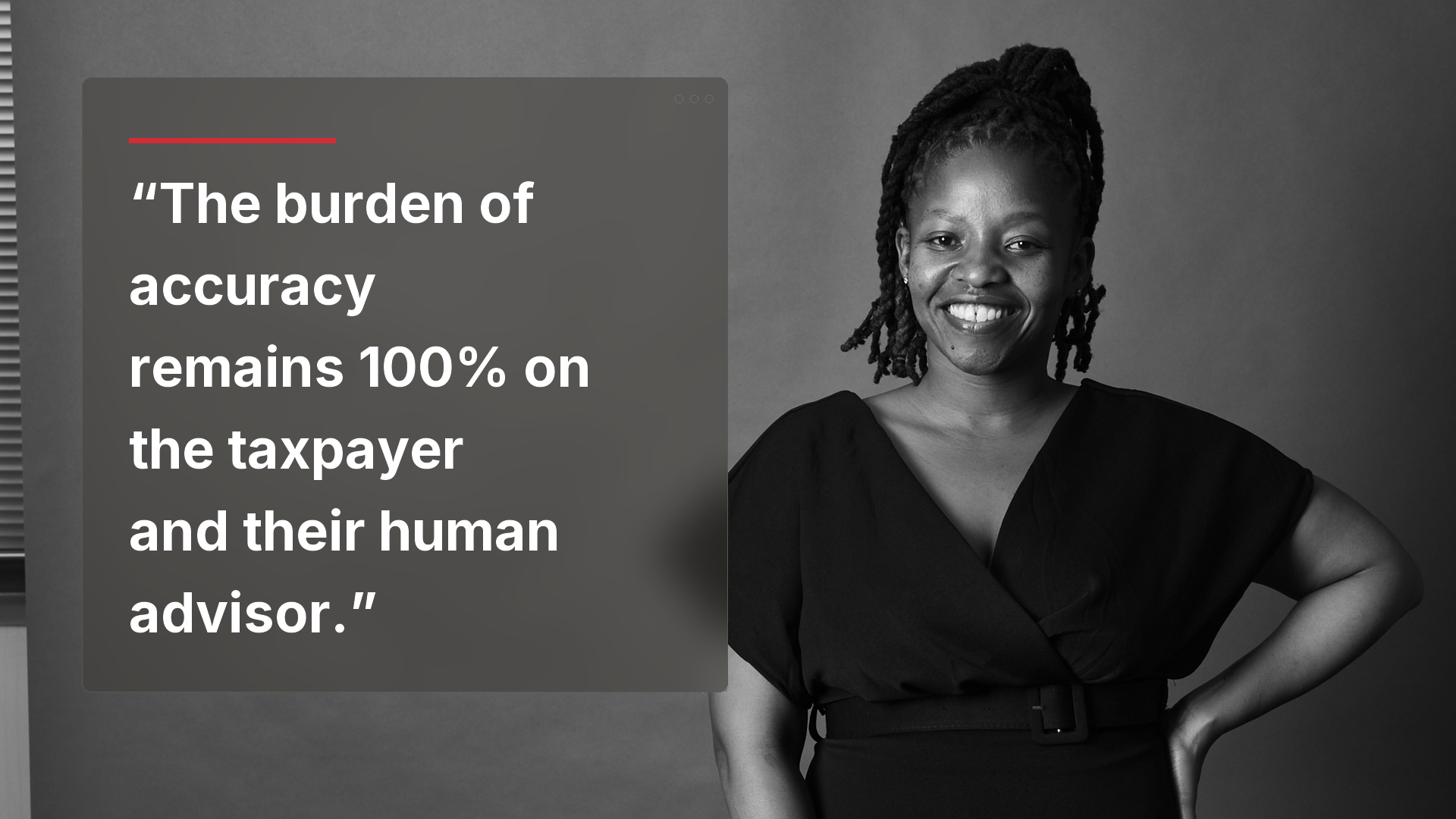
A major risk is “hallucination,” where an AI might invent a tax code or misinterpret a Texas-specific nuance like the margin tax nexus. If an AI makes a mistake, the software provider’s terms of service almost always disclaim liability. The burden of accuracy remains 100% on the taxpayer and their human advisor. To protect your firm, see How To Audit Proof Your Texas Business Using Ai Software.
Trade-offs of Automated Tax Advice
- Works best when: You are verifying standard deductions, summarizing long IRS publications for quick review, or performing initial data classification for thousands of receipts.
- Avoid when: Interpreting ambiguous Texas margin tax laws, handling high-stakes litigation, or submitting a final filing without a human “sanity check.”
- Risks: Factual inaccuracies (hallucinations), data privacy breaches if using public AI models, and the loss of a “reasonable cause” defense with the IRS.
- Mitigations: Always maintain a human-in-the-loop review process, use only SOC 2 compliant platforms, and ensure your professional liability insurance covers AI-assisted work.
For a deeper dive into the legalities, Houston executives should consult specialized Texas tax counsel regarding AI liability and professional standards.
Industry-Specific AI Applications: Energy, Real Estate, and Government
Houston’s economy is unique, and general AI tools often fall short. Specialized applications are required to handle the nuances of our local industries.
Real Estate and Construction Optimization in Sugar Land and Katy
In the booming suburbs of Sugar Land and Katy, real estate investors are using AI to manage 1031 exchanges and Section 179D reclassifications. AI tools can analyze property data to identify energy-efficient building deductions that would take a human auditor days to find. Specialized Houston firms focus on these tailored strategies, ensuring property owners maximize their cash flow through intelligent property analysis.
Government Contractor Compliance in Conroe and The Woodlands
For government contractors in Conroe and The Woodlands, compliance is the difference between winning a contract and facing a debarment. AI agents can be trained on specific municipal tax codes and federal procurement regulations. According to local data, Houston government contractors using AI have seen a 40% reduction in audit red flags. Specialized automation platforms provide the audit-ready documentation necessary for multi-jurisdictional filing.
To see how these tools impact your bottom line, consider how AI-driven forecasting and smarter due diligence can stabilize treasury operations in volatile markets.
Implementing a Secure AI Roadmap for Your Houston Firm
Successful AI adoption isn’t about buying a piece of software; it’s about a structured rollout. We recommend a 180-day implementation timeline:
- Day 0-30 (Discovery): Identify “Shadow AI” (employees using unapproved tools like ChatGPT for sensitive data) and map your data infrastructure.
- Day 30-90 (Governance): Establish data classification and implement MFA and SOC 2 compliant access controls.
- Day 90-180 (Optimization): Transition to Automated Accounting and begin training staff on AI-enhanced workflows.
Detailed guidance on this process can be found in our Roadmap for Modern Accounting.
Professional Development and AI Certification
The talent pipeline in Houston is robust. With over 1.6 million students in Texas higher education, institutions like the University of Houston are producing a new generation of AI-literate accountants. For current professionals, “Certified AI for Accountants” programs are becoming essential. These certifications ensure that CPAs understand the Texas Responsible AI Governance Act and can scale their business without losing the human touch.
Infrastructure Readiness and Performance
A common pitfall is ignoring the IT backbone. AI workloads are resource-intensive. If your network isn’t optimized, AI tools can actually slow down your system. We’ve seen Houston firms struggle with “sluggish” reports because their cloud scaling wasn’t configured for parallel AI prompts.
To avoid this, ensure your infrastructure treats AI as a “first-class citizen.” This means real-time monitoring of compute peaks and optimizing your network for high-volume data transfers. For tips on avoiding these bottlenecks, read How To Use Ai For Financial Forecasting Without Losing Your Mind.
Frequently Asked Questions about Houston AI Tax Automation
Who is liable if AI makes a mistake on a Houston business tax return?
The taxpayer and their licensed CPA bear the ultimate legal responsibility. U.S. law and the Texas Board of Public Accountancy do not recognize “the AI did it” as a valid defense. AI software providers typically include strict disclaimers in their terms of service that shift all liability for accuracy to the user.
How much can a Houston SMB save by switching to AI tax software?
On average, Houston small-to-mid-sized businesses (SMBs) report $2,500 in monthly savings on administrative labor and up to $10,000 in annual federal tax savings. These savings primarily come from identifying overlooked deductions and reducing the billable hours required for manual bookkeeping and reconciliation.
Does AI replace the need for a Houston CPA?
No. AI functions as a “Digital Senior” or a highly efficient assistant that handles data processing, classification, and initial calculations. However, a human CPA is still required to provide professional judgment, interpret complex Texas-specific tax nuances, and represent the business in front of the IRS or the Texas Comptroller.
Conclusion
The integration of AI financial analysis tax Houston is no longer optional for businesses that want to scale. From the energy firms in downtown to the real estate developers in Katy, the efficiency gains—up to 60% for accounting workflows—are too significant to ignore. However, the key to success is not just the tool, but the infrastructure and security surrounding it.
At Netsurit, we specialize in helping Houston businesses navigate this transition safely. We ensure your IT environment is ready for the demands of AI while keeping your sensitive financial data protected from emerging cyber threats.
Secure your Houston financial data with elite cybersecurity and AI solutions.