Why AI Automated Financial Forecasting Is Replacing Manual Planning in 2026
AI automated financial forecasting uses machine learning and predictive analytics to generate financial projections from live data — faster and more accurately than manual methods.
Here’s what it delivers at a glance:
| What It Does | What That Means for You |
|---|---|
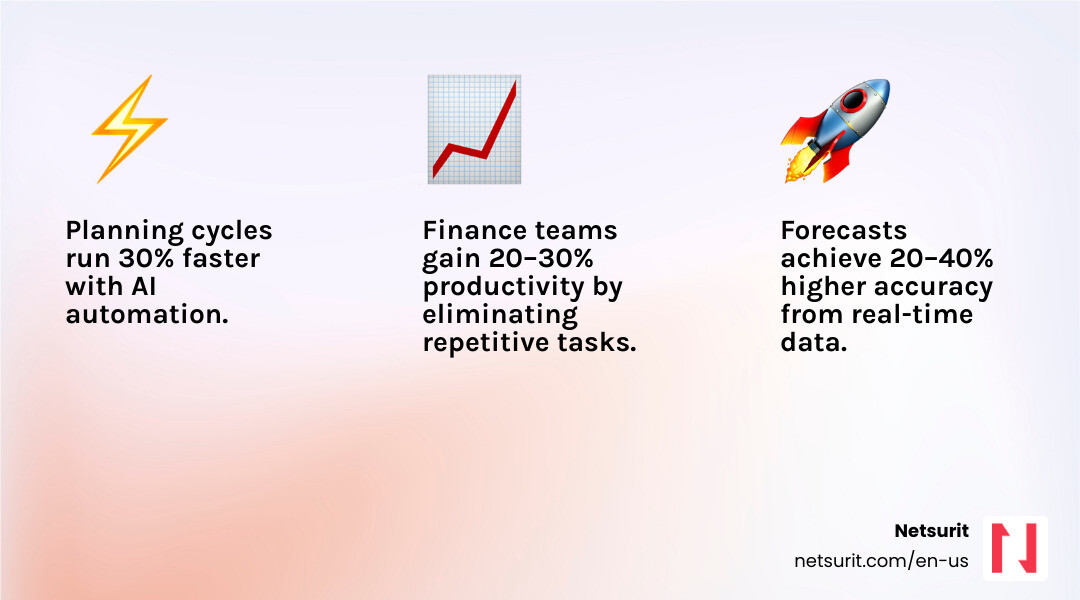
| Automates data collection and modeling | Planning cycles run 30% faster |
| Learns from historical and real-time data | Forecasts are 20–40% more accurate |
| Flags anomalies and variance automatically | Fewer surprises, earlier course corrections |
| Runs multiple scenarios simultaneously | Better decisions under uncertainty |
| Frees finance teams from repetitive tasks | 20–30% productivity gain across the finance function |
Most finance teams still spend the majority of their time collecting and cleaning data — not analyzing it. Annual budgets take months to build. Rolling forecasts take weeks. By the time a forecast is ready, the market has already moved.
That gap is expensive. A single improvement in forecast error — from 6% down to 2%, for example — can translate to $40 million in savings for a large organization. For smaller businesses, the proportional impact is just as real.
The shift is accelerating. As of 2024, 58% of finance functions were piloting AI tools, up from 37% the prior year. By 2028, Gartner expects half of all organizations to replace traditional bottom-up forecasting with AI-driven models entirely.
This guide explains how AI forecasting works, where it delivers the most value, which tools lead the field, and how to implement it without derailing your existing operations.
I’m Orrin Klopper, CEO and co-founder of Netsurit — a global IT services and digital transformation company I’ve been building since 1995. Over nearly three decades of helping businesses modernize their technology, I’ve seen how AI automated financial forecasting is shifting finance teams from reactive number-crunching to forward-looking strategy. Let’s break down exactly how to make that shift work for your organization.
Glossary for AI automated financial forecasting:
- AI-powered financial analysis
- AI for financial planning
- AI in treasury management
Beyond Spreadsheets: The Shift to AI Automated Financial Forecasting
Traditional financial planning is often described as part art and part science, but the “art” side usually involves a lot of guesswork. In April 2026, relying on static spreadsheets is a liability. Manual processes are rigid, prone to human error, and struggle to incorporate external variables like shifting interest rates or consumer spending trends.
The move toward AI automated financial forecasting isn’t just about replacing Excel; it’s about shifting the finance function from a reactive record-keeper to a proactive advisor. Organizations are realizing that financial statements made smarter with AI provide a clearer view of the road ahead. Platforms like OneStream allow teams to move beyond disconnected add-ons and integrate AI directly into their core planning workflows.
Defining AI Automated Financial Forecasting
At its core, this technology uses machine learning (ML) algorithms to identify patterns in historical data and predict future outcomes. Unlike a standard linear regression in a spreadsheet, AI models can handle “time-series” data—information that changes over time—and incorporate thousands of variables simultaneously. By building automated data pipelines from your ERP, CRM, and external market feeds, the system provides a continuous, rolling view of your financial health.
Why Traditional Bottom-Up Forecasting is Obsolete
The old way of doing things—asking every department head to manually input their best guesses into a template—is slow and often biased. Gartner predicts that by 2028, 50% of organizations will use AI to replace this time-consuming bottom-up approach. Manual reconciliation creates “data latency,” where the information you’re looking at is already weeks old. AI eliminates this by providing real-time updates, ensuring that your budget reflects the current reality of the business rather than a snapshot from last quarter.
High-Signal Benefits: Accuracy, Speed, and Dynamic Steering
The primary goal of any forecast is to reduce uncertainty. When you implement AI automated financial forecasting, you aren’t just getting numbers faster; you’re getting numbers you can actually trust to make million-dollar decisions.
| Feature | Traditional Forecasting | AI-Powered Forecasting |
|---|---|---|
| Accuracy | High variance; prone to bias | 20–40% improvement in accuracy |
| Speed | Weeks to consolidate | Real-time or hours to generate |
| Data Inputs | Limited internal historical data | Massive internal + external datasets |
| Flexibility | Rigid; hard to update | Dynamic; adapts to new data daily |
| Efficiency | 90% data prep / 10% analysis | 20% data prep / 80% analysis |
Improving Accuracy with AI Automated Financial Forecasting
One of the most compelling reasons to switch is the drastic reduction in forecast error. Research shows that half of businesses using AI in budgeting cut overall error by at least 20%, while top performers achieve a 50% reduction. For example, using a cash flow crystal ball driven by AI allows treasury teams to spot payment behavior changes before they create a liquidity crisis. One global manufacturer reduced their error margin from 6% to 2% using AI, which saved them $40 million by optimizing their capital allocation. Tools like the WNS Forecaster & Predictor help teams identify these trends without needing a PhD in data science.
Productivity Gains and Resource Allocation
Finance professionals often spend 90% of their time “trudging through the numbers” and only 10% on strategy. We believe the goal should be an 80/20 ratio in favor of analysis. By automating rote tasks like bank reconciliations and data tagging, AI productivity tools allow your team to focus on high-value work. This shift increases overall finance function productivity by 20% to 30%, turning your accountants into strategic business partners.
Real-World Applications for Houston-Based Finance Teams
In the Texas business landscape—from the energy corridor in Houston to the growing data center hubs in Conroe—agility is a competitive necessity. Whether you are managing a logistics firm in Katy or a tax practice in Sugarland, AI provides the “dynamic steering” needed to navigate market volatility.
Strategic Scenario Planning via AI Automated Financial Forecasting
Scenario planning used to involve manually changing three cells in a spreadsheet to see “Best Case” and “Worst Case.” AI allows for thousands of “what-if” simulations. You can instantly see how a 2% increase in fuel costs would impact your margins across every product line in real-time. By using AI agents for financial controllers, companies can simulate complex risk scenarios and develop mitigation strategies before a crisis hits.
Revenue and Expense Management Use Cases
AI excels at identifying the drivers behind your numbers.
- Revenue Prediction: AI can analyze hundreds of factors, such as customer churn patterns and pricing elasticity, to provide highly accurate sales projections.
- Expense Management: Tools like Atlar or Abacus.AI can automatically categorize spending and flag anomalies. If a department’s OPEX starts trending above the historical norm, the AI flags it immediately for review.
- Cash Flow: By normalizing transaction data across multiple banks, AI helps you predict exactly when cash will hit your account, reducing the need for large, idle cash buffers.
Navigating the Implementation Minefield: Tools and Challenges
While the benefits are clear, implementation isn’t a “flip of the switch” process. It requires a balance of the right technology and a change in organizational behavior.
Leading Platforms for AI Forecasting
Several vendors now offer enterprise-grade AI forecasting solutions:
- OneStream: Best for large enterprises needing a unified platform with “SensibleAI” for transparent, non-black-box modeling.
- NetSuite: Ideal for mid-market companies wanting AI integrated directly into their ERP for revenue and expense projections.
- Vena & Jedox: Excellent for teams that want to keep the familiar Excel interface while adding a powerful AI engine in the background.
- Forecastia: A great entry point for SMBs and startups looking for automatic financial forecasting without the complexity of enterprise suites.
Overcoming Barriers to Adoption
The biggest hurdle isn’t the technology—it’s the data. About 35% of CFOs cite data quality as their primary barrier to AI adoption. If your data is siloed or messy, the AI’s output will be unreliable.
Trade-offs Box:
- Works best when: You have at least 24 months of clean historical data and a centralized ERP.
- Avoid when: Your business model changes so frequently that historical data has zero predictive value.
- Risks: Over-dependence on models without human oversight; “black box” models that finance can’t explain to the board.
- Mitigations: Use “closed” LLMs for security; run AI forecasts in parallel with manual ones for 3–6 months to build trust.
For businesses in our service areas like Tacoma or Albuquerque, partnering with experts for AI business solutions can help bridge the skill gap and ensure secure integration. Technical frameworks like Microsoft’s finnts or reporting copilots can further streamline these efforts.
Scaling from Pilot to Enterprise-Wide AI Forecasting
We recommend a “start small, scale fast” approach. Don’t try to overhaul your entire 5-year plan on day one. Instead, pick a high-impact, high-frequency area—like weekly revenue forecasting for a specific product line—and run a pilot.
Best Practices for Successful Integration
- Build Automated Pipelines: Move away from manual CSV uploads. Your AI should pull directly from your source systems.
- Focus on Drivers: Identify the 5–10 variables that actually move the needle for your business (e.g., headcount, raw material costs, web traffic).
- Prioritize Change Management: 70% of the value in an AI transformation comes from changing people’s behaviors, not the software itself. Ensure your team knows how to interpret and challenge the AI’s insights.
- Use Expert Support: If you lack in-house data scientists, leverage AI and ML development services to build custom models tailored to your specific industry IP.
The Role of Generative AI in Insight Generation
Generative AI is changing the “last mile” of forecasting: communication. Instead of just giving you a chart, modern AI can write a narrative report explaining why a variance occurred. It can perform root-cause analysis in seconds, stating, “Revenue is down 4% because of a delay in the Conroe facility’s supply chain, partially offset by higher-than-expected sales in the Houston metro area.” This transforms accounting and finance from a game of “what happened” to “what we should do next.”
Frequently Asked Questions about AI Forecasting
How does AI forecasting handle limited historical data?
While more data is always better, modern techniques like Generative Adversarial Networks (GANs) can create “synthetic data” to augment small datasets. Tools like Abacus.AI use deep learning to find patterns even when historical records are sparse, allowing startups to benefit from predictive modeling early on.
Will AI replace the role of financial analysts?
No. AI replaces the “drudgery” of data entry and basic calculation. The role of the financial analyst is evolving into that of a strategic advisor. Human judgment is still required to provide business context, evaluate qualitative factors (like a competitor’s reputation), and make final strategic trade-offs that an algorithm cannot.
What is the future of AI in financial modeling?
By the end of 2026, Gartner predicts that 80% of large enterprise finance teams will use internally managed generative AI platforms. We are moving toward “autonomous finance,” where AI agents monitor budgets in real-time and suggest reallocations automatically. The focus will shift from creating the forecast to executing the strategy the forecast reveals.
Conclusion
The transition to AI automated financial forecasting is no longer a “nice-to-have” luxury for the Fortune 500; it is a fundamental requirement for any business that wants to remain competitive in a volatile market. By reducing errors, accelerating planning cycles, and freeing your team for strategic work, AI provides the momentum needed to achieve your business aspirations.
At Netsurit, we act as an elite tech partner to help you navigate this transition. Whether you’re looking to secure your financial data or implement advanced AI agents, we’re here to help you crush downtime and unlock growth.
Ready To Work Smarter? Let’s Talk AI or explore our specialized IT services for accounting firms to start your transformation.