The Regulatory Burden Is Breaking Manual Compliance — Here’s What AI Changes
AI enhanced financial compliance is the use of artificial intelligence to automate, monitor, and strengthen how financial institutions meet regulatory requirements — faster and more accurately than manual processes allow.
How AI improves financial compliance (quick answer):
| AI Capability | What It Does | Key Benefit |
|---|---|---|
| Agentic AI orchestration | Plans and executes end-to-end compliance workflows | Automates up to 70% of manual work |
| Transaction monitoring | Detects anomalies using behavioral analysis | Reduces false positives by up to 80% |
| Intelligent Document Processing | Extracts data from unstructured documents | Cuts manual handling time by up to 72% |
| Explainable AI (XAI) | Justifies AI decisions in plain language | Meets regulator transparency requirements |
| LLM-powered reporting | Summarizes regulations and generates SARs | Speeds up reporting and audit preparation |
Financial institutions spent an estimated $274.1 billion combating money laundering in 2022 — and seized less than 0.2% of laundered proceeds. That ratio exposes a hard truth: more manual effort is not the answer.
Compliance teams today face three compounding pressures. Regulations tighten and multiply. Alert volumes overwhelm analysts — some investigating 50 to 100 alerts daily, with 95% to 98% being false positives. And penalties keep rising: regulatory fines for global financial institutions surged 31% in the first half of 2024 alone.
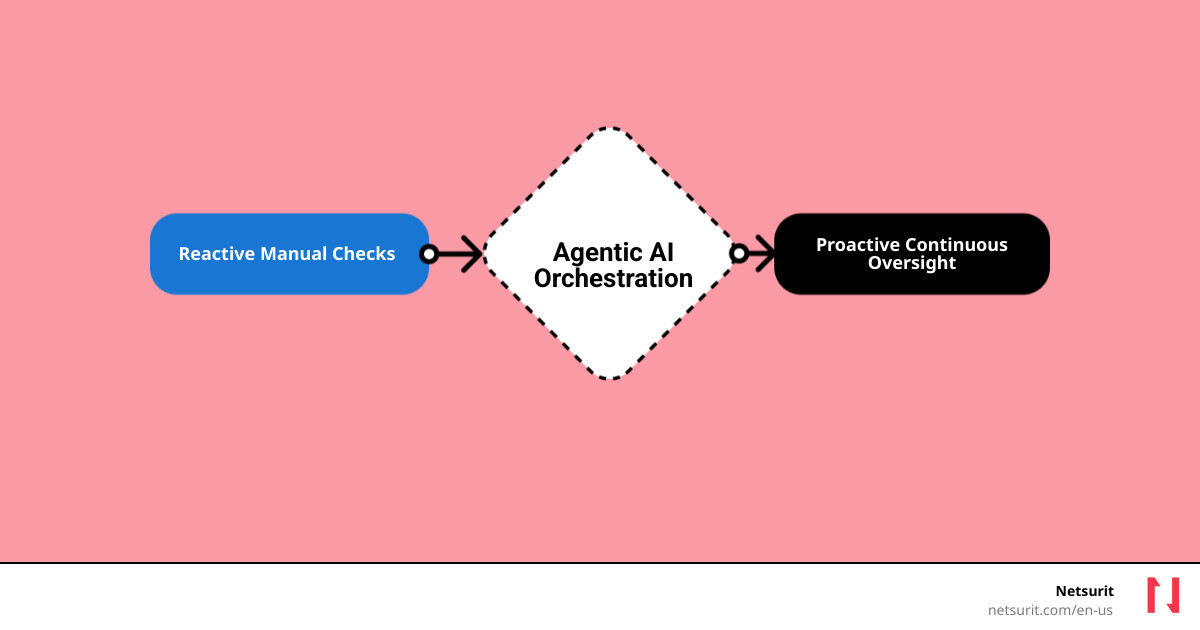
The problem is not effort. It is architecture. Manual, rule-based systems were built for a slower, simpler regulatory environment. They produce alert fatigue, siloed data, and reactive responses — not the proactive, continuous oversight regulators now expect.
AI changes the architecture. It shifts compliance from a periodic scramble into a continuous, intelligent operation. The five practical ways covered in this article are not theoretical — they reflect where financial institutions are seeing measurable results right now, in April 2026.
I’m Orrin Klopper, CEO and co-founder of Netsurit, a global IT services and digital transformation company — and over nearly three decades of helping organizations modernize their technology, I’ve seen how the shift to AI enhanced financial compliance separates firms that stay ahead of risk from those that absorb it. This guide gives you the concrete steps to land on the right side of that divide.
AI enhanced financial compliance basics:
- AI-powered financial analysis
- AI fraud detection
- AI for regulatory reporting
Orchestrate Complex Workflows with Agentic AI
Traditional AI functions like a high-speed calculator—it follows a script. In contrast, agentic AI acts as a semi-autonomous orchestrator. It doesn’t just process data; it plans, coordinates, and executes complex compliance workflows. While older machine learning models might flag a suspicious transaction, an agentic system can independently gather the customer’s Know Your Customer (KYC) profile, check recent sanctions updates, and draft a preliminary case narrative for a human to review.
This shift from “task-specific AI” to “workflow-orchestrating AI” is what allows firms to move from reactive firefighting to strategic oversight. By using Fenergo Agentic AI | Financial Compliance Software | CLM and KYC, institutions can automate up to 70% of manual work, allowing their most skilled analysts to focus on high-risk investigations rather than data entry.
Scaling AI Enhanced Financial Compliance in Houston Accounting Firms
For accounting firms and wealth management offices in the Houston metro area—including Sugarland, Conroe, and Katy—resource reallocation is the primary “so what.” Small to mid-sized firms often struggle with the sheer volume of manual due diligence required for new high-net-worth clients.
By implementing agentic workflows, a Sugarland wealth management firm can reduce manual onboarding effort by 70% while improving risk detection accuracy by four times. Instead of hiring three additional junior analysts to handle paperwork, the firm can use agentic AI to pre-screen clients, allowing the existing team to provide higher-value strategic advice.
Strategic Priorities for Agentic Implementation
Successful deployment requires more than just “turning on” the software. We recommend focusing on these four priorities:
- Framing Ambition: Define exactly which high-impact processes (e.g., sanctions screening or periodic reviews) will be transitioned to AI first.
- Workflow Redesign: Don’t just automate a broken manual process. Redesign the workflow to optimize the human-AI partnership, where AI handles the “heavy lifting” and humans provide the final judgment.
- Quality Gates: Implement strict boundaries and “checkpoints” where the AI must stop and wait for human approval before proceeding to the next stage of a workflow.
- Performance Validation: Continuously monitor the AI for bias or “drift” to ensure it remains aligned with evolving regulations.
Reducing False Positives with AI Enhanced Financial Compliance
One of the greatest drains on financial services productivity is “alert fatigue.” Traditional transaction monitoring relies on static, rule-based thresholds (e.g., “flag any transaction over $10,000”). These rigid rules are easily bypassed by sophisticated criminals but frequently flag legitimate customer behavior.
AI enhanced financial compliance replaces these static rules with dynamic behavioral analysis. Instead of looking at a single transaction, the AI looks at the context—the user’s historical patterns, peer group behavior, and cross-system data. This contextual intelligence can reduce false positives by up to 80%, as noted in Compliance supercharged: How machine learning protects your business.
Contextual Intelligence in AML and Sanctions
In the realm of Anti-Money Laundering (AML), AI uses entity resolution to connect disparate data points. If a customer in Katy, Texas, opens three different accounts under slightly different names, an AI-driven system can identify them as a single entity and monitor the combined risk.
| Feature | Traditional Rule-Based | AI Behavioral Analysis |
|---|---|---|
| Logic | “If X > $10k, then alert” | “Is this behavior normal for this specific user?” |
| False Positive Rate | 95% – 98% | 15% – 20% |
| Detection Scope | Known patterns only | Emergent and complex patterns |
| Adaptability | Manual updates required | Continuous learning and adaptation |
By leveraging Agentic AI: Ushering in a New Era for Sanctions Compliance – Nasdaq Verafin, firms can achieve real-time triage. The AI “pre-investigates” alerts, dismissing obvious false positives and presenting analysts with a summarized evidence package for genuine threats.
Trade-offs: AI-Driven Monitoring
While AI significantly reduces noise, it is not a “set and forget” solution.
- Works best when: High-volume transaction data is centralized and normalized across all branches (e.g., Houston and Tacoma locations).
- Avoid when: Data silos exist. If your KYC data cannot “talk” to your transaction data, the AI lacks the context to be effective.
- Risks: Model drift (the model becomes less accurate as criminal tactics change) and over-reliance on automated “Acknowledge” recommendations.
- Mitigations: Perform monthly drift audits and mandate human review for high-value or “Red” alerts.
Streamline Onboarding with Intelligent Document Processing
In banking and tax services, documentation is the bottleneck. Extracting data from PDFs, scanned IDs, and handwritten forms is slow and prone to error. Intelligent Document Processing (IDP) uses AI to transform this unstructured data into actionable insights.
Research shows that IDP can reduce manual document handling times by up to 72%. For firms managing complex client lifecycles, this is a massive operational win.
Accelerating Client Lifecycle Management (CLM)
AI-powered CLM streamlines the entire journey from onboarding to ongoing monitoring. Digital AI agents can perform automated due diligence by:
- Verifying identities against global databases in seconds.
- Identifying “Ultimate Beneficial Owners” (UBOs) in complex corporate structures.
- Continuously monitoring for “material changes” in a client’s risk profile (e.g., a new sanctions listing).
By following the guidance in AI Compliance: SEC Rules for Financial Firms, firms ensure that their automated onboarding processes meet the rigorous standards of the SEC and other regulators.
Case Study: Conroe Tax Practice Efficiency
Consider a mid-sized tax practice in Conroe, Texas. Before April 2026, their onboarding process involved manual data entry from client tax organizers and bank statements, taking an average of four hours per client. After implementing IDP, the firm automated the ingestion of these documents.
The result? Manual handling time dropped to 30 minutes per client—a 5x productivity boost. This allowed the firm to scale its client base during the busy season without increasing headcount, all while maintaining a perfect audit trail for local regulatory adherence.
Ensure Defensibility with Explainable AI (XAI)
For years, the “black-box problem” hindered AI adoption in finance. If a bank denies a loan or flags a transaction for fraud, regulators (and customers) want to know why. Traditional deep learning models often cannot provide that answer.
Explainable AI (XAI) solves this by providing human-understandable justifications for AI-generated outputs. This is essential for maintaining trust and ensuring fairness in credit scoring and fraud detection.
XAI Techniques for Credit Scoring and Fraud
Firms typically use two types of XAI techniques:
- Ante-hoc models: These are inherently interpretable models, such as decision trees, where the logic is clear from the start.
- Post-hoc explanations: These use tools like SHAP or LIME to explain the decisions of complex “black-box” models after the fact.
For example, an XAI system might explain a credit denial by stating: “The application was denied because the debt-to-income ratio is 15% higher than the threshold for this product.” This level of detail is vital for Auditing smarter not harder: The power of AI in internal audits.
Addressing the Needs of Diverse Stakeholders
Different stakeholders require different types of explanations:
- Regulators: Need detailed audit trails and evidence of fairness.
- Business Users: Need to understand risk scores to make informed decisions.
- Customers: Need clear, non-technical reasons for adverse actions (like a denied transaction).
- Developers: Need to understand model behavior to troubleshoot and improve performance.
Establish Governance for Generative AI and LLMs
The rise of Large Language Models (LLMs) like GPT-4 has opened new doors for AML and Bank Secrecy Act (BSA) compliance. LLMs are excellent at summarizing 500-page regulatory updates or drafting Suspicious Activity Reports (SARs). However, they also introduce unique risks, such as “hallucinations” (generating false information) and non-deterministic behavior (giving different answers to the same question).
Mitigating Risks in Large Language Models
To safely deploy generative AI, firms must implement a robust governance framework. This includes:
- Retrieval-Augmented Generation (RAG): Instead of letting the AI “guess” based on its training data, RAG forces the AI to look up information in your firm’s verified policy library first.
- PII Redaction: Automatically scrubbing Personally Identifiable Information from prompts before they are processed by external models.
- Human-in-the-Loop: Ensuring a qualified analyst reviews every AI-generated report before it is filed with a regulator.
As we emphasize in The importance of cybersecurity compliance, AI security and regulatory compliance are now inextricably linked.
The Future of AI Enhanced Financial Compliance and Neurosymbolic AI
What comes next? We are seeing the emergence of Neurosymbolic AI—a hybrid approach that combines the pattern-recognition power of deep learning with the logic-based reasoning of traditional rules. This “best of both worlds” approach will enable even greater predictive foresight, allowing firms to detect financial crimes before they even occur, rather than just reacting to them.
Frequently Asked Questions
How does agentic AI differ from traditional AI in compliance?
Traditional AI follows fixed scripts or “if-then” logic for specific, narrow tasks. Agentic AI acts as a semi-autonomous orchestrator. It can plan its own steps, navigate between different software systems, and execute a complex end-to-end workflow (like a full KYC review) with minimal human intervention.
Can AI really reduce compliance costs by 60-70%?
Yes. By automating routine document verification via IDP and reducing false positive alerts in transaction monitoring by up to 80%, firms drastically lower their “cost per alert.” This allows institutions to handle higher transaction volumes without a corresponding increase in compliance headcount.
What are the primary regulatory expectations for AI use in 2026?
Regulators, including the SEC and those overseeing the EU AI Act, expect four things:
- Transparency: You must be able to explain how the AI reached its decision.
- Governance: You must have documented policies for model validation and testing.
- Fairness: You must prove your models aren’t discriminating against protected groups.
- Human Oversight: There must be a “human-in-the-loop” for high-stakes decisions.
Conclusion
The transition to AI enhanced financial compliance is no longer a “future project”—it is an operational necessity in April 2026. For financial institutions in Houston, Albuquerque, and beyond, the choice is clear: continue absorbing the rising costs and risks of manual processes, or embrace the efficiency of agentic orchestration.
At Netsurit, we serve as a strategic advisor to financial firms, helping them navigate this transformation. From implementing secure LLM governance to deploying agentic “AI workers” that crush downtime, we provide the managed IT and AI solutions needed to unlock business momentum.
Ready to modernize your compliance architecture?
- Explore Our services: Cyber risk compliance
- Get More info about accounting firm IT services
- Contact us to schedule a tailored AI readiness assessment for your firm.