Author: Orrin Klopper

  • 5 Ways AI is Helping Financial Services Ensure Compliance

    5 Ways AI is Helping Financial Services Ensure Compliance

    The Regulatory Burden Is Breaking Manual Compliance — Here’s What AI Changes

    AI enhanced financial compliance is the use of artificial intelligence to automate, monitor, and strengthen how financial institutions meet regulatory requirements — faster and more accurately than manual processes allow.

    How AI improves financial compliance (quick answer):

    AI Capability What It Does Key Benefit
    Agentic AI orchestration Plans and executes end-to-end compliance workflows Automates up to 70% of manual work
    Transaction monitoring Detects anomalies using behavioral analysis Reduces false positives by up to 80%
    Intelligent Document Processing Extracts data from unstructured documents Cuts manual handling time by up to 72%
    Explainable AI (XAI) Justifies AI decisions in plain language Meets regulator transparency requirements
    LLM-powered reporting Summarizes regulations and generates SARs Speeds up reporting and audit preparation

    Financial institutions spent an estimated $274.1 billion combating money laundering in 2022 — and seized less than 0.2% of laundered proceeds. That ratio exposes a hard truth: more manual effort is not the answer.

    Compliance teams today face three compounding pressures. Regulations tighten and multiply. Alert volumes overwhelm analysts — some investigating 50 to 100 alerts daily, with 95% to 98% being false positives. And penalties keep rising: regulatory fines for global financial institutions surged 31% in the first half of 2024 alone.

    The problem is not effort. It is architecture. Manual, rule-based systems were built for a slower, simpler regulatory environment. They produce alert fatigue, siloed data, and reactive responses — not the proactive, continuous oversight regulators now expect.

    AI changes the architecture. It shifts compliance from a periodic scramble into a continuous, intelligent operation. The five practical ways covered in this article are not theoretical — they reflect where financial institutions are seeing measurable results right now, in April 2026.

    I’m Orrin Klopper, CEO and co-founder of Netsurit, a global IT services and digital transformation company — and over nearly three decades of helping organizations modernize their technology, I’ve seen how the shift to AI enhanced financial compliance separates firms that stay ahead of risk from those that absorb it. This guide gives you the concrete steps to land on the right side of that divide.

    Infographic showing the shift from reactive manual compliance checks to proactive agentic AI orchestration in financial

    AI enhanced financial compliance basics:

    Orchestrate Complex Workflows with Agentic AI

    Traditional AI functions like a high-speed calculator—it follows a script. In contrast, agentic AI acts as a semi-autonomous orchestrator. It doesn’t just process data; it plans, coordinates, and executes complex compliance workflows. While older machine learning models might flag a suspicious transaction, an agentic system can independently gather the customer’s Know Your Customer (KYC) profile, check recent sanctions updates, and draft a preliminary case narrative for a human to review.

    This shift from “task-specific AI” to “workflow-orchestrating AI” is what allows firms to move from reactive firefighting to strategic oversight. By using Fenergo Agentic AI | Financial Compliance Software | CLM and KYC, institutions can automate up to 70% of manual work, allowing their most skilled analysts to focus on high-risk investigations rather than data entry.

    Scaling AI Enhanced Financial Compliance in Houston Accounting Firms

    For accounting firms and wealth management offices in the Houston metro area—including Sugarland, Conroe, and Katy—resource reallocation is the primary “so what.” Small to mid-sized firms often struggle with the sheer volume of manual due diligence required for new high-net-worth clients.

    By implementing agentic workflows, a Sugarland wealth management firm can reduce manual onboarding effort by 70% while improving risk detection accuracy by four times. Instead of hiring three additional junior analysts to handle paperwork, the firm can use agentic AI to pre-screen clients, allowing the existing team to provide higher-value strategic advice.

    Strategic Priorities for Agentic Implementation

    Successful deployment requires more than just “turning on” the software. We recommend focusing on these four priorities:

    1. Framing Ambition: Define exactly which high-impact processes (e.g., sanctions screening or periodic reviews) will be transitioned to AI first.
    2. Workflow Redesign: Don’t just automate a broken manual process. Redesign the workflow to optimize the human-AI partnership, where AI handles the “heavy lifting” and humans provide the final judgment.
    3. Quality Gates: Implement strict boundaries and “checkpoints” where the AI must stop and wait for human approval before proceeding to the next stage of a workflow.
    4. Performance Validation: Continuously monitor the AI for bias or “drift” to ensure it remains aligned with evolving regulations.

    Reducing False Positives with AI Enhanced Financial Compliance

    One of the greatest drains on financial services productivity is “alert fatigue.” Traditional transaction monitoring relies on static, rule-based thresholds (e.g., “flag any transaction over $10,000”). These rigid rules are easily bypassed by sophisticated criminals but frequently flag legitimate customer behavior.

    AI enhanced financial compliance replaces these static rules with dynamic behavioral analysis. Instead of looking at a single transaction, the AI looks at the context—the user’s historical patterns, peer group behavior, and cross-system data. This contextual intelligence can reduce false positives by up to 80%, as noted in Compliance supercharged: How machine learning protects your business.

    Contextual Intelligence in AML and Sanctions

    In the realm of Anti-Money Laundering (AML), AI uses entity resolution to connect disparate data points. If a customer in Katy, Texas, opens three different accounts under slightly different names, an AI-driven system can identify them as a single entity and monitor the combined risk.

    Feature Traditional Rule-Based AI Behavioral Analysis
    Logic “If X > $10k, then alert” “Is this behavior normal for this specific user?”
    False Positive Rate 95% – 98% 15% – 20%
    Detection Scope Known patterns only Emergent and complex patterns
    Adaptability Manual updates required Continuous learning and adaptation

    By leveraging Agentic AI: Ushering in a New Era for Sanctions Compliance – Nasdaq Verafin, firms can achieve real-time triage. The AI “pre-investigates” alerts, dismissing obvious false positives and presenting analysts with a summarized evidence package for genuine threats.

    Trade-offs: AI-Driven Monitoring

    While AI significantly reduces noise, it is not a “set and forget” solution.

    • Works best when: High-volume transaction data is centralized and normalized across all branches (e.g., Houston and Tacoma locations).
    • Avoid when: Data silos exist. If your KYC data cannot “talk” to your transaction data, the AI lacks the context to be effective.
    • Risks: Model drift (the model becomes less accurate as criminal tactics change) and over-reliance on automated “Acknowledge” recommendations.
    • Mitigations: Perform monthly drift audits and mandate human review for high-value or “Red” alerts.

    Streamline Onboarding with Intelligent Document Processing

    In banking and tax services, documentation is the bottleneck. Extracting data from PDFs, scanned IDs, and handwritten forms is slow and prone to error. Intelligent Document Processing (IDP) uses AI to transform this unstructured data into actionable insights.

    Research shows that IDP can reduce manual document handling times by up to 72%. For firms managing complex client lifecycles, this is a massive operational win.

    Accelerating Client Lifecycle Management (CLM)

    AI-powered CLM streamlines the entire journey from onboarding to ongoing monitoring. Digital AI agents can perform automated due diligence by:

    • Verifying identities against global databases in seconds.
    • Identifying “Ultimate Beneficial Owners” (UBOs) in complex corporate structures.
    • Continuously monitoring for “material changes” in a client’s risk profile (e.g., a new sanctions listing).

    By following the guidance in AI Compliance: SEC Rules for Financial Firms, firms ensure that their automated onboarding processes meet the rigorous standards of the SEC and other regulators.

    Case Study: Conroe Tax Practice Efficiency

    Consider a mid-sized tax practice in Conroe, Texas. Before April 2026, their onboarding process involved manual data entry from client tax organizers and bank statements, taking an average of four hours per client. After implementing IDP, the firm automated the ingestion of these documents.

    The result? Manual handling time dropped to 30 minutes per client—a 5x productivity boost. This allowed the firm to scale its client base during the busy season without increasing headcount, all while maintaining a perfect audit trail for local regulatory adherence.

    Ensure Defensibility with Explainable AI (XAI)

    For years, the “black-box problem” hindered AI adoption in finance. If a bank denies a loan or flags a transaction for fraud, regulators (and customers) want to know why. Traditional deep learning models often cannot provide that answer.

    Explainable AI (XAI) solves this by providing human-understandable justifications for AI-generated outputs. This is essential for maintaining trust and ensuring fairness in credit scoring and fraud detection.

    XAI Techniques for Credit Scoring and Fraud

    Firms typically use two types of XAI techniques:

    1. Ante-hoc models: These are inherently interpretable models, such as decision trees, where the logic is clear from the start.
    2. Post-hoc explanations: These use tools like SHAP or LIME to explain the decisions of complex “black-box” models after the fact.

    For example, an XAI system might explain a credit denial by stating: “The application was denied because the debt-to-income ratio is 15% higher than the threshold for this product.” This level of detail is vital for Auditing smarter not harder: The power of AI in internal audits.

    Addressing the Needs of Diverse Stakeholders

    Different stakeholders require different types of explanations:

    • Regulators: Need detailed audit trails and evidence of fairness.
    • Business Users: Need to understand risk scores to make informed decisions.
    • Customers: Need clear, non-technical reasons for adverse actions (like a denied transaction).
    • Developers: Need to understand model behavior to troubleshoot and improve performance.

    Establish Governance for Generative AI and LLMs

    The rise of Large Language Models (LLMs) like GPT-4 has opened new doors for AML and Bank Secrecy Act (BSA) compliance. LLMs are excellent at summarizing 500-page regulatory updates or drafting Suspicious Activity Reports (SARs). However, they also introduce unique risks, such as “hallucinations” (generating false information) and non-deterministic behavior (giving different answers to the same question).

    Mitigating Risks in Large Language Models

    To safely deploy generative AI, firms must implement a robust governance framework. This includes:

    • Retrieval-Augmented Generation (RAG): Instead of letting the AI “guess” based on its training data, RAG forces the AI to look up information in your firm’s verified policy library first.
    • PII Redaction: Automatically scrubbing Personally Identifiable Information from prompts before they are processed by external models.
    • Human-in-the-Loop: Ensuring a qualified analyst reviews every AI-generated report before it is filed with a regulator.

    As we emphasize in The importance of cybersecurity compliance, AI security and regulatory compliance are now inextricably linked.

    The Future of AI Enhanced Financial Compliance and Neurosymbolic AI

    What comes next? We are seeing the emergence of Neurosymbolic AI—a hybrid approach that combines the pattern-recognition power of deep learning with the logic-based reasoning of traditional rules. This “best of both worlds” approach will enable even greater predictive foresight, allowing firms to detect financial crimes before they even occur, rather than just reacting to them.

    Frequently Asked Questions

    How does agentic AI differ from traditional AI in compliance?

    Traditional AI follows fixed scripts or “if-then” logic for specific, narrow tasks. Agentic AI acts as a semi-autonomous orchestrator. It can plan its own steps, navigate between different software systems, and execute a complex end-to-end workflow (like a full KYC review) with minimal human intervention.

    Can AI really reduce compliance costs by 60-70%?

    Yes. By automating routine document verification via IDP and reducing false positive alerts in transaction monitoring by up to 80%, firms drastically lower their “cost per alert.” This allows institutions to handle higher transaction volumes without a corresponding increase in compliance headcount.

    What are the primary regulatory expectations for AI use in 2026?

    Regulators, including the SEC and those overseeing the EU AI Act, expect four things:

    1. Transparency: You must be able to explain how the AI reached its decision.
    2. Governance: You must have documented policies for model validation and testing.
    3. Fairness: You must prove your models aren’t discriminating against protected groups.
    4. Human Oversight: There must be a “human-in-the-loop” for high-stakes decisions.

    Conclusion

    The transition to AI enhanced financial compliance is no longer a “future project”—it is an operational necessity in April 2026. For financial institutions in Houston, Albuquerque, and beyond, the choice is clear: continue absorbing the rising costs and risks of manual processes, or embrace the efficiency of agentic orchestration.

    At Netsurit, we serve as a strategic advisor to financial firms, helping them navigate this transformation. From implementing secure LLM governance to deploying agentic “AI workers” that crush downtime, we provide the managed IT and AI solutions needed to unlock business momentum.

    Ready to modernize your compliance architecture?

  • How to Automate Your Tax Compliance and Sleep Better

    How to Automate Your Tax Compliance and Sleep Better

    Automated tax compliance software handles the full lifecycle of tax management — from real-time rate calculation and nexus tracking to filing and remittance — without manual intervention.

    Quick answer: What does automated tax compliance software do?

    Function What It Does
    Tax calculation Applies correct rates across 11,000+ U.S. jurisdictions in real time
    Nexus tracking Monitors economic thresholds (e.g., sales volume, transaction count) by state
    Filing & remittance Submits returns and payments automatically on schedule
    Audit defense Maintains audit-ready records and exemption certificates
    ERP integration Connects to Shopify, SAP, NetSuite, Stripe, and 1,400+ other platforms
    Global coverage Manages VAT, GST, and e-invoicing across 190+ countries

    If you run a business in Texas — or anywhere in the U.S. — the stakes are real. States are actively coordinating enforcement, and U.S. businesses paid billions in penalties last year alone for sales tax mistakes. The complexity keeps growing: a single ZIP code can span multiple tax jurisdictions, and 2026 regulations are tightening requirements further.

    Manual tax processes don’t just waste time. They create compounding risk — missed nexus thresholds, miscategorized products, late filings. Businesses that still rely on spreadsheets or disconnected accounting tools are one audit away from a serious problem.

    The good news: modern automated tax platforms — like Avalara, Vertex, and TaxJar — have made end-to-end compliance achievable for businesses of every size, from a Katy-based e-commerce startup to a multinational enterprise.

    This guide breaks down how these tools work, which ones lead the market in 2026, and how to choose the right fit for your business.

    I’m Orrin Klopper, CEO and co-founder of Netsurit — a global IT services firm that has spent over 30 years helping businesses modernize the systems that carry the most risk, including automated tax compliance software integrations across ERP and cloud environments. In that time, I’ve seen how the right technology stack turns compliance from a liability into a non-issue.

    Automated tax compliance software terms to remember:

    Why Your Business Needs Automated Tax Compliance Software in 2026

    By April 2026, the era of “good enough” tax spreadsheets has officially ended. Tax jurisdictions in the U.S. have ballooned to over 11,000, each with its own specific rules for what is taxable and what isn’t. For example, Texas Sales Tax On Cloud Services Explained highlights that software-as-a-service (SaaS) is taxed at 80% of the billable amount in Texas—a nuance that manual systems frequently miss.

    Modern automated tax compliance software provides a 99.999% accuracy rate because it pulls from tens of thousands of regulatory sources in real time. This isn’t just about convenience; it’s about survival. States are now using sophisticated data-matching algorithms to identify businesses that have crossed “economic nexus” thresholds—often set at $100,000 in sales or 200 transactions—without registering to collect tax.

    Leading providers like Avalara process over 54 billion transactions annually. They provide a level of audit defense that a human team simply cannot match. If a state auditor comes knocking, these platforms produce a “single source of truth” report that proves exactly why a specific rate was applied to a specific transaction on a specific day.

    The high cost of manual filing in Texas

    For a distributor in Conroe or a retail chain in Houston, the cost of a single mistake can be devastating. Texas is aggressive about tax enforcement. Beyond the uncollected tax itself, penalties and interest can quickly exceed the original liability.

    When you scale a business across state lines, you aren’t just dealing with Texas; you’re dealing with the varying rules of 45 states that collect sales tax. Manual filing requires a dedicated team to track deadlines, fill out forms, and remit payments. How To Audit Proof Your Texas Business Using Ai Software demonstrates that automation can reduce the time spent on these tasks by up to 50%, allowing your staff to focus on growth rather than paperwork.

    Top-Rated Solutions and Market Leaders

    Choosing the right platform depends on your transaction volume, geographic reach, and existing software stack. Here is how the market leaders compare in 2026:

    Provider Best For Key Strength Gartner Rating
    Avalara Global Enterprises 1,400+ integrations; “Agentic AI” 4.2/5
    Vertex Complex ERP Users Deep SAP/Oracle integration 3.8/5
    TaxJar E-commerce SMBs 100% on-time filing guarantee 4.7/5
    Taxbit Digital Assets/Crypto Reconciled $500B+ in transactions N/A
    Fonoa Digital Platforms High-volume API performance 4.6/5

    Avalara remains the heavyweight in the space, supporting compliance in over 190 countries. Its platform is built for scale, having filed over 6.6 million returns in 2025 alone. For businesses dealing with digital assets, Taxbit has emerged as the standard, generating over 100 million tax forms for end-users.

    The Role of Agentic AI in Modern Automated Tax Compliance Software

    The biggest shift we’ve seen leading into 2026 is the move from “passive” software to “agentic” AI. Traditional software waited for you to input data; agentic tax and compliance tools now act as autonomous digital employees.

    These AI agents don’t just calculate tax; they observe your business workflows. They can automatically map new product SKUs to the correct tax codes using natural language processing. If a tax law changes in a jurisdiction where you have nexus, the agent updates your ruleset and notifies you of the change. This transition to ai-powered tax compliance means your team spends less time auditing the software and more time acting on the insights it provides.

    Essential Integrations for Seamless Workflows

    Tax software is only as good as the data it receives. If your tax engine isn’t talking to your ERP or your e-commerce platform, you still have a manual data entry problem.

    Leading automated tax compliance software must integrate natively with:

    • ERP Systems: SAP S/4HANA, Microsoft Dynamics 365, and Oracle NetSuite.
    • E-commerce: Shopify, Magento, and BigCommerce.
    • Payment Processors: Stripe and PayPal.
    • Accounting Software: QuickBooks, Sage, and Xero.

    For a Houston-based company using ai-native accounting software, these integrations ensure that tax is calculated at the moment of sale, not calculated later as an afterthought.

    Streamlining operations for Sugarland professional services

    In Sugarland, professional service firms often struggle with “use tax” on out-of-state purchases and complex multi-jurisdictional billing. High-quality integrations reduce API latency to milliseconds, ensuring that your checkout or invoicing process never slows down. With over 1,400 partner integrations, platforms like Avalara allow you to “plug and play” your tax compliance regardless of whether you are selling on Amazon or through a custom-built portal.

    Strategic Selection and Implementation

    Implementing automated tax compliance software is a strategic move, but it requires a clear roadmap. Most businesses see a return on investment (ROI) within the first year through the elimination of filing fees and the mitigation of audit risk.

    For many, the first step is a “Nexus Study” to determine exactly where you are legally required to collect tax. From there, you can choose between a pure software play or a managed service.

    Taxbit and other modern platforms now offer “onboarding in minutes” for simpler setups, but enterprise-grade ERP integrations can take 4 to 6 months. During this time, it is critical to use a “sandbox” environment to test transactions before they go live.

    How to Choose the Right Automated Tax Compliance Software for Your Scale

    Don’t buy a Ferrari to drive across the street. If you are a Katy-based startup selling only in the U.S., a solution like TaxJar or TaxCloud (an SST Certified provider) might be more cost-effective. However, if you are an enterprise dealing with global VAT, GST, and e-invoicing, you need the heavy lifting provided by Vertex or Avalara.

    Trade-offs: Pure Software vs. Managed Services

    Feature Pure Software Managed Services
    Control High – your team manages the tool Low – the provider handles filings
    Cost Lower monthly fees Higher – includes service hours
    Audit Support Self-serve reports Expert representation
    Best For Teams with internal tax expertise Lean teams that want to outsource risk

    As we often say in the IT world, Dont Mess With Texas Algorithms Why You Need Ai Audit Assistance. The state’s auditors are using AI to find you; you should be using AI to stay compliant.

    Frequently Asked Questions about Tax Automation

    How does the software handle economic nexus tracking?

    The software monitors your sales and transaction counts in real time against the specific laws of each state. When you approach a threshold (e.g., reaching $90,000 of a $100,000 limit), the system alerts you so you can register with the state before you become non-compliant.

    Can these tools manage international VAT and e-invoicing?

    Yes. Leading global solutions handle Value Added Tax (VAT) and Goods and Services Tax (GST) in over 190 countries. They also manage the increasingly common requirement for “e-invoicing,” where digital invoices must be validated by a government portal in real time before being sent to the customer.

    What is the typical implementation timeline for a Katy-based e-commerce startup?

    For a standard Shopify or WooCommerce setup, you can often be up and running in a few days. If you require custom API work or integration with a legacy ERP, expect a timeline of 3 to 6 months.

    Conclusion

    At Netsurit, we believe that technology should be a catalyst for growth, not a source of stress. Automated tax compliance software is a cornerstone of a modern, resilient business. By automating the tedious and risky work of tax management, you unlock “compliance momentum”—the ability to enter new markets and launch new products without the fear of a looming audit.

    Whether you are looking to integrate AI into your accounting workflows or need a comprehensive cybersecurity audit to protect your financial data, we are here to help. Our teams in Houston, New York, and beyond specialize in making complex IT transitions seamless.

    Scale your firm with elite IT and AI support and turn your tax compliance from a headache into a competitive advantage.

  • Audit Smarter, Not Harder: Unlocking the Power of Automation

    Audit Smarter, Not Harder: Unlocking the Power of Automation

    Why Financial Audits Need a Technology Upgrade

    Financial audit automation is the use of technology—like Robotic Process Automation (RPA), Artificial Intelligence (AI), and Machine Learning (ML)—to perform repetitive audit tasks that traditionally require manual effort. It covers data collection, risk assessment, control testing, transaction analysis, and report generation. The goal is to increase speed, accuracy, and consistency while freeing auditors to focus on professional judgment and strategic advisory work.

    Key benefits:

    • Speed: Automated data extraction is over 95% faster than manual methods
    • Accuracy: Audit teams using AI tools reduced manual data-entry errors by as much as 90%
    • Coverage: Full-population analysis instead of sample-based testing
    • Efficiency: 83% more efficient control mapping and 63% more efficient real-time data reporting
    • Profitability: Firms report up to 25% increases in engagement realization

    If your firm still relies on spreadsheets, email chains, and manual reconciliations, you’re not just working harder—you’re actively losing ground to competitors who have already made the shift. The audit industry is fiercely competitive, with nearly 2,300 firms registered with the Public Company Accounting Oversight Board (PCAOB) alone. Manual processes are slow, error-prone, and expensive. They drain your best auditors’ time on low-value tasks like data entry and document chasing, leaving little capacity for the strategic analysis that clients actually pay for.

    Financial audit automation changes this equation. It replaces manual drudgery with machine precision, analyzing entire datasets in the time it would take a human to review a sample. It flags anomalies in real time, automatically populates workpapers, and generates reports with a single click. The result is faster audits, fewer errors, happier clients, and a team that can focus on judgment, interpretation, and relationship building.

    For accounting and CPA firms in the Houston metro area—including Sugarland, Conroe, and Katy—this shift is especially urgent. Many serve high-volume, data-intensive industries like energy, healthcare, and manufacturing, where manual audits simply can’t keep pace with the transaction volumes and complexity. A firm that can audit 100% of a client’s transactions, not just a sample, delivers a qualitatively different service.

    This guide walks you through what financial audit automation is, why it matters, where to apply it in your audit workflow, how to choose the right tools, and how to prepare your team for the transition. You’ll also see concrete examples from Houston-area firms that have already made the leap.

    I’m Orrin Klopper, CEO and co-founder of Netsurit, a global IT services and digital change company. Over the past three decades, I’ve helped hundreds of professional services firms—including CPA and accounting practices—modernize their operations through strategic IT and automation, including financial audit automation implementations that directly increase efficiency and profitability.

    Infographic comparing traditional vs automated audit stages - Financial audit automation infographic mindmap-5-items

    This infographic shows the four stages of a traditional audit—planning, controls testing, substantive testing, and reporting—compared to an automated audit. Each stage highlights the time saved through automation: planning reduces from days to hours with automated data gathering and AI-guided risk assessment; controls testing shifts from manual sampling to real-time monitoring; substantive testing moves from limited sampling to full-population analysis; and reporting compresses from manual workpaper assembly to one-click generation. The visual emphasizes the cumulative time savings and increased audit coverage at each stage.

    From Manual Drudgery to Automated Precision: What is Financial Audit Automation?

    Traditionally, a financial audit validates management’s representation of a company’s financial performance. This often involves a time-consuming process that can take up to three months. Auditors manually review documents, reconcile accounts, and sample transactions to form an opinion. This approach is inherently limited by human capacity and the sheer volume of data involved.

    Financial audit automation fundamentally changes this by replacing manual, sample-based testing with automated, full-population analysis. Instead of auditors painstakingly reviewing a small percentage of transactions, automation tools can process an entire dataset. This shift significantly reduces the risk of human error, which can be as high as 90% in manual data entry. By automating these tasks, we ensure greater accuracy and consistency across the audit.

    The Core Technologies Driving the Shift

    The power behind financial audit automation comes from several advanced technologies:

    • Robotic Process Automation (RPA): RPA deploys software robots to mimic human actions in repetitive, rule-based tasks. Think of it as a digital assistant that can log into systems, extract data from documents, and perform reconciliations without human intervention. For instance, an RPA bot can automatically pull invoice data from a vendor portal and match it against your client’s general ledger.
    • Artificial Intelligence (AI): AI, particularly in the form of machine learning, allows systems to learn from data, identify patterns, and make predictions or decisions. In auditing, AI can analyze vast datasets to spot anomalies, classify documents, or even predict potential fraud risks. A European Journal study found that audit teams using AI tools reduced manual data-entry errors by as much as 90%, proving AI’s impact on accuracy.
    • Machine Learning (ML): A subset of AI, ML algorithms enable continuous improvement. As they process more data, they become more adept at identifying subtle inconsistencies or deviations that might indicate a control weakness or a misstatement. This means the automation gets smarter over time.
    • Data Analytics Platforms: These platforms consolidate data from various sources—ERPs, CRMs, financial systems—to provide a unified view. They enable auditors to run complex queries, visualize data, and perform full-population testing to interrogate transactional data across multiple audit areas simultaneously.

    These technologies work in harmony, allowing for a data-driven approach to auditing that moves beyond historical, isolated testing methods.

    Black and white portrait of a smiling business professional beside a quote about reducing human error through automated financial audit analysis.

    Houston Example: Auditing an Energy Client

    Consider a Katy, TX-based CPA firm auditing an upstream oil and gas client. Traditionally, they spent weeks manually sampling and verifying joint interest billing (JIB) statements, which detail expenses shared by partners in a venture. This manual process was prone to human error and often left potential discrepancies unfinded due to limited sampling.

    By implementing an RPA tool, the firm now automatically extracts and reconciles 100% of JIB data against production reports and contracts. The RPA bot flags any billing discrepancies or inconsistencies in hours, not weeks. This allows the auditors to focus their valuable time on investigating the flagged items, understanding the root cause, and providing strategic recommendations to the client, rather than sifting through thousands of line items. This shift improves audit quality and delivers significantly faster, more comprehensive results.

    The Business Case: Why Your Firm Can’t Afford to Ignore Automation

    The move to financial audit automation is not merely a technological upgrade; it is a strategic imperative. The benefits extend far beyond simply doing things faster; they fundamentally reshape how your firm operates and competes.

    • Increased Efficiency: Automation tackles the repetitive, low-value tasks that consume auditors’ time. This includes data extraction, reconciliation, and basic control testing. With these tasks handled by machines, auditors can complete engagements more quickly. This means more engagements per auditor, leading to higher revenue potential. AuditBoard customers, for example, have reported 83% more efficient control mapping and 63% more efficient real-time data reporting.
    • Improved Accuracy: Manual processes are inherently susceptible to human error. A misplaced decimal or a copy-paste mistake can have significant consequences. Automation eliminates these risks, ensuring consistent application of rules and calculations. This leads to more reliable audit findings and greater confidence in financial statements.
    • Higher Profitability: By saving time and reducing errors, automation directly impacts your bottom line. Fewer hours spent on grunt work means lower labor costs per engagement. Fieldguide customers spend 66% less time drafting test procedures with AI, demonstrating substantial time savings. Warren Averett even increased engagement realization by up to 25% with automated report generation.
    • Improved Client Satisfaction: Clients appreciate faster, more thorough audits. When auditors spend less time on basic data validation, they have more capacity to provide in-depth insights, strategic advice, and a deeper understanding of the client’s business. This lifts the auditor from a compliance checker to a trusted business advisor.
    • Competitive Advantage: In a fiercely competitive market, firms that accept automation gain an edge. They can offer more comprehensive services, faster turnaround times, and potentially more competitive pricing due to their internal efficiencies. This allows them to attract and retain clients more effectively. As 84% of finance leaders say audit tech makes all the difference, adopting these tools is crucial for staying relevant.

    Graphic with red bracket design and text stating that automation is not a tech upgrade but a competitive strategy in auditing.

    Trade-offs of Audit Automation

    While the benefits are compelling, a balanced view acknowledges that financial audit automation is not a silver bullet. We must carefully consider its limitations:

    • Works best when: Processes are repetitive, rule-based, and involve high volumes of structured data. Think invoice matching, bank reconciliations, or simple control checks. These are prime candidates for RPA and basic AI applications.
    • Avoid when: Tasks require significant professional judgment, complex interpretation, or extensive client relationship building. For example, the initial risk assessment interviews or evaluating the reasonableness of complex accounting estimates still demand human expertise and nuanced communication.
    • Risks: Over-reliance on technology without proper human oversight can lead to undetected errors, especially if the underlying data is flawed. Magnifying data quality issues is a real concern; if garbage goes in, automated garbage comes out. Initial implementation also presents costs and potential disruption to workflows.
    • Mitigations: Implement human-in-the-loop workflows where auditors review automated outputs and apply judgment. Conduct thorough data cleansing before automation. Start with pilot projects in low-risk, high-impact areas to build confidence and refine processes.

    Automating the Audit Lifecycle: Where to Start

    Financial audit automation can be integrated across all four stages of the audit lifecycle, changing each step from a labor-intensive process into a more efficient, data-driven operation.

    Stage 1: Planning and Risk Assessment

    This initial stage sets the tone for the entire audit. Automation here moves us from reactive to proactive.

    • Automated Data Gathering: Instead of manually requesting and compiling client data, automation tools can connect directly to ERP systems, GLs, and other financial platforms to pull relevant information. This ensures a complete, accurate, and up-to-date dataset for planning.
    • Continuous Risk Monitoring: AI-powered tools can continuously monitor client data for unusual patterns or significant changes in financial activity, flagging potential risks as they emerge, rather than just at year-end.
    • AI-Guided Risk Identification: Machine learning algorithms can analyze historical audit data and industry benchmarks to identify high-risk areas more effectively. This allows auditors to focus their attention on the most critical aspects of the engagement. This approach is key to developing a sound IT Strategy for your firm.

    Stage 2: Internal Controls Testing

    Internal controls are the backbone of reliable financial reporting. Automation can continuously verify their effectiveness.

    • Automated Control Monitoring: Automation tools can continuously test controls by monitoring transactions and activities in real-time. For example, a system can automatically check if all payments over a certain threshold have the required dual authorization.
    • Real-time Exception Flagging: Any deviation from established control procedures is immediately flagged, allowing auditors to investigate exceptions promptly. This replaces periodic, sample-based testing with continuous, full-population monitoring.
    • Automated Evidence Collection: For controls that require documented evidence, RPA can automatically collect and organize supporting documents, linking them directly to the control being tested. This eliminates manual chasing and filing.

    Stage 3: Substantive Testing and Fieldwork

    This is where auditors traditionally spend the most time verifying account balances and transaction classes. Automation here delivers significant gains.

    • Automated Data Extraction: Tools can extract specific data points from invoices, contracts, bank statements, and other documents, regardless of format (PDF, scanned images), converting them into structured data for analysis. This is generally over 95% faster than manual extraction.
    • Full-Population Transaction Testing: Instead of sampling, AI and ML can analyze every single transaction in a dataset. This allows for comprehensive testing of balances like accounts receivable, accounts payable, and revenue recognition.
    • AI-Powered Anomaly Detection: Machine learning algorithms are excellent at identifying unusual transactions, duplicate entries, or patterns that deviate from the norm, which human auditors might miss. This improves fraud detection and error identification.
    • Automated Reconciliations: Bank reconciliations, intercompany reconciliations, and sub-ledger to general ledger reconciliations can be performed automatically, with discrepancies highlighted for auditor review.

    Stage 4: Reporting

    The final stage, reporting, benefits from automation by streamlining documentation and delivering insights more effectively.

    • Automated Workpaper Generation: Automation can automatically populate audit workpapers with data extracted and analyzed in previous stages. This saves considerable time and ensures consistency.
    • One-Click Report Creation: With all data points and findings organized, tools can generate standard and custom audit reports with minimal manual input, including financial statements, management letters, and compliance reports.
    • Real-time Dashboards: Instead of static reports, automated systems can provide dynamic dashboards that offer real-time insights into audit progress, key findings, and risk exposure, enhancing stakeholder alignment.

    Choosing Your Toolkit: Key Features in Financial Audit Automation Software

    Selecting the right financial audit automation software is a critical decision. With so many platforms claiming to automate everything, it’s essential to know what features truly matter for your firm. 84% of finance leaders say audit tech makes all the difference, so choose wisely.

    When evaluating solutions, look for these key features:

    • Integration Capabilities: The software must seamlessly integrate with your existing systems (ERP, GL, CRM, payroll, document management). A tool that can’t talk to your data sources will create more work, not less. Look for APIs and pre-built connectors.
    • Scalability: Your firm in Houston, Sugar Land, or Conroe will grow. The tool you choose today should serve you well in three to five years, handling increased transaction volumes and new business lines without performance degradation.
    • Data Security: This is non-negotiable. You are entrusting sensitive client financial data to this system. Ensure the platform has robust security measures, including data encryption, secure access protocols, and regular security audits.
    • User Experience (UX): An intuitive, user-friendly interface is crucial for adoption. If the software is complicated, your team will resist using it, negating its benefits. Look for clear dashboards, easy navigation, and comprehensive documentation.
    • Vendor Support: Evaluate the vendor’s reputation for customer support, training, and ongoing updates. A reliable partner will provide the resources needed for successful implementation and continuous optimization.

    Critical Security and Data Privacy Considerations

    When implementing financial audit automation, data security and privacy are paramount. Handling sensitive financial data requires a vigilant approach.

    • Data Encryption: Ensure all data, both in transit and at rest, is strongly encrypted. This protects against unauthorized access.
    • Access Controls: Implement strict role-based access controls. Only authorized personnel should have access to specific data sets and functionalities within the automation tool.
    • Compliance Certifications (SOC 2, ISO 27001): Reputable automation providers will hold industry-standard security certifications like SOC 2 Type 2 or ISO 27001. These indicate that the vendor adheres to rigorous security and privacy controls.
    • Vendor Security Posture: Thoroughly vet potential vendors. Inquire about their incident response plans, data breach notification policies, and how they handle third-party risk. Your firm’s cybersecurity is only as strong as its weakest link. Netsurit specializes in cybersecurity services and can help you assess vendors and ensure your data remains protected.

    Houston Example: Selecting a Tool for Growth

    A mid-sized firm in Sugar Land, TX, with a growing portfolio of healthcare clients, recognized the need for automation. Their existing manual processes for verifying patient billing and insurance claims were becoming unsustainable, particularly given the strict compliance requirements of HIPAA.

    When evaluating automation tools, they prioritized a platform with robust, HIPAA-compliant security features. They specifically looked for vendors with SOC 2 Type 2 certification and strong data encryption capabilities. While a cheaper option was available, it lacked the necessary security assurances. The firm ultimately chose a more secure, albeit initially more expensive, platform that also demonstrated the scalability to handle a projected 3x increase in transaction volume over two years. This strategic decision protected their clients’ sensitive data and positioned the firm for sustainable growth in the healthcare sector.

    Implementation and the Evolving Auditor: From Ticker to Strategist

    Implementing financial audit automation is not just about installing new software; it’s a journey that involves change management, strategic planning, and a commitment to upskilling your team.

    • Change Management: Resistance to change is natural. Auditors may fear job displacement or the complexity of new tools. Address these concerns head-on through clear communication, demonstrating how automation frees them from tedious tasks to focus on higher-value work. Highlighting the benefits to their job satisfaction and career growth helps foster buy-in.
    • Implementation Planning: Develop a clear roadmap. Start with a pilot program in a low-risk, high-impact area to demonstrate success and gather feedback. This phased approach allows your team to adapt gradually and helps refine processes before a wider rollout.
    • User Adoption: Even intuitive tools require structured onboarding and training. Accountants should factor in sufficient training time to fully realize software benefits. Without proper training, initial missteps can lead to inefficiencies and user frustration. Provide continuous support and create champions within your team to advocate for the new technology.

    The New Skillset: How Financial Audit Automation Changes the Auditor’s Role

    The narrative that automation will replace auditors is a myth. Instead, it redefines the auditor’s role, shifting it from a “ticker and checker” to a strategic advisor. This evolution requires a new set of skills:

    • Shift from Manual Tasks to Strategic Analysis: Auditors will spend less time on data entry and reconciliation, and more time interpreting the results of automated analysis. This means focusing on the “why” behind the numbers, not just the “what.”
    • Focus on Judgment and Critical Thinking: Automation handles the routine, but complex issues, unusual patterns, and areas requiring professional judgment will become the auditor’s primary domain. This lifts the intellectual challenge of the job.
    • Data Interpretation Skills: Auditors need to understand how automation tools work, how to interpret their outputs, and how to identify when something looks amiss in the automated results. This requires a strong grasp of data analytics and visualization.
    • Technology Proficiency: A fundamental understanding of the underlying technologies—RPA, AI, ML, and data analytics—becomes essential. As a paper by the Federation of European Accountants (though a decade old, its point remains perennial) states, “It will be essential for auditors to evolve and maintain professional knowledge and skillsets at the level required to respond to and keep up with the changes [in technology and big data].”

    This evolution makes the auditing profession more engaging and valuable, attracting a new generation of talent keen on technology and strategic problem-solving.

    What to Watch Next: The Future of Auditing

    The evolution of financial audit automation is continuous, with several exciting developments on the horizon:

    • Predictive Analytics for Risk Forecasting: Moving beyond identifying current risks, future tools will use predictive analytics to forecast potential issues before they materialize. This will allow firms to advise clients proactively, mitigating problems before they become audit findings.
    • Continuous Auditing Models: Imagine an audit that never truly ends. Continuous auditing leverages automation to monitor transactions and controls 24/7, providing real-time assurance and identifying irregularities as they happen. This shift means auditors can intervene and provide insights much earlier.
    • Deeper Integration of Generative AI for Narrative Reporting: Generative AI is already changing content creation. In auditing, it will soon assist with drafting narrative portions of audit reports, summarizing complex findings, and even tailoring communications to different stakeholders, based on automated data analysis.
    • Increased Regulatory Scrutiny of Automated Audit Evidence: As automation becomes standard, regulators will increasingly scrutinize the reliability and explainability of automated audit evidence. Firms will need to ensure their automated processes are transparent, auditable, and can withstand rigorous review. This means robust documentation of algorithms and data sources.

    Conclusion

    Financial audit automation is no longer a futuristic concept but a practical necessity for firms to maintain accuracy, efficiency, and a competitive edge. By strategically implementing the right tools and empowering your team with new skills, you transform your audit practice from a reactive, compliance-driven function into a proactive, value-adding service. This allows your Houston-area firm to deliver higher quality audits, faster, and with greater insight for your clients.

    At Netsurit, we understand the complexities of integrating advanced technology into professional services firms. We provide the expert IT strategy and support to ensure your technology infrastructure is ready for this change, helping you crush downtime and open up business momentum. Let us help you steer the future of auditing, making your practice smarter, not just harder.

  • Stay Ahead of the Curve: Your Guide to AI-Powered Tax Compliance

    Stay Ahead of the Curve: Your Guide to AI-Powered Tax Compliance

    Why AI Tax Compliance Matters Now More Than Ever

    AI tax compliance is the use of artificial intelligence to automate, improve, and secure tax preparation, reporting, and enforcement processes. If you’re looking to streamline tax compliance, here’s what you need to know:

    What AI Tax Compliance Delivers:

    • Automated Data Analysis: AI cross-references multiple data sources to flag errors and discrepancies before filing
    • Risk Assessment: Machine learning models predict audit risk and prioritize high-risk areas for review
    • Efficiency Gains: Tasks like GL account mapping that once took weeks now take days with AI-assisted automation
    • Improved Accuracy: AI reduces human error in calculations, classifications, and form completion
    • Proactive Compliance: Real-time monitoring identifies issues before they become costly penalties

    The Reality You’re Facing:

    Tax authorities are already ahead of you. 65% of global tax administrations now use AI in their daily operations. The IRS recovered $375 million in fiscal year 2023 using AI to detect fraud and flag non-compliant returns. The Canada Revenue Agency uses AI to cross-reference your clients’ tax returns with third-party data, e-transfers, and cryptocurrency transactions. In Austria, AI models analyzed 6.5 million tax cases in 2023, generating €185 million in additional revenue from detected fraud.

    For accounting and tax firms in the Houston metro area—from Sugarland to Conroe to Katy—this creates an urgent problem. Your competitors who adopt AI will handle more clients with fewer errors while you’re still drowning in manual data entry. Your clients face higher audit risk if their returns contain inconsistencies that AI systems flag automatically. And if your firm suffers a data breach because you’re using unsecured AI tools, you could lose your practice overnight.

    The good news: AI can level the playing field, but only if you implement it with a clear strategy and rock-solid security. This isn’t about replacing your expertise—it’s about freeing you from repetitive tasks so you can focus on strategic advice that clients actually pay premium fees for.

    I’m Orrin Klopper, CEO of Netsurit, and over nearly three decades I’ve helped businesses modernize their technology without compromising security. As firms steer AI tax compliance, the firms that win will be those that build secure, scalable infrastructure before they deploy AI tools. Let me show you how.

    Infographic showing AI adoption by tax authorities: 65% of global tax administrations use AI; IRS recovered $375 million in FY2023 using AI; 29 of 38 OECD members report using AI in tax administration; Austrian tax authority analyzed 6.5 million cases with AI in 2023, generating €185 million in additional revenue; Singapore's AI chatbot handled 70,000 taxpayer queries in FY2024, saving 11,666 taxpayer hours - AI tax compliance infographic 4_facts_emoji_grey

    How Tax Authorities Are Using AI to Intensify Enforcement

    Tax agencies are no longer just processing returns; they are actively using AI to find discrepancies and target audits with unprecedented accuracy. Understanding their playbook is the first step to building your defense.

    The IRS, for instance, has identified AI models and data management as a priority in its 2023 Strategic Operating Plan. They are actively expanding their use of AI for operational efficiency and tax administration, leveraging supplemental funding to boost their capabilities. This means more sophisticated predictive risk assessment models are at play, designed to identify patterns and trends in large partnerships, hedge funds, private equity groups, and even individual returns. In fiscal year 2023 alone, the Department of Treasury recovered $375 million by using AI to mitigate check fraud and strengthen processes to reclaim potentially fraudulent payments. This isn’t just about catching big fish; it’s about casting a wider, more precise net.

    Graphic with tax document and calculator icon above text explaining that tax agencies use AI to predict risk, uncover hidden patterns, and target audits with unprecedented precision.

    We see this across the board: 29 of the 38 OECD members now report using AI in tax administration. These tools are used to automate internal processes, improve taxpayer services, and, critically, detect potential fraudulent returns. The IRS continues to roll out new compliance efforts, signaling a clear shift towards more data-driven, AI-powered enforcement. This is why having robust Managed IT services for accounting firms is no longer a luxury but a necessity, ensuring your systems can keep pace with these evolving demands.

    Automating Data Analysis and Risk Scoring

    Tax authorities now use AI to analyze vast datasets—from bank records to social media—to build a comprehensive financial picture of taxpayers. This goes beyond simple data entry; it involves sophisticated anomaly detection and unstructured data analysis. For example, a Katy-based construction company’s undeclared income from a side project could be flagged when an AI model cross-references its public project bids with its declared revenue. The AI might also analyze social media posts, online reviews, or even aerial photographs to detect undeclared assets, as seen in France where AI is used to spot undeclared swimming pools.

    The core of this capability lies in technologies like Optical Character Recognition (OCR), which extracts relevant data from paper returns and other documents to populate databases, reducing manual entry and backlogs. Once digitized, AI algorithms get to work. They can identify patterns, uncover hidden behaviors, and detect new connections between transactions, assets, or taxpayers. This means that a small discrepancy, perhaps in a pre-filled tax return, can trigger further scrutiny. It’s a powerful tool for tax authorities to modernize risk management, improve tax collection, auditing, and fraud detection. The implications for firms in Houston are clear: meticulous record-keeping and a proactive approach to compliance are paramount. For more on how tax authorities leverage these technologies, refer to the OECD report on AI in Tax Administration.

    Improving Taxpayer Communication (and Scrutiny)

    While AI-powered chatbots and virtual assistants offer faster service, they also serve as a data collection tool. Every interaction can be logged and analyzed to refine a taxpayer’s risk profile. This dual-purpose technology helps agencies provide support while simultaneously sharpening their enforcement focus.

    The IRS, for instance, has deployed AI-powered voice and chat bots to assist taxpayers with simple collection questions and tasks, reducing wait times and providing faster service. These bots can answer common questions, handle payments, and provide information on refunds. In Singapore, a virtual assistant answers tax questions in multiple languages and has cut call-center inquiries by half, saving an estimated 11,666 taxpayer hours in FY2024. This efficiency is undeniable.

    However, each interaction provides valuable data points that AI systems can use to build a more comprehensive profile of a taxpayer’s compliance behavior. Real-time error prompts, personalized guidance, and automated assistance during tax return submissions are all about improving the taxpayer experience, but they also serve as mechanisms for early detection of potential non-compliance. For us, this means that while AI can streamline communication, we must also be aware that every digital touchpoint is a potential source of data for tax authorities. Leveraging communication tools like those offered by Microsoft Teams services can improve collaboration within your firm, allowing for more precise internal review before client submissions.

    Streamline Your Operations with AI Tax Compliance

    Integrating AI into your workflow allows your team to move from tedious data entry to high-value strategic analysis, directly improving your firm’s profitability and client service. It transforms compliance from a reactive chore into a proactive risk management function. The statistics confirm this shift: 96% of businesses say they are changing their tax operating models, recognizing the imperative to accept new technologies. This change isn’t just about doing the same things faster; it’s about doing fundamentally different things.

    Portrait of a tax professional next to a quote stating that the future of tax compliance belongs to firms that automate intelligently, review strategically, and secure relentlessly.

    We see AI delivering significant efficiency gains, improving accuracy, and bolstering risk management. This allows our tax professionals to pivot from rote tasks to more strategic roles, enhancing client relationships and offering deeper insights. For a firm in the Houston area, this translates to a competitive edge. You can attract and retain clients by demonstrating a sophisticated, modern approach to tax compliance, all while ensuring your own operations are lean and resilient.

    Leveraging Generative AI for Complex Tasks

    Generative AI (GenAI) goes beyond simple automation. It can interpret, summarize, and create content, tackling complex tasks that once took weeks. Unlike traditional AI, which is often predictive and single-function, GenAI is a generalist system capable of understanding and generating almost all forms of information. This includes complex legal texts, tax codes, and operational procedures.

    For instance, a Sugarland accounting firm can use a GenAI tool to map a new client’s messy General Ledger (GL) accounts to standard tax categories. This process, traditionally a labor-intensive task taking weeks or even months and multiple team members, can be streamlined into a two-day process supplemented by human review using GenAI-assisted automation. GenAI can ingest the GL data, standardize it, and map it based on pre-vetted prompts in near real-time.

    Beyond GL mapping, GenAI can summarize legislative changes, keeping your team updated on the changing tax landscape. It can also assist in drafting audit responses, providing a starting point that human experts can then refine and tailor. For multinational enterprises, GenAI offers solutions for complex transfer pricing documentation by analyzing digital footprints and comparing public and financial statements to ensure reporting accuracy and consistency. This empowers your team to focus on the nuances of tax law and client-specific strategies rather than spending countless hours on data reconciliation and document drafting.

    Changing the Role of Your Tax Professionals

    AI automates the grunt work, freeing your team to focus on what humans do best: strategy, critical thinking, and client relationships. This shift allows us to handle more clients with higher accuracy, without burning out our staff. We’re moving from a model where staff completes most tax compliance preparation, followed by layers of review, to one where AI does much of the preparation, and staff monitors AI and reviews initial outputs. This also means fewer levels of review may be required due to the consistency of AI outputs, allowing staff to focus human review on areas that add the most value or present the greatest risk.

    • Works best when: Applied to repetitive, data-intensive tasks like transaction classification, data extraction, and initial form preparation. Imagine an AI sifting through thousands of receipts to categorize expenses for a small business client in Conroe, quickly identifying deductible items.
    • Avoid when: The task requires deep subjective judgment, complex ethical considerations, or nuanced client relationship management. No AI can replace the empathy and strategic insight needed to advise a family on complex estate planning or steer a contentious IRS audit.
    • Risks: Over-reliance (“automation bias”) can dull critical thinking skills in junior staff, leading to a diminished capacity to spot errors or complex issues that AI might miss.
    • Mitigations: Implement a “human-in-the-loop” protocol for all critical outputs and rotate staff through strategic review roles to maintain core competencies. Encourage continuous learning and upskilling in AI interpretation and validation, ensuring our professionals are masters of the tools, not subservient to them.

    Steer the Risks and Challenges of AI Implementation

    Adopting AI is not without its pitfalls. The primary barriers are not just technological but also relate to trust, security, and cost. A successful implementation requires a clear-eyed view of the challenges and a robust plan to mitigate them. In fact, 77% of tax leaders require 90% or higher accuracy before entrusting AI with their tax processes, highlighting the critical need for trust. Other significant barriers include budget constraints (45%), limited AI expertise (36%), and concerns about data security and privacy (30%).

    These aren’t just abstract concerns; they have real-world implications for firms in the Houston area. A security blind spot caused by unmanaged AI adoption can lead to data breaches, particularly in data-rich environments like financial services. This is why a strong foundation in Cybersecurity consulting services is non-negotiable when starting on an AI journey.

    Ensuring Data Security and Mitigating Bias in AI tax compliance

    Your clients’ financial data is your most sensitive asset. Using AI requires a rock-solid security posture to prevent breaches and ensure compliance with regulations. For example, a Conroe-based wealth management firm must ensure its AI tools are hosted in a secure, private environment and that the AI’s decision-making models are audited for biases that could unfairly target certain client profiles. The ‘Toeslagenaffaire’ child benefits scandal in the Netherlands, where flawed data and a skewed algorithm led to wrongful accusations of fraud, serves as a stark reminder of the devastating impact of unchecked algorithmic bias.

    We must prioritize taxpayer rights, data governance, and human-in-the-loop oversight. This means not only protecting data at rest and in transit but also understanding the algorithms that process it. AI systems trained on historical data can perpetuate past biases, leading to discriminatory assessments or disproportionately impacting certain groups, such as low-income filers. To counter this, we need robust governance frameworks that ensure transparency, explainability, and accountability in AI deployment. Utilizing Private cloud services can provide the controlled and secure environment necessary for handling sensitive tax data with AI, giving us greater control over data sovereignty and security protocols. Balancing innovation with integrity is paramount in AI tax compliance, as discussed in detail in this article on Balancing innovation and integrity in tax administration.

    Building a Business Case and Overcoming Adoption Barriers

    The fear of high costs and complexity stops many firms from adopting AI. The solution is to start small with a pilot project focused on a specific, high-impact problem. For example, a small Houston CPA firm could begin by using an AI tool to automate sales tax compliance for a single e-commerce client, demonstrating clear ROI before scaling the solution across the firm. This incremental approach allows us to learn quickly, build confidence, and demonstrate tangible value without overcommitting resources.

    Calculating the Return on Investment (ROI) for AI in tax compliance involves considering not just cost savings from automation, but also the value of increased accuracy, reduced audit risk, and the ability to free up skilled professionals for higher-value advisory work. Upskilling your team is also crucial; this isn’t about replacing jobs, but about evolving roles. Your staff needs training to monitor AI outputs, interpret results, and leverage the tools effectively. Choosing the right technology partner is equally vital, one who understands both the intricacies of AI and the stringent security demands of the financial services industry. A comprehensive IT audit can help identify your firm’s current capabilities and gaps, laying the groundwork for a strategic AI implementation plan.

    Prepare Your Firm for the Future of AI-Driven Taxation

    The evolution of AI in tax is accelerating. Staying ahead means building an agile, secure technology foundation today. This involves not just adopting tools, but partnering with experts who can help you steer the changing landscape and integrate AI safely and effectively. We anticipate future trends will include greater integration of “Rules as Code” (RaC), where tax laws are translated into machine-readable formats, enhancing accuracy and consistency in AI applications. This shift demands proactive compliance strategies and strategic IT partnerships that can evolve with the technology. Netsurit Innovate is designed to bring you cutting-edge AI solutions custom for your firm’s needs.

    Actionable Steps for Your Firm

    To thrive in an AI-driven tax landscape, firms in Houston, Sugarland, Conroe, and Katy must take concrete steps:

    • Digitize and Standardize Everything: AI thrives on clean, structured data. Digitize all records and standardize your data management processes. This foundational work ensures AI tools have reliable inputs, preventing the “garbage in, garbage out” problem.
    • Invest in Foundational Security: Before adopting any AI tool, ensure your network, cloud, and endpoint security are robust. Unmanaged AI adoption creates security blind spots, and a breach of sensitive client data can be catastrophic.
    • Start with a Pilot Program: Choose one specific pain point (e.g., GL mapping, expense categorization) and test an AI solution to prove its value. This allows for controlled learning and demonstrates clear ROI to stakeholders.
    • Train Your Team for Oversight: Shift training from manual processes to AI monitoring, output verification, and strategic analysis. Your team’s role will evolve from doing to guiding and validating, requiring new skills in prompt engineering and algorithmic interpretation.
    • Consult with a Technology Partner: Work with an IT expert who understands both AI and the security demands of the financial services industry. A partner like Netsurit can help steer the complexities of secure AI implementation, ensuring compliance and data protection.

    What to Watch Next in AI tax compliance

    The next wave of change will involve greater coordination between global tax authorities and the use of AI to enforce complex international tax laws. Public disclosure of country-by-country reports (CbCR) will create new risks, as AI will be used to scrutinize this data for inconsistencies. We’re already seeing bodies like the OECD’s Joint International Tax Evasion and Crime Information Centre (JITSIC) fostering cooperation between tax authorities. This intensified collaboration, coupled with AI’s analytical power, means that discrepancies across international tax filings will be far easier to detect.

    Prepare for a future where AI is not just a compliance tool, but a central element of tax policy and enforcement. This will likely involve the emergence of AI oversight bodies and more sophisticated AI-driven tax policy, where algorithms might even inform legislative changes. For firms in the Houston area dealing with international clients or complex corporate structures, this means an even greater need for proactive AI tax compliance strategies, leveraging technology to ensure every detail is aligned and transparent.

    Frequently Asked Questions about AI in Tax Compliance

    How does AI help with sales and use tax compliance?

    AI automates the process of tracking thousands of changing sales tax rates and rules across different jurisdictions. It can automatically classify products and services, apply the correct tax at the point of sale, and prepare remittance reports, significantly reducing the risk of costly errors for businesses with multi-state operations. For a Katy-based e-commerce business, this means the difference between seamless, accurate tax collection and a mountain of manual adjustments and potential penalties.

    Can AI replace my accountant or tax professional?

    No. AI is a tool that automates repetitive tasks, but it cannot replace the strategic advice, ethical judgment, and client understanding of a human professional. AI handles the “what,” freeing up accountants to focus on the “why” and “what’s next” for their clients. We believe AI empowers professionals to offer higher-value services, strengthening client relationships rather than eroding them.

    What’s the first step to implementing AI for tax compliance in a small firm?

    Start with a security and infrastructure assessment. Before you can safely use AI, you must ensure your data is protected and your IT environment is ready. A thorough IT audit will identify vulnerabilities and create a roadmap for building a secure foundation for AI. Without this crucial first step, you risk exposing sensitive client data and undermining the very benefits AI promises.

    Conclusion

    AI is fundamentally reshaping the tax compliance landscape, arming tax authorities with powerful enforcement tools and offering firms a path to greater efficiency and accuracy. Success in this new era depends on a strategic approach that balances technological adoption with uncompromising security and expert human oversight. To build a secure, AI-ready foundation that protects your clients and powers your firm’s growth, partner with a technology expert who understands the unique demands of your industry.

    Speak to an expert at Netsurit.

  • Deploying AI in Houston: A Roadmap for Modern Accounting

    Deploying AI in Houston: A Roadmap for Modern Accounting

    AI Accounting Integration in Houston: What You Need to Know Before You Deploy

    AI accounting integration Houston is the process of embedding AI-powered tools — such as automated bookkeeping, agentic reconciliation, and intelligent tax filing — directly into your accounting workflows, replacing manual, error-prone processes with systems that run faster and with greater accuracy.

    Here is what Houston businesses are deploying right now, and why it matters:

    What AI Replaces What You Gain Reported Impact
    Manual transaction categorization Automated bookkeeping Up to 91% fewer manual hours
    Spreadsheet-based reconciliation Real-time account matching 77% faster workflow completion
    Manual tax filing preparation AI-driven document intake and draft returns 94% average time savings
    Static monthly reports Real-time financial dashboards Faster, actionable decisions
    Reactive anomaly review Continuous AI-driven anomaly detection Fewer errors, earlier alerts

    Houston’s economy runs on high-volume, complex financial operations — energy contracts, multi-site construction projects, manufacturing supply chains, and a growing startup sector. Manual bookkeeping was never built for that scale. By April 2026, 76% of finance and accounting leaders globally are already using AI to drive efficiency, and the gap between firms that have integrated AI and those still running manual processes is widening fast.

    That gap has a real cost. Businesses relying on traditional accounting processes face slower close cycles, higher error rates, and staff stretched thin on tasks that AI can handle in minutes. The shift to AI-integrated accounting is not a future trend — it is an operational decision Houston businesses are making right now.

    This guide gives you a concrete roadmap to deploy AI accounting systems: which workflows to automate first, which tools to evaluate, how to secure financial data, and how to measure ROI within 90 days.

    I’m Orrin Klopper, CEO of Netsurit, and over nearly three decades of leading IT and digital transformation for businesses across North America, I’ve helped organizations navigate exactly the kind of infrastructure shift that AI accounting integration Houston represents today. That experience shapes every recommendation in this guide.

    Infographic: Traditional vs AI-integrated accounting workflow transition for Houston businesses - AI accounting integration

    Maximizing ROI through AI Accounting Integration Houston

    By April 2026, the discussion in Houston boardrooms has shifted from “Can we trust AI?” to “How fast can we scale it?” The metrics are hard to ignore. Local accounting firms and SMBs are reporting that they can cut bookkeeping hours by up to 91% using AI-driven transaction categorization and reconciliation. When you remove the manual friction of matching bank statements to ledger entries, work gets completed 77% faster.

    For a mid-sized energy services firm in Katy or a manufacturing plant in Conroe, this isn’t just about saving time; it’s about capital allocation. High-value staff members who previously spent 20 hours a week on data entry are now acting as “digital seniors,” focusing on financial strategy and advisory. AI tools to reduce manual data entry in accounting firm are the foundation of this shift, allowing firms to process $1.3 billion in transactions monthly across the bookkeeping sector with near-zero human intervention.

    Strategic Steps for AI Accounting Integration Houston

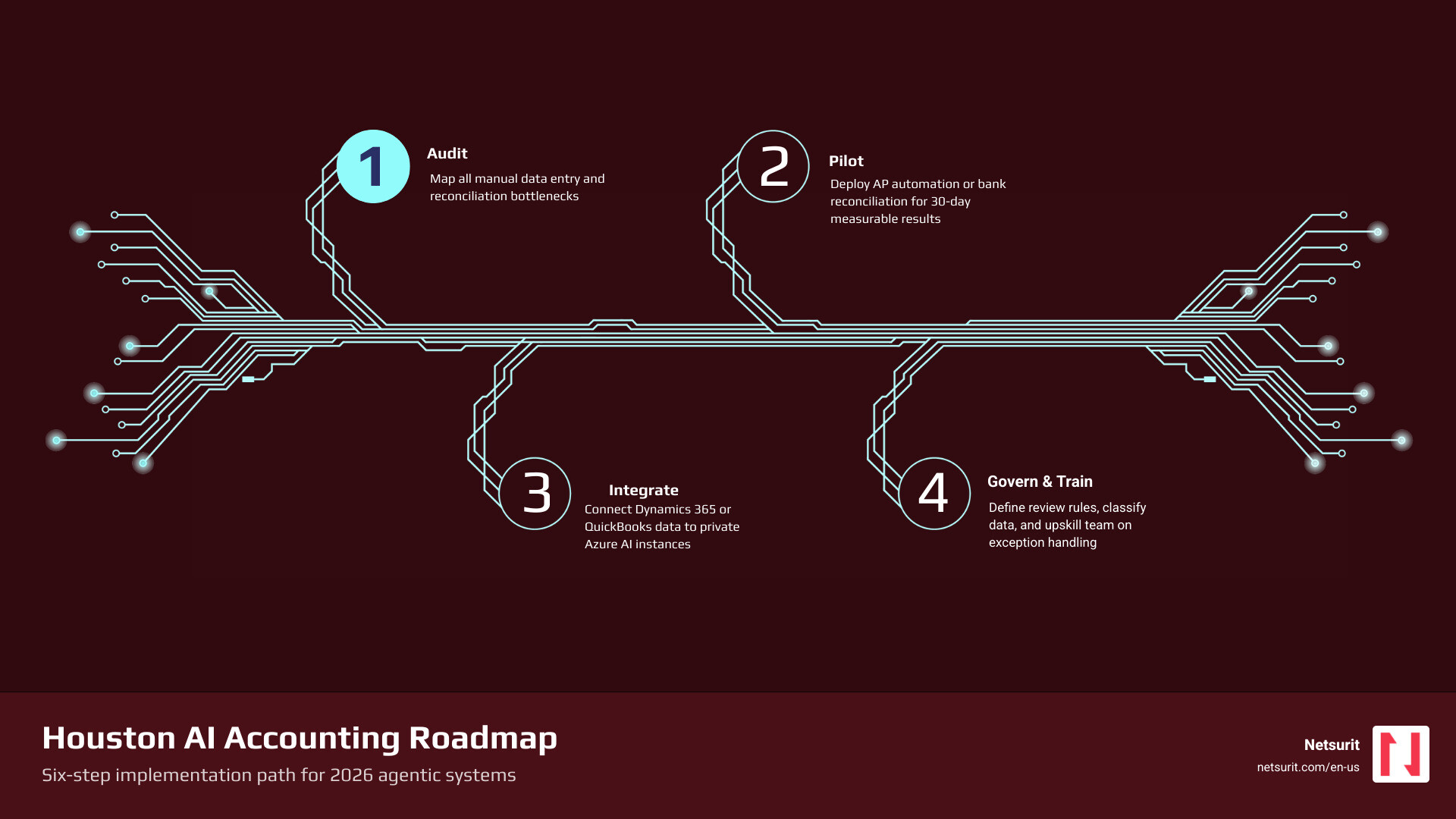
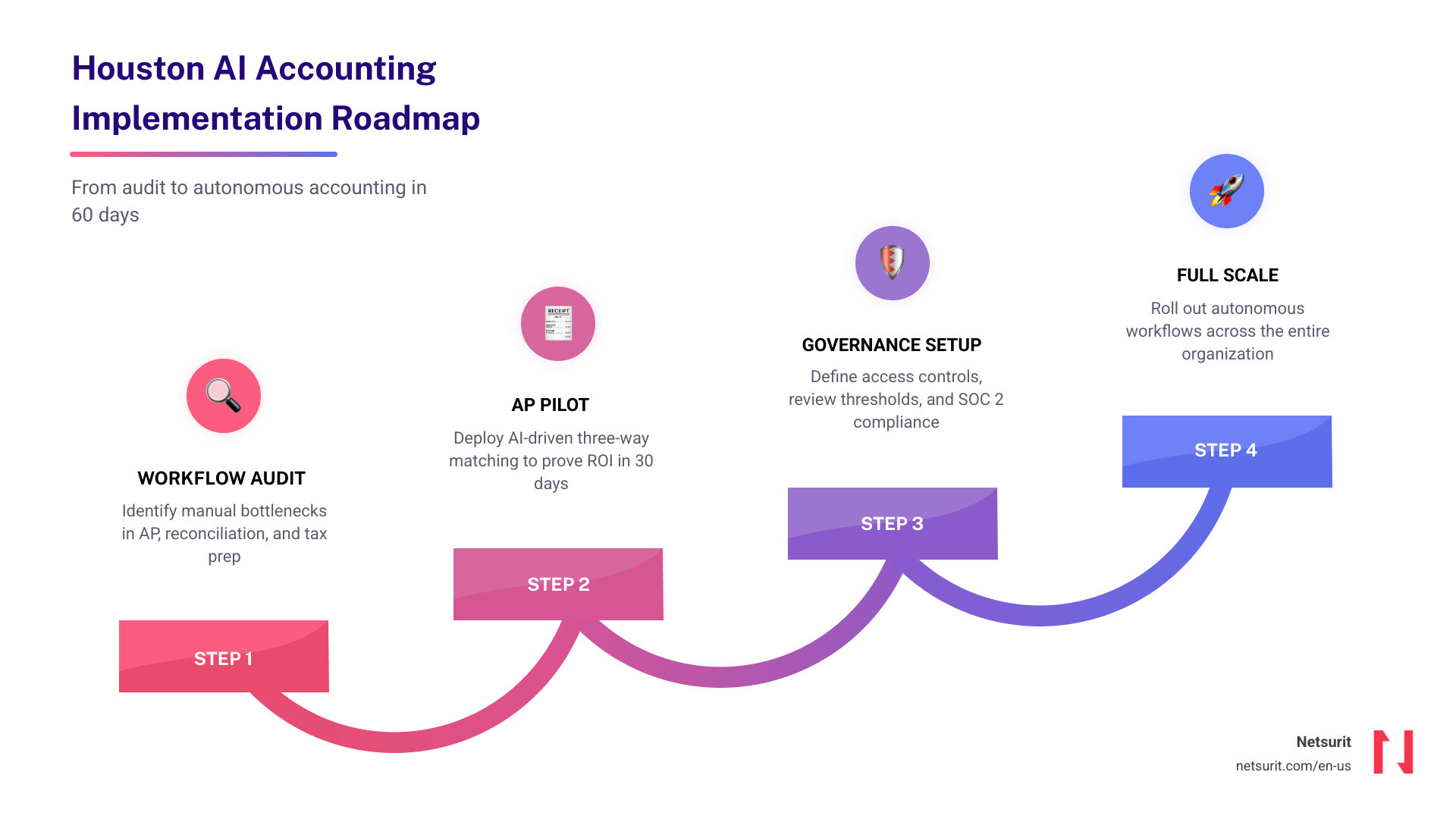
    Successful deployment requires a “strategy-first” approach rather than chasing the latest software hype. We recommend starting with a comprehensive workflow mapping of your most labor-intensive processes.

    1. Identify Document-Heavy Workflows: Focus on accounts payable (AP) and tax document intake. These areas offer the most immediate measurable gains.
    2. Deploy AI-Driven Chatbots: Use tools like AI ChatBot for Accounting & Tax in Houston | 01Data.ai to handle repetitive client inquiries regarding deadlines and document status.
    3. Audit Your Tech Stack: Ensure your current ERP or bookkeeping software allows for API-based integration. You want a “white-label” experience where AI works in the background of your existing brand.
    4. Implement Human-in-the-Loop Guardrails: AI should handle the volume, but humans must handle the exceptions.

    To truly improve accounting efficiency, you must treat AI as a team member that requires clear SOPs and oversight.

    Measuring Success in AI Accounting Integration Houston

    The benchmark for success in Houston is often the 90-day mark. Local businesses using AI tax filing automation report an average 78% cost reduction within this first quarter. With over 150 Houston companies already using Tax Filing Automation Automation Houston | AI Solutions by Autonoly, the data shows a consistent saving of 8 hours daily per implementation.

    Metric Traditional Process AI-Integrated (2026)
    Bookkeeping Hours 40 hours/week 4 hours/week
    Tax Prep Time 15 days 1 day
    Error Rate 3-5% (Human) <0.1% (AI)
    Reporting Speed Monthly (Static) Real-time (Dynamic)

    By simplifying regulatory reporting with AI copilots, Houston firms are meeting SEC and IRS requirements with significantly less partner-level review time.

    Automating High-Volume Workflows with Agentic AI

    The most significant evolution in 2026 is the rise of Agentic AI. Unlike traditional automation that follows a rigid “if-this-then-that” script, agentic AI agents are autonomous. They don’t just flag an anomaly; they investigate it. If a Houston restaurant group sees a sudden dip in profitability at its Sugarland location, an AI agent can independently pull data from the POS system, inventory logs, and payroll records to identify the cause—such as a spike in overtime or a vendor price hike—and present a solution before the monthly close.

    These agents provide a 4x average efficiency gain in ERP tasks. For financial controllers, these systems act as a “co-pilot,” managing the entire invoice workflow from receipt to payment prioritization. You can find the best AI agents for financial controllers that handle multi-state compliance and complex inter-company reconciliations autonomously.

    Enhancing Industry-Specific Operations

    Houston’s core industries have unique accounting challenges that generic software can’t solve.

    • Energy Sector: AI agents manage complex joint interest billings (JIB) and royalty payments, ensuring accuracy across thousands of stakeholders.
    • Manufacturing: Integrated systems like Microsoft Dynamics 365 Business Central provide real-time visibility into inventory costs. Using AI for effortless expense tracking helps manufacturers maintain margins in a fluctuating market.
    • Construction: AI automates project costing and automating AR with AI, predicting which contractors might pay late based on local economic trends.

    For firms needing a rapid start, the Executive reporting automation for Accounting firms in Houston, Usa | AI Integration Sprint offers a 6-week roadmap to move from messy spreadsheets to automated KPI dashboards.

    Trade-offs of Agentic AI:

    • Works best when: Workflows are repeatable and data is digitized.
    • Avoid when: Decisions require high-level ethical judgment or nuanced client negotiation.
    • Risks: “Hallucinations” in complex narrative reporting.
    • Mitigations: Mandatory human review for any transaction or report over a specific dollar threshold.

    Securing Financial Data Against Houston-Specific Threats

    As we integrate more AI, the attack surface for cybercriminals expands. Houston accounting firms are prime targets for ransomware because they hold sensitive PII (Personally Identifiable Information) and tax data. By April 2026, a “security-first” IT posture is no longer optional; it is a fiduciary requirement.

    We focus on building ransomware resilience into the AI integration process. This involves more than just a firewall; it requires SOC 2 compliance and continuous threat detection. If you are unsure of your current posture, exploring cybersecurity services in houston is the first step toward a secure deployment.

    AI governance is about “explainability.” If the IRS audits a return prepared with AI assistance, you must be able to show the audit trail.

    • Data Encryption: All financial data must be encrypted both at rest and in transit.
    • PII Handling: Use AI tools that offer data masking to ensure sensitive client details aren’t used to train public LLMs.
    • Internal Audits: Use AI’s role in internal audits to proactively catch errors before they become compliance issues.

    For local CPAs, knowing how to secure client tax data from ransomware attacks houston is as important as knowing the tax code itself. The future of AI and auditing relies on this “trust-but-verify” model where AI provides the assurance and humans provide the certification.

    Partnering for Successful AI Deployment in Houston

    Deploying AI is a heavy lift for an internal IT team already managing daily support. Most successful Houston businesses partner with specialists who understand both the local market and the specific nuances of accounting technology.

    When evaluating a partner for AI accounting integration Houston, look for:

    1. Local Expertise: Providers in Houston, Katy, or Sugarland understand Texas-specific taxes (like the franchise tax) and local industry cycles.
    2. Strategic Roadmapping: Avoid partners who just sell tools. You need a consultant who builds a roadmap based on your business outcomes.
    3. Managed Support: AI systems require ongoing tuning. A managed IT services houston model ensures your AI agents don’t “drift” or lose accuracy over time.

    Strategic it consulting houston can help you bridge the gap between legacy systems like QuickBooks Desktop and modern, AI-enabled ERPs.

    Training and Certification for Houston Accountants

    Technology is only as good as the people operating it. In 2026, the most successful firms are investing in “Digital Senior” training. Local events like the S.T.A.R.S. Summit in Houston now offer specific CPE credits for AI proficiency.

    Accountants should look into:

    Reliable accounting firm it services should include a component of staff enablement to ensure the tools are actually used.

    Frequently Asked Questions about AI Accounting

    What is the typical cost of AI accounting integration for Houston SMBs?

    While pricing varies by scale, many Houston SMBs start with pilot programs or monthly subscriptions. Tax-specific AI agents can start as low as a few hundred dollars per month, while full ERP-agnostic AI integrations for larger manufacturers are typically quoted based on transaction volume and complexity. Most firms see a full ROI within 90 days due to the dramatic reduction in manual labor costs.

    How do Houston firms address data security during AI migration?

    Security is addressed through a multi-layered approach: SOC 2 compliant data centers, end-to-end encryption, and strict “human-in-the-loop” approvals. Local providers like AI Consultants in Houston, TX | AI Implementation & AI Strategy and Business-Grade AI & Consulting Solutions – Houston – PennComp emphasize governance frameworks that prevent sensitive financial data from leaking into public AI models.

    Which AI tools are best for Houston’s energy and manufacturing sectors?

    For manufacturing, Microsoft Dynamics 365 Business Central integrated with AI agents (like those offered by DSWi) is the gold standard for real-time inventory and project costing. For startups and high-growth firms, platforms like CPA, Tax Accountant, and Bookkeeping in Houston | Zeni or Otterz: Bookkeeping,CFO & Tax Services for Startups | AI Powered provide the speed and scalability needed to move from pre-seed to late-stage growth.

    Conclusion

    The deployment of AI accounting integration Houston is no longer a “nice-to-have” luxury; it is the engine of modern financial operations. From the autonomous capabilities of agentic AI to the massive time savings in tax filing and bookkeeping, the technology of 2026 allows Houston’s accountants to stop being data processors and start being strategic powerhouses.

    At Netsurit, we are committed to helping you navigate this roadmap, ensuring your transition to AI is secure, compliant, and—most importantly—profitable. The future of accounting isn’t just about better software; it’s about unlocking the potential of your team through smarter systems.

    More info about managed services

  • The Ultimate Guide to Houston AI Accounting Software

    The Ultimate Guide to Houston AI Accounting Software

    Why AI Accounting Automation Is Reshaping Houston Businesses in 2026

    AI accounting automation Houston is the practice of using machine learning, predictive analytics, and intelligent software agents to handle bookkeeping, invoicing, collections, tax filing, and financial reporting — replacing slow, error-prone manual processes with fast, accurate, autonomous workflows.

    Here is what Houston businesses need to know right now:

    What AI Accounting Automates Key Benefit
    Accounts receivable & invoicing Reduces days sales outstanding (DSO) by 25–40%
    Bank and ledger reconciliation Cuts manual effort by up to 60%
    Tax filing (franchise, sales, multi-state) Saves up to 8 hours per day per team
    GL entry posting Up to 97% accuracy with AI-posted entries
    Cash flow forecasting Improves forecast accuracy by 85%+
    Financial close & reporting Up to 30% faster month-end close

    Houston’s economy — built on energy, healthcare, construction, and professional services — runs on tight margins and complex compliance requirements. Yet many firms here still rely on manual bookkeeping cycles that delay decisions, drain staff time, and leave cash sitting uncollected. As of April 2026, that gap between manual operations and AI-enabled competitors is no longer a minor inefficiency. It is a measurable competitive disadvantage.

    The firms pulling ahead are not necessarily the largest. They are the ones that replaced spreadsheet-driven workflows with systems that reconcile accounts in real time, flag anomalies before they become audit issues, and collect receivables faster — without adding headcount.

    This guide covers the tools, ROI benchmarks, Texas-specific compliance considerations, and implementation steps that matter most to Houston businesses evaluating AI accounting automation today.

    I’m Orrin Klopper, CEO of Netsurit — a global IT and digital transformation firm I have built since 1995, helping over 300 organizations modernize their operations through managed IT, cloud, security, and AI services, including AI accounting automation Houston implementations across industries. The practical framework in this guide draws directly from that experience working with finance teams who need results, not hype.

    Manual vs. AI accounting workflow comparison infographic for Houston businesses - AI accounting automation Houston

    The ROI of AI Accounting Automation Houston

    In the competitive Houston market, performance is measured by cash flow and efficiency. Transitioning to AI accounting automation Houston allows firms to move from reactive record-keeping to proactive financial management. By April 2026, the data shows that automation is no longer just about “saving time”—it is about unlocking capital that was previously trapped in inefficient processes.

    Metric Manual Accounting AI-Automated Accounting
    Days Sales Outstanding (DSO) 45–60+ days 25–40% reduction (approx. 30–35 days)
    Manual Data Entry Effort High (100%) 60% reduction
    Forecast Accuracy 60–70% 85%+
    Financial Close Time 10–15 days 30% faster (approx. 7–10 days)
    Bad Debt Write-offs Standard industry rates 15–25% reduction

    For a mid-sized Houston enterprise with $10 million in annual revenue, a 25% reduction in DSO can improve working capital by $250,000 to $400,000. These are not theoretical gains; they are realized through the deployment of AI productivity tools that manage the entire Order-to-Cash (O2C) cycle. Platforms like HighRadius now guarantee a 10% reduction in DSO and a 40% increase in productivity for the Office of the CFO.

    Streamlining Accounts Receivable with AI Accounting Automation Houston

    The most immediate ROI for Houston businesses often appears in Accounts Receivable (AR). Traditional AR relies on manual follow-ups and “dunning” letters that often ignore customer payment patterns. Modern AI AR automation uses predictive models to identify which customers are likely to pay late before the invoice even becomes due.

    By implementing AI tools to reduce manual data entry, Houston companies achieve:

    • 85%+ Improvement in Forecast Accuracy: Machine learning analyzes historical payment data and local economic trends to predict cash flow.
    • 40–50% Fewer Billing Disputes: AI validates invoices against purchase orders and contracts in real-time, catching errors before they reach the client.
    • Reduced Manual Effort: Automated workflows handle routine collections, allowing your team to focus only on high-value dispute resolution.

    Scaling Local Firms via AI Accounting Automation Houston

    For local accounting firms in areas like Katy and Sugar Land, the primary challenge is capacity. You cannot grow if your staff is buried in manual bookkeeping. Tools like Botkeeper have changed the math by delivering 97% accuracy on AI-posted General Ledger (GL) entries.

    When you automate accounting firm workflows, you eliminate the “bottleneck” of junior-level data entry. This allows a single “digital senior” to oversee a much larger portfolio of clients. The result is a firm that can scale revenue without a linear increase in payroll costs.

    Trade-offs: AI ROI Expectations

    • Works best when: Data is digitized and centralized in a modern ERP or cloud accounting system.
    • Avoid when: Processes are undocumented or vary wildly between every single client.
    • Risks: “Garbage in, garbage out”—AI will automate bad processes if they aren’t cleaned up first.
    • Mitigations: Conduct a readiness assessment to standardize workflows before turning on the automation.

    Top Platforms for Houston’s Energy and Healthcare Sectors

    Houston’s unique industry mix requires more than “out of the box” software. An energy company in the Energy Corridor has different compliance needs than a multi-location healthcare clinic in Conroe.

    Autonomous Bookkeeping for High-Volume Transactions

    In sectors like healthcare, where transaction volume is high and billing is complex, Zeni has become a staple. Zeni processes over $1.3 billion in transactions monthly, using AI to provide real-time visibility into burn rates and cash position. For Houston startups and mid-market firms, this eliminates the “monthly wait” for financial statements.

    Local providers like InteliKeeper also offer a hybrid “automation + human touch” model. This is particularly useful for Houston businesses that want the speed of a bot-driven system but still need a dedicated account manager to discuss strategic decisions. This ensures financial statements are made smarter by combining machine precision with human context.

    AI-Driven Audit and Risk Management

    The audit landscape in Houston is shifting from “sampling” to “full-population analytics.” Traditionally, an auditor might look at 5% of your transactions. In 2026, AI allows firms like Whitley Penn to analyze 100% of transactions for anomalies.

    This shift significantly improves risk management by:

    1. Detecting Fraud: Identifying patterns that humans might miss across thousands of entries.
    2. Ensuring Compliance: Automatically flagging transactions that don’t meet Houston industry standards or specific energy sector regulations.
    3. Speeding Up Audits: Reducing the time staff spends on manual “ticking and tying” so they can focus on high-risk areas.

    Using AI for auditing smarter means your internal or external audit becomes a tool for improvement rather than just a compliance hurdle.

    Solving Texas-Specific Tax and Compliance Challenges

    Texas may not have a state income tax, but our Franchise Tax and Sales Tax regulations are notoriously complex, especially for businesses with government contracts or multi-state operations.

    Automating Multi-State Filings for Energy Enterprises

    Houston energy firms often operate across state lines, triggering a nightmare of different tax nexus rules. Autonoly has gained significant traction here, with over 150 Houston-based companies using their tax filing automation.

    Key advantages include:

    • 94% Time Savings: Automating the retrieval of data and population of forms.
    • Audit-Ready Documentation: AI maintains a complete audit trail, which is vital for simplifying regulatory reporting.
    • Error Reduction: AI agents trained on Texas tax codes achieve 99.9% accuracy, drastically reducing the risk of penalties.

    Understanding AI in tax and accounting is now a requirement for any Houston CFO who wants to avoid the “January-to-April” burnout.

    Real-Time Reconciliation for Construction and Logistics

    For the construction industry in Katy and Conroe, cash flow is tied to milestones. If reconciliation is delayed, project funding can stall. AI accounting automation Houston solves this by providing real-time bank data feeds that match invoices to payments within minutes.

    AI agents can now:

    • Predict project-stage payments based on historical completion data.
    • Automate “milestone invoicing,” ensuring that as soon as a project manager flags a task as complete, the bill goes out.
    • Perform due diligence smarter by continuously monitoring vendor health and insurance compliance.

    Transitioning to Agentic AI and the “Digital Senior” Role

    As we move through 2026, the conversation is shifting from “AI assistance” to “Agentic AI.” While early AI tools acted as copilots (requiring you to drive), agentic AI operates as an autonomous worker that can orchestrate entire processes from end to end.

    Redefining Job Descriptions in the Houston Market

    The “Staff Accountant” of 2020 is becoming the “Accounting Systems Analyst” of 2026. Houston employers are no longer just looking for CPA credentials; they want professionals who understand data analytics and process oversight.

    This evolution is changing how companies handle managed IT services in Houston. IT and Finance are merging. The “Digital Senior” role involves:

    • Overseeing AI Agents: Ensuring the bots are categorizing transactions correctly.
    • Strategic Advisory: Using the real-time data provided by AI to advise on mergers, acquisitions, or capital expenditures.
    • Exception Management: Only stepping in when the AI flags a high-complexity anomaly.

    Even payroll is being transformed. Instead of manual entry, AI handles payday perfection by automatically adjusting for local tax changes and multi-state withholdings.

    Overcoming Implementation Hurdles and Governance

    The biggest barrier to AI accounting automation Houston isn’t the technology—it’s the strategy. Many firms rush to buy a tool without a roadmap. This often leads to “tool sprawl” where systems don’t talk to each other.

    Local consultants like PennComp emphasize a “governance-first” approach. Before deploying Microsoft Copilot or a specialized AR bot, you must address:

    1. Data Privacy: Ensuring client financial data is encrypted and compliant with SOC 2 standards.
    2. Legacy Systems: How the new AI will talk to your 10-year-old ERP.
    3. Training: Investing time to help your staff move from “data entry” to “data oversight.”

    We specialize in fixing business problems with smart tech by creating a roadmap that prioritizes security and measurable ROI.

    Frequently Asked Questions about AI Accounting

    How quickly can Houston businesses see ROI from AI automation?

    Most Houston SMBs see measurable efficiency gains within the first 30 days. Full ROI—measured by significant DSO reduction or labor cost savings—typically occurs within 90 to 180 days. For example, a Houston-based government contractor recently reported saving $72,000 annually within the first year of tax automation.

    Will AI accounting tools integrate with my existing ERP like SAP or QuickBooks?

    Yes. Modern platforms like HighRadius and Zeni are designed to sit on top of your existing ERP. They use APIs to pull and push data, meaning you don’t have to “rip and replace” your current system to benefit from AI.

    Does AI replace the need for a human CPA or bookkeeper?

    No. It replaces the tedium they face. AI handles the 80% of work that is repetitive and rules-based. This allows your human CPA to focus on the 20% that requires professional judgment, tax strategy, and client relationship management.

    Conclusion

    By April 2026, AI accounting automation Houston has moved from a “nice-to-have” luxury to a core operational requirement. Whether you are managing an energy enterprise in the city center or a growing healthcare practice in Sugar Land, the ability to automate your financial workflows is the key to maintaining a competitive edge.

    At Netsurit, we help Houston businesses navigate this transition. We don’t just hand you a piece of software; we build a strategic AI roadmap that integrates with your existing IT infrastructure and secures your most sensitive financial data.

    If you are ready to crush downtime and unlock your business momentum, explore our services and let’s discuss how we can modernize your finance department for the future.

  • How Houston Firms Use AI to Stop Being Bored

    How Houston Firms Use AI to Stop Being Bored

    Why Houston Accounting Firms Are Turning to AI Solutions Right Now

    By April 2026, Houston accounting firms have largely eliminated the 40-hour manual reconciliation week. Thesis: Houston firms are replacing repetitive manual tasks with Agentic AI to reclaim 30% of their billable hours, transforming accountants from “data processors” into “strategic advisors.”

    AI Application Primary Benefit
    Automated bookkeeping 70+ hours saved per month
    Invoice and AP automation 90% of invoices processed without manual input
    R&D tax credit identification Millions in credits that manual reviews miss
    Financial close automation Close cycle cut from 10 days to 3
    Agentic AI advisory tools Forecasts and scenario models ready before client meetings

    Firms across the metro—from Sugar Land to Conroe to Katy—have stopped debating whether to adopt AI. They are now deciding how fast to scale it. Houston faces a shrinking pool of accounting talent and spikes in tax season demand. AI solves the repetitive work—reconciliations, invoice matching, and data entry—allowing staff to focus on high-stakes client judgment.

    I’m Orrin Klopper, CEO of Netsurit. We’ve spent nearly three decades helping organizations implement AI solutions accounting practices Houston firms rely on to stay competitive. In this guide, I’ll walk you through how Houston firms deploy these systems and the results they achieve.

    Infographic: Traditional bookkeeping vs. Agentic AI workflows in Houston accounting practices - AI solutions accounting

    Deploying Autonomous Finance in Houston Practices

    By April 2026, the shift from “automated” to “autonomous” finance has become the standard for high-growth firms in the Houston metro area. While traditional automation follows rigid “if-then” rules, autonomous systems use Agentic AI to observe, learn, and execute entire workflows. In Sugar Land and Katy, financial controllers use these systems to manage Order-to-Cash (O2C) and Record-to-Report (R2R) cycles with minimal oversight.

    The efficiency gains are no longer theoretical. Local practices report that AI now automates 90% of invoices, with 80% of transactions being auto-coded directly into the general ledger. This isn’t just about speed; it’s about capital optimization. Automated Accounts Payable (AP) systems have enabled a 3x increase in early payment discount capture, turning the AP department from a cost center into a small revenue generator.

    The “so what?” for your practice is clear: firms using these systems reduce the monthly financial close cycle from ten days to just three. This allows Houston business owners to make mid-month strategic pivots based on real-time data rather than waiting for a post-mortem report three weeks late.

    Feature Manual Data Entry AI-Driven Autonomous Workflows
    Data Processing Human-led, prone to fatigue/error Machine-led, 99.9% accuracy
    Reconciliation Monthly batch processing Real-time, continuous matching
    Invoicing Manual entry and verification 90% touchless automation
    Cycle Time 10+ days to close 3 days or less

    Scaling AI for Houston Small Businesses

    You don’t need a “Big Four” budget to access enterprise-grade intelligence. Cloud-based AI solutions accounting practices Houston small businesses use allow boutique firms to compete on insights rather than just price. By adopting comprehensive IT services for your accounting practice, even a solo practitioner in Conroe can offer sophisticated tax optimization.

    AI-driven systems now identify an average of $10,000 in federal tax savings per small business client by flagging missed deductions in real-time. Furthermore, automated document tagging ensures that every receipt and invoice is electronically organized, providing built-in audit protection. Moving to a cloud-first, no-contract model allows these smaller firms to remain agile, scaling their tech stack up or down as the Houston energy market fluctuates.

    Real-Time Bookkeeping and R&D Credits

    The most significant impact of AI in 2026 is the ability to handle massive transaction volumes without adding headcount. AI platforms now process billions in transactions monthly across Houston, maintaining GAAP-compliant financial statements with daily auto-updates.

    This real-time visibility is particularly lucrative for the Houston tech and engineering sectors. AI tools can track engineering hours against specific project codes, identifying R&D tax credits that manual audits often overlook. For example, one local tech firm captured $6.5 million in R&D credits simply because the AI identified qualifying activities that were buried in Slack logs and Jira tickets—data a human accountant would never have time to manually sift through.

    Solving the Houston Talent Shortage with Agentic AI

    Houston faces a significant accountant shortage. Student interest in the field has declined while the complexity of Texas franchise and federal taxes has increased. According to the AICPA, the profession is actively seeking ways to accelerate the talent pipeline. To bridge this gap, local firms are hiring “Digital Seniors”—Agentic AI systems that perform the work of a senior associate.

    These agents handle the heavy lifting during the January–April “busy season” crunch, reducing staff burnout. Instead of spending 60 hours a week “ticking and tying” spreadsheets, your junior staff can focus on improving accounting efficiency and managing client relationships.

    AI-driven productivity gains in Houston firms:

    • 30–50% reduction in total accounting staff hours.
    • 40% increase in overall practice productivity.
    • 10% reduction in Days Sales Outstanding (DSO) through automated collections.
    • Elimination of manual data entry errors in 95% of routine tasks.

    Trade-offs of AI Talent Integration

    Feature Guidance
    Works best when Handling high-volume, repetitive tasks like bank reconciliations and automating AR workflows.
    Avoid when Managing complex, subjective client advisory or sensitive negotiations requiring high emotional intelligence.
    Risks Potential for AI “hallucinations” in tax law interpretation and loss of institutional mentoring.
    Mitigations Implement strict governance frameworks and mandatory upskilling programs for staff to audit AI outputs.

    Industry-Specific AI Needs: Energy, Healthcare, and Manufacturing

    Houston’s core industries have unique accounting requirements that general AI tools can’t always handle. Success requires IT consulting in Houston that understands local nuances.

    • Energy: AI now automates complex joint interest billing (JIB) and depletion allowances, which are notorious for manual errors.
    • Healthcare: Firms serving Houston’s medical center use AI to automate patient billing cycles while maintaining strict HIPAA compliance.
    • Manufacturing: In Conroe and East Houston, AI is used for real-time inventory forecasting and automating the calculation of the Texas franchise tax.
    • Sales Tax: For firms with clients expanding beyond Texas, AI provides automated nexus tracking to ensure compliance with varying state regulations.

    Case Study: Conroe Manufacturing Firm

    In early 2026, a mid-sized manufacturer in Conroe faced a 40% increase in supply chain complexity due to new international trade regulations. By implementing an Agentic AI system to manage their digital finance transformation, they reduced their financial close time by 30%. Within the first 90 days, the system identified $50,000 in duplicate vendor payments that had slipped through their previous manual system.

    Strategic Implementation and Governance

    Adopting AI solutions accounting practices Houston firms trust requires strategy, not just a subscription. We use the ACE Method (Complexity, Effort, and Impact) to prioritize automation. Before deploying autonomous agents, conduct a readiness assessment. If your underlying data is messy, AI will simply produce “garbage in, garbage out” results faster.

    AI strategy best practices for Houston firms:

    • Define Governance: Establish clear policies on who owns AI outputs and how they are verified.
    • Start Small: Automate one document-heavy process (like AP) before moving to full autonomous finance.
    • Audit for Compliance: Ensure your AI workflows align with SEC rules for financial firms and Texas Identity Theft Laws.
    • Invest in Training: Treat training time as a strategic investment, not an overhead cost.

    Security for AI-Enhanced Accounting Practices

    CPA firms remain a top target for cybercriminals. As you integrate AI, your cybersecurity services in Houston must evolve. AI implementation should always be wrapped in a “Zero Trust” architecture to secure client tax data from ransomware.

    Data privacy is the biggest hurdle. You must implement guardrails to ensure your clients’ sensitive financial data isn’t used to train public AI models. For SOC 2 compliance, every AI-generated entry must have a clear, human-readable audit trail. We recommend using encrypted client portals that feed data directly into AI engines, effectively eliminating IT downtime during busy season.

    Frequently Asked Questions

    How can small Houston firms start with AI without high costs? The most cost-effective way is to utilize AI modules already integrated into your existing cloud accounting software (like QuickBooks or Xero). This avoids the need for outsourcing IT staff for custom development and allows you to pay as you grow.

    What training is available for Houston CPAs to learn AI? The University of Houston and various local professional bodies now offer “Certified AI for Accountants” programs. These courses focus on practical skills like predictive analytics, fraud detection with AI, and prompt engineering for financial reporting.

    Does AI replace the need for a Houston CPA? Absolutely not. AI is designed to handle the “boredom” of data entry and reconciliation. Human CPAs remain the essential “strategic powerhouse” for capital allocation, navigating complex tax litigation, and providing the high-level advice that builds long-term client trust.

    Conclusion

    Houston accounting firms that successfully transition to autonomous finance by May 2026 will secure a permanent competitive advantage in a talent-starved market. By automating the routine, you allow your team to focus on the high-value advisory work that clients actually want to pay for. At Netsurit, we provide the managed IT services in Houston and the security frameworks necessary to make this transition seamless.

    Next Step: Audit your current manual workflows this week to identify the first three tasks—such as bank reconciliation or invoice entry—ready for AI delegation.

    Contact Netsurit for an AI Readiness Assessment

  • AI Accounting Optimization Houston: The Future of Financial Efficiency

    AI Accounting Optimization Houston: The Future of Financial Efficiency

    AI Accounting Optimization in Houston: What You Need to Know First

    AI accounting optimization Houston is transforming how CPA firms and finance teams operate across the metro area. If you want the short answer on how to get started, here it is:

    How to optimize accounting with AI in Houston — quick overview:

    Step Action Expected Result
    1 Identify repetitive workflows (data entry, reconciliation, tax filing) Pinpoint where AI saves the most time
    2 Deploy AI tools for bookkeeping, invoice processing, and reporting Reduce manual hours by 30–50%
    3 Use prompt toolkits for emails, meeting notes, and client deliverables Save 5–10 hours per week per CPA
    4 Apply security guardrails: SOC 2 compliance, human review, access controls Protect client data and meet regulatory standards
    5 Partner with a vetted local AI or IT provider Get implementation support with Houston-specific context

    Houston accounting firms are under real pressure. Client expectations for real-time reporting are rising. The CPA talent pool is shrinking. And manual processes — month-end closes, multi-entity reconciliations, high-volume tax filings — eat hours that staff don’t have.

    The data backs this up. As of April 2026, 76% of finance and accounting leaders report using AI to improve efficiency. Firms that have integrated AI into core workflows report cutting accounting staff hours by 30–50%. Yet many Houston firms are still running on spreadsheets and legacy software, leaving significant time and money on the table.

    This isn’t about replacing accountants. It’s about removing the friction that slows them down — so a firm in Katy or Sugar Land can close faster, file cleaner, and advise better.

    I’m Orrin Klopper, CEO and co-founder of Netsurit, a global IT services and digital transformation company that has spent over 30 years helping businesses modernize their operations — including guiding accounting and finance teams through practical AI accounting optimization Houston strategies. In the sections below, I’ll walk you through exactly where AI fits in your firm’s workflows, which risks to watch for, and how to choose the right partner to make it work.

    Infographic showing 2026 AI adoption statistics and time savings for Houston accounting firms - AI accounting optimization

    Why Houston Firms are Prioritizing AI Accounting Optimization

    In the Houston market, the shift toward AI isn’t just a trend; it’s a response to a perfect storm of economic factors. As of April 2026, the local accounting industry faces a persistent talent shortage, particularly in specialized sectors like energy and government contracting. Firms are finding it increasingly difficult to recruit and retain mid-level CPAs who are often burnt out by high-volume manual data entry.

    By prioritizing AI accounting optimization Houston, firms are moving from a reactive “fix-it” IT mindset to a proactive, outcome-based strategy. Enhancing SMB Accounting with Agentic AI – Business Logix – Houston highlights that agentic AI—systems that can perform tasks independently—is now a baseline requirement for staying competitive. Many firms are turning to IT Outsourcing Houston to bridge the gap between their legacy systems and these modern, autonomous tools.

    The Competitive Landscape in April 2026

    The Houston market is aggressive. Clients in the Energy Corridor and downtown financial districts no longer want to wait 15 days after month-end for a financial statement. They expect real-time visibility. Firms that fail to provide instant dashboards or predictive insights risk losing long-term clients to “tech-forward” competitors who use AI to deliver 24/7 financial monitoring.

    Addressing the CPA Talent Gap

    The most immediate benefit of AI is staff retention. When you automate the “grunt work”—reconciling thousands of transactions or chasing down W-9s—your CPAs can focus on high-value advisory work. Research shows that integrating AI into firm workflows can save individual CPAs between 5 and 10 hours per week. This reduction in “drudge work” is often the difference between a satisfied employee and one looking for the exit.

    High-Impact Workflows for AI Accounting Optimization Houston

    To see real ROI, you must look beyond general AI and focus on specific accounting workflows. Many firms start by trying to automate accounting firm workflows with AI in areas where human error is most common or volume is highest.

    Workflow Manual Process AI-Optimized Process Time/Cost Impact
    Tax Filing Manual data entry from PDFs Tax Filing Automation Houston via AI agents 90% reduction in filing time
    Accounts Payable Manual invoice matching AI extraction and PO verification 60% faster payment cycles
    Reconciliation Line-by-line bank matching Automated pattern recognition 30-50% fewer staff hours
    Audit Support Random sample testing 100% transaction scrutiny 40% reduction in audit risk

    Scaling Tax and Audit with AI Accounting Optimization Houston

    For Houston-based firms dealing with complex R&D tax credits or multi-state energy filings, AI is a force multiplier. AI agents can scan thousands of documents to identify qualifying expenses that a human might miss. In the realm of assurance, AI and auditing for financial assurance allows firms to move from sampling to full-population testing, significantly increasing the reliability of financial statements.

    Advisory and Client Accounting Services (CAS)

    AI transforms the back office into a “strategic powerhouse.” Instead of just reporting what happened last month, firms use AI-driven forecasting for treasury to predict what will happen next month. This allows a CPA in Sugar Land or Conroe to offer “Fractional CFO” services that provide actionable recommendations on cash flow management and capital allocation before a crisis occurs.

    Trade-offs: Implementing AI Workflows

    • Works best when: Data is digitized and workflows are already documented.
    • Avoid when: Client data is unorganized or stored in physical-only formats.
    • Risks: “Hallucinations” where the AI suggests incorrect figures if not supervised.
    • Mitigations: Always maintain a “human-in-the-loop” for final verification and approval.

    Practical Prompt Strategies to Reclaim 10 Hours Weekly

    You don’t always need a $50,000 custom software build to see results. Large Language Models (LLMs) and tools like Microsoft Copilot can be used immediately to boost AI productivity in daily tasks. The key is “prompt engineering”—knowing exactly what to ask the AI to get a usable result.

    Automating Client Deliverables

    Instead of staring at a blank screen, use AI to draft the first version of workpaper summaries or client proposals. For example, a Houston CPA can prompt an AI: “Summarize these three bank statements, highlight any transactions over $5,000 that lack a clear vendor name, and draft a professional email to the client requesting clarification.” This turns a 45-minute task into a 5-minute review. Specialized AI for accounting workflows can even help draft advisory scripts for upcoming client meetings.

    Streamlining Daily Communication

    The average accountant spends hours managing an overflowing inbox. AI can perform sentiment analysis to flag “urgent” or “unhappy” client emails, ensuring you address the biggest fires first. It can also be used for AI’s role in financial scrutiny, quickly summarizing lengthy legal or regulatory updates so you can keep clients informed without reading 50-page PDFs.

    Example Scenario: The Katy Tax Season Rush Imagine a mid-sized firm in Katy during the peak of tax season. By using a “Prompt Toolkit,” the lead partner uses AI to summarize meeting notes from three different client Zoom calls simultaneously. The AI extracts the key action items and populates the firm’s CRM. The partner saves 2 hours of administrative work every single day, allowing them to review four additional returns before the end of the day.

    While the benefits of AI accounting optimization Houston are clear, the risks are real. You cannot simply upload sensitive client tax data to a public AI tool. Security and confidentiality are non-negotiable professional standards.

    Maintaining Professional Standards

    AI is a co-pilot, not the captain. Every AI-generated report or tax summary must undergo a human review. We recommend a “Trust but Verify” approach. This ensures that the firm maintains its reputation for accuracy while still benefiting from the speed of automation. Using AI to help manage risks involves setting up internal guardrails that prevent AI from making autonomous decisions on high-stakes filings without a CPA’s sign-off.

    Compliance with Texas and Federal Regulations

    Houston firms must navigate a complex web of regulations, from the Texas Comptroller’s rules to federal SEC mandates. It is vital to secure client tax data from ransomware attacks in Houston by using SOC 2-compliant AI providers. Furthermore, staying updated on AI compliance and SEC rules for financial firms ensures that your use of automated forecasting doesn’t run afoul of transparency requirements.

    Trade-offs: Security vs. Speed

    • Works best when: Using “closed” AI environments (like enterprise-grade Microsoft Copilot).
    • Avoid when: Using free, public versions of AI tools that “learn” from your data.
    • Risks: Data leakage or breach of client confidentiality.
    • Mitigations: Implement strict AI usage policies and use multi-factor authentication (MFA) on all financial platforms.

    Selecting the Right AI Accounting Optimization Houston Partner

    Choosing a partner is about more than technical skill; it’s about local context. A partner in Sugar Land or downtown Houston understands the specific nuances of the Texas franchise tax and the local energy economy. When evaluating a provider, look for those who offer IT consulting Houston with a specific focus on financial workflows.

    Top Houston AI Development Companies for Accounting Optimization

    Several local leaders are helping firms bridge the gap. Companies like PennComp focus on business-grade AI and consulting, helping SMBs identify where AI fits into their existing IT stack. WG Consulting offers digital innovation services that help larger firms overhaul their entire financial operations. These partners don’t just “install software”; they build a roadmap for long-term growth.

    Criteria for Evaluating AI Developers

    When vetting a vendor, ask about scalability. Why do growing accounting firms struggle with IT scalability? Often, it’s because they choose “point solutions” that don’t talk to each other. Your AI partner should ensure that your new automation tools integrate seamlessly with your existing ERP (like Microsoft Dynamics 365 Business Central) and your document management systems.

    What to watch next: By 2027, we expect to see “Agentic Ecosystems” where your tax software automatically talks to your client’s bank and your firm’s workflow manager, requiring zero human intervention for standard monthly reconciliations.

    Frequently Asked Questions about AI Accounting Optimization

    How much time can Houston CPAs realistically save with AI?

    Most firms see an immediate saving of 5–10 hours per week per professional by automating administrative tasks like email, meeting summaries, and basic data categorization. For high-volume bookkeeping, staff hours can be reduced by 30–50%.

    Is AI safe for sensitive client tax data?

    Yes, but only if you use “Enterprise-grade” tools. Public AI tools are not safe for sensitive data. You must use SOC 2-compliant platforms that offer data “siloing,” meaning your data is never used to train the global AI model.

    Which Houston-based companies specialize in AI for accounting?

    Firms like PennComp, WG Consulting, and specialized MSPs like Netsurit provide the infrastructure and strategic consulting needed to implement AI accounting optimization Houston safely and effectively.

    Conclusion

    The future of accounting in Houston is not about who has the most staff, but who has the smartest workflows. By embracing AI accounting optimization Houston, firms in Katy, Sugar Land, and beyond can reclaim their time, protect their margins, and provide the high-level advisory services their clients demand. At Netsurit, we help you navigate this transition by providing the managed IT and cybersecurity foundation required for modern AI.

    Ready to protect your firm’s communications while you scale? Secure your firm with elite Email Security and start your optimization journey today.

  • How to Audit-Proof Your Texas Business Using AI Software

    How to Audit-Proof Your Texas Business Using AI Software

    Texas Just Made AI Compliance Mandatory — Here’s What You Need to Know

    AI compliance tools Texas businesses need are no longer optional. As of January 1, 2026, the Texas Responsible Artificial Intelligence Governance Act (TRAIGA) is in effect — and penalties for violations can reach $200,000 per incident.

    Here’s a quick answer to what you’re looking for:

    Top AI compliance tools for Texas businesses in 2026:

    Tool Best For Key Capability
    TXAIMS Private businesses, healthcare, government Prohibited practice screening, NIST alignment, evidence bundles
    VerifyWise Multi-regulation coverage Maps all 26 TRAIGA requirements, impact assessments
    Adeptiv AI Deployer risk management Documentation, safeguard tracking, governance workflows

    What every Texas business must do now:

    1. Identify every AI system you use or build
    2. Determine if you are a developer, a deployer, or both
    3. Screen for prohibited practices (discrimination, manipulation, explicit content)
    4. Align with the NIST AI Risk Management Framework for safe harbor protection
    5. Generate documented evidence bundles before the Texas AG comes knocking

    TRAIGA applies to any business operating in Texas or serving Texas residents — regardless of company size. There is no small-business exemption. A single uncurable violation costs more than most businesses spend on compliance in a year.

    The law passed the Texas House 146-3 and the Senate 31-0. This is not a partisan fight — Texas sees AI governance as a business and consumer protection issue. That broad consensus means enforcement is coming.

    I’m Orrin Klopper, CEO of Netsurit, a managed IT and digital transformation company with offices across the US including Texas — and helping businesses navigate AI compliance tools Texas regulations is central to what our team does every day. In the sections below, I’ll walk you through exactly how to make your Texas business audit-proof under TRAIGA.

    TRAIGA compliance timeline from January 2026 enactment through enforcement milestones - AI compliance tools Texas

    The Texas Responsible AI Governance Act, or TRAIGA (HB 149), represents a massive shift in how we handle technology. Unlike other state regulations that only target “high-risk” systems, TRAIGA is broad. If your business uses AI to offer products or services to Texans, you are likely covered. The law distinguishes between two roles: Developers (those who build or substantially modify AI) and Deployers (those who use AI in their operations).

    Texas took a unique path compared to Colorado or California. While Colorado focuses on “disparate impact” (statistical differences in outcomes), Texas focuses on intentional discrimination. This means the Attorney General looks for evidence that an AI was designed or used with the intent to discriminate against protected classes. However, don’t let that higher bar for the prosecution make you complacent. The law also prohibits AI behavior that encourages self-harm, facilitates criminal activity, or produces sexually explicit content.

    One of the most important features of TRAIGA is the 60-day cure period. If the Attorney General identifies a curable violation, you have two months to fix it before fines kick in. But wait—”uncurable” violations, such as those involving significant harm or prohibited content, don’t get this grace period. They can result in immediate penalties of up to $200,000. For more details on these nuances, refer to the Texas TRAIGA (HB 149) Compliance Guide.

    How Texas Compares to Other States

    Feature Texas (TRAIGA) Colorado (SB 24-205) California
    Scope Any AI system “High-risk” AI only Focus on privacy/automated decisions
    Discrimination Standard Intent-based Disparate impact Disparate impact
    Small Business Exemption None Limited exemptions Varies by revenue
    Legal Defense Rebuttable Presumption Affirmative Defense Varies

    Example: A tax firm in Conroe using AI to automate audit risk assessments must identify as a “deployer.” Even if they didn’t build the tool, they must ensure it doesn’t intentionally flag taxpayers based on protected characteristics like race or religion.

    Essential AI Compliance Tools Texas Businesses Need in 2026

    To avoid the “parking ticket” trap—where you only realize you’re in trouble when the fine arrives—you need proactive software. AI compliance tools Texas businesses use most frequently in 2026 include TXAIMS, VerifyWise, and Adeptiv AI. These platforms act as a central nervous system for your governance, providing “evidence bundles” that you can hand to an auditor or the Attorney General to prove you’ve done your due diligence.

    TXAIMS, for instance, offers tiered plans that help businesses scale their compliance as they adopt more tools. Whether you are a small accounting office in Katy or a large logistics firm in Houston, these tools automate the grueling task of prohibited practice screening. You can view their structure at TXAIMS Pricing and Plans. These platforms are fundamentally changing how regulated industries operate by moving compliance from a manual checklist to an automated workflow. For a deeper look at this shift, see AI Compliance Tools Transforming Regulated Industries.

    Trade-offs box:

    • Works best when: Managing 3+ AI systems; operating in high-risk sectors like finance or healthcare; requiring defensible audit trails.
    • Avoid when: Using only low-risk, non-consequential tools like basic spellcheck or simple calculators.
    • Risks: Relying entirely on the tool without human oversight; a false sense of security if the tool is misconfigured.
    • Mitigations: Human-in-the-loop verification; quarterly reviews with your IT partner; regular legal counsel check-ins.

    Scaling Governance with AI Compliance Tools Texas

    As your business grows, manually tracking every AI interaction becomes impossible. Modern tools map your operations against all 26 TRAIGA requirements, including impact assessments and transparency notices. VerifyWise, for example, provides a comprehensive roadmap for these 26 points, ensuring no requirement slips through the cracks. You can explore their approach in the Texas AI Act (TRAIGA) Compliance Guide | VerifyWise.

    Effective governance isn’t just about following the law; it’s about risk management. By mapping your AI usage, you protect your reputation and your bottom line. Learn more about this in our guide on Protect Your Organization How Ai Can Help You Manage Risks.

    Screening for Prohibited Practices with AI Compliance Tools Texas

    The “Texas Standard” for AI is strict when it comes to harmful behavior. Software like Adeptiv AI helps businesses screen for prohibited practices, such as behavioral manipulation or the generation of unlawful content. This is particularly critical for businesses that use generative AI for marketing or client communication. Detailed requirements are outlined in the Texas Responsible AI Governance Act | Adeptiv AI.

    Furthermore, machine learning can actually be your best defense. By using AI to monitor AI, you can catch discriminatory patterns or biometric risks before they become legal liabilities. We’ve seen how Compliance Supercharged How Machine Learning Protects Your Business can turn a reactive “firefighting” culture into a proactive, audit-ready environment.

    If you operate in healthcare, government, or legal services, TRAIGA isn’t your only hurdle. Texas has passed several companion bills that add layers of complexity:

    1. Healthcare (SB 1188): Requires clear, conspicuous disclosures when AI is used in patient interactions. You must also ensure health records are stored in the US and reviewed by medical professionals.
    2. Government (SB 1964 & HB 3512): State agencies and their contractors must follow specific ethics guidelines. Employees using computers for more than 25% of their duties must undergo DIR-certified AI training.
    3. Legal & Finance: The State Bar of Texas issued Opinion 705, which mandates human oversight and verification of all AI-generated legal work.

    A major risk in these sectors is “shadow AI”—when employees use unapproved tools like ChatGPT to summarize sensitive patient files or financial audits. This bypasses all corporate controls and creates immediate compliance violations. Understanding Staying Ahead Of The Curve Ais Role In Financial Compliance and Ai Compliance Sec Rules Financial Firms is essential for any firm handling sensitive data in the Houston metro area.

    Example: A Sugarland accounting firm providing client advisory via generative AI must disclose this interaction clearly. If a client thinks they are talking to a human CPA but are actually interacting with a bot, the firm could face penalties for deceptive practices under TRAIGA and professional ethics guidelines.

    Implementation Roadmap: From Shadow AI to Audit-Ready

    Getting compliant doesn’t happen overnight, but you can achieve a “defensible” state within 90 days if you follow a structured roadmap.

    1. Inventory (Days 1-30): You cannot govern what you don’t see. Identify every AI tool in use, from embedded features in your CRM to browser extensions used by your marketing team.
    2. NIST Mapping (Days 31-60): Align your usage with the NIST AI Risk Management Framework (RMF). This is your “get out of jail free” card (or close to it). Substantial alignment provides a rebuttable presumption of reasonable care.
    3. Governance & Oversight (Days 61-90): Establish a human-in-the-loop policy. No AI output that affects a consumer or employee should be sent without human review.

    We often help clients integrate these steps into their broader Cyber Risk Compliance strategy. AI compliance is an extension of cybersecurity. If your AI is compromised, your data is compromised. Recognizing The Importance Of Cybersecurity Compliance is the first step toward a truly audit-proof business.

    Example: A Katy-based CPA firm should conduct a 30-day visibility audit. They might find that staff are using unapproved browser-based AI tools to summarize complex tax codes. While efficient, these tools often lack the data security required by Texas law, making the firm liable for any data leaks.

    Frequently Asked Questions about Texas AI Compliance

    What is the maximum penalty for a TRAIGA violation?

    Uncurable violations can cost up to $200,000 per instance. For curable violations that are not remediated within the 60-day window, fines typically range from $10,000 to $12,000. Additionally, ongoing violations can accrue daily penalties between $2,000 and $40,000 until the issue is resolved.

    Does NIST AI RMF compliance provide a safe harbor?

    Yes. Under Section 546.103 of TRAIGA, substantial alignment with the NIST AI Risk Management Framework (or an equivalent recognized framework) provides a rebuttable presumption of reasonable care. This means that in a legal dispute, the burden is on the state to prove you didn’t act reasonably, rather than on you to prove you did. It is one of the strongest legal defenses available to Texas businesses.

    Who qualifies for the Texas AI regulatory sandbox?

    The Texas Department of Information Resources (DIR) manages a regulatory sandbox program. Both developers and deployers can apply if they are testing innovative AI systems that provide a public benefit or significant technological advancement. Participants can receive a 36-month testing period with temporary regulatory relief and legal immunity while they refine their safeguards.

    Conclusion

    The era of “move fast and break things” is over for AI in the Lone Star State. With the Texas Attorney General now empowered to enforce TRAIGA, the risks of non-compliance are simply too high to ignore. By using the right AI compliance tools Texas offers and aligning with the NIST framework, you can turn a looming regulatory threat into a competitive advantage.

    At Netsurit, we specialize in helping businesses in Houston, Sugarland, Katy, and beyond build audit-proof documentation and robust AI governance. Don’t wait for a cure notice to start your journey. Secure your Texas business with elite AI governance and managed IT solutions and ensure your innovation stays on the right side of the law.

  • Don’t Mess with Texas Algorithms: Why You Need AI Audit Assistance

    Don’t Mess with Texas Algorithms: Why You Need AI Audit Assistance

    Why Your Firm Needs Professional AI Audit Assistance Houston

    AI audit assistance Houston is the process of using automated tools and expert analysis to find security gaps, compliance failures, and workflow inefficiencies in your AI systems — before regulators or attackers find them first.

    Quick answer — what AI audit assistance covers:

    Area What Gets Audited
    Shadow AI Unauthorized tools employees use without IT approval
    Data security PII exposure, encryption gaps, access controls
    Compliance HIPAA, SOC 2, Texas Identity Theft Laws
    Workflow efficiency Manual bottlenecks, automation opportunities
    SEO & web performance Page speed, broken links, local keyword gaps

    Here is the problem in plain numbers: 68% of employees use AI tools without their employer’s knowledge. Meanwhile, 95% of enterprise AI pilots fail to deliver measurable ROI. And only 8% of organizations have a governance framework actually embedded in their operations.

    That gap — between AI adoption and AI control — is where real damage happens.

    For Houston businesses, the stakes are higher than average. The city sits at the center of energy, healthcare, and professional services — all data-rich, heavily regulated industries. A single compliance miss in a Sugar Land accounting firm or a Katy medical practice can trigger federal investigations, client loss, or worse.

    An AI audit does not just find problems. It tells you which problems matter most and what to fix first.

    The good news: you do not need to figure this out alone.

    I’m Orrin Klopper, CEO of Netsurit — a global IT services company with deep roots in Houston, where I’ve spent years helping regulated businesses navigate exactly this kind of AI audit assistance Houston challenge. With five Microsoft Solution Partner designations and hands-on experience across energy, finance, and healthcare sectors, our team has seen what separates firms that scale AI safely from those that don’t.

    Infographic showing 95% AI pilot failure rate, 68% shadow AI usage, and key AI audit focus areas for Houston businesses - AI

    The Step-by-Step Process for AI Audit Assistance Houston

    Effective auditing requires a structured approach. We move from discovery to remediation in a way that minimizes disruption to your daily operations.

    1. Inventory & Visibility: We identify every AI tool currently interacting with your data. This includes “Shadow AI”—apps like ChatGPT or Midjourney that employees use on personal browsers to draft client emails or summarize sensitive tax documents.
    2. Risk Assessment: We categorize tools based on their data access. A tool used for generating social media captions carries less risk than one used to analyze PII (Personally Identifiable Information) for a Sugar Land accounting firm.
    3. Data Classification: We map how data moves. If a staff member pastes a client’s financial record into a public AI model, that data is no longer private. We set boundaries to prevent this.
    4. Roadmap Development: We build a 90-day action strategy. This prioritizes high-risk vulnerabilities first, such as securing Microsoft Copilot permissions or implementing IT audits and assessments to ensure your infrastructure can handle automated workflows.

    Scenario: A mid-sized accounting firm in Sugar Land discovered through an audit that 40% of their staff used unapproved AI browser extensions to “clean up” spreadsheet data. The audit allowed them to transition these users to a secure, enterprise-grade version of Copilot with strict data boundaries, eliminating the risk of data leakage.

    Identifying High-Impact Automation Opportunities

    An audit isn’t just about saying “no” to risky tools; it’s about finding where AI can actually make you money. Many Houston firms struggle with manual data entry—a notorious time-sink that leads to burnout and human error.

    By conducting a Houston AI Automation Audit for Smarter Workflow Optimization, businesses can pinpoint exactly where friction exists. Common “quick wins” include:

    • Lead Handling: Automatically capturing form submissions and assigning them to the right partner.
    • Invoice Reconciliation: Using AI to match receipts to bank statements without manual typing.
    • Document Summarization: Reducing the time spent on initial research for complex tax codes.

    Example: A Conroe-based tax firm implemented automated document sorting following an AI audit. They saved over 15 hours per week during peak tax season, allowing senior partners to focus on high-value advisory work rather than administrative filing.

    AI SEO Audits vs. Traditional Methods: Detecting Hidden Risks

    In the competitive Houston market, being on the second page of Google is effectively being invisible. Traditional SEO audits often rely on monthly manual checks. AI audit assistance Houston provides real-time, granular detection of issues that human eyes often miss.

    Feature Traditional SEO Audit AI-Powered SEO Audit
    Speed Manual, periodic checks Real-time, continuous monitoring
    Scope Sample of top pages Scans every single page instantly
    Detection Broken links, basic keywords Intent analysis, page speed bottlenecks
    Mobile Basic layout check Real-time usability & speed simulation

    AI-driven audits excel at auditing smarter, not harder. They can detect if a large image on a Katy service business’s mobile site is slowing down load times, directly hurting their local search ranking.

    Trade-offs of Automated Auditing

    While AI is powerful, it is not a “set and forget” solution. Understanding the limits of automation is key to financial assurance.

    • Works best when: Scanning for technical errors (404s, slow scripts, missing metadata) across thousands of pages.
    • Avoid when: Evaluating brand voice or the “human feel” of high-stakes thought leadership content.
    • Risks: AI tools can sometimes “hallucinate” data or flag non-issues as critical errors.
    • Mitigations: Always maintain human oversight. An audit report is a guide, not a mandate. Use a local Houston partner to interpret the results through the lens of your specific business goals.

    Texas has specific, stringent expectations for AI use. For instance, UTHealth Houston’s Policy 235 (HOP 235) establishes a framework for “Heightened Scrutiny AI Systems” (HSAIS). These are systems that make or control “consequential decisions”—decisions that impact a person’s legal rights, health, or financial status.

    If your Houston business uses AI for hiring, credit scoring, or medical diagnostics, you likely fall under these heightened requirements. This involves:

    • Mandatory Inventory: Registering all AI systems in a central database.
    • Impact Assessments: Proving the tool isn’t biased before it goes live.
    • Transparency: Disclosing to the public when they are interacting with an AI system.

    Our managed IT services Houston ensure that your AI implementation doesn’t just work—it complies with the Texas Department of Information Resources (DIR) ethics standards and HIPAA requirements for PII protection.

    Governance for Houston Tax and Accounting Firms

    For firms handling sensitive financial data, “good enough” isn’t an option. You need a mature governance strategy. Currently, only 20% of companies have a mature governance plan for generative AI.

    To bridge this gap, firms must focus on:

    • SOC 2 & PCI DSS: Ensuring AI tools meet the same rigorous security standards as your accounting software.
    • Vendor Due Diligence: Auditing the AI provider’s own security. Do they use your data to train their public models? If the answer is “yes,” your firm is at risk.
    • Liability Management: Identifying who is responsible if an AI tool provides an incorrect tax calculation.

    Consulting your guide to AI in tax and accounting helps define these boundaries early, protecting your firm from reputational damage and legal liability.

    Maximizing ROI: What Houston Business Owners Should Ask

    Investing in an AI audit can range significantly in cost, typically between $10,000 and $100,000 depending on the complexity of your systems and the size of your data footprint. However, the cost of not auditing is often much higher.

    95% of AI pilots fail to deliver ROI because they lack a strategic foundation. By making financial statements smarter with AI, businesses can see measurable results—like a 30% increase in lead generation or a 20% reduction in operational overhead—within the first 30 to 90 days.

    Questions for Your AI Audit Provider

    Before hiring a service for AI audit assistance Houston, ask these critical questions:

    1. How do you handle data boundaries? Ensure your data stays within your private tenant and isn’t leaked to public models.
    2. What is your experience with Microsoft Copilot deployment? Copilot is powerful but can expose sensitive files if your SharePoint permissions aren’t audited first.
    3. Do you provide technical controls or just advice? You need a partner who can actually implement the fixes, not just hand you a PDF of problems.
    4. How do you conduct due diligence on financial scrutiny? Ensure the audit covers the accuracy and explainability of AI-generated financial outputs.

    Frequently Asked Questions

    How much does AI audit assistance Houston cost?

    Pricing varies based on your needs. A one-time initial assessment might start at a few thousand dollars, while ongoing compliance management typically ranges from $1,000 to $5,000 per month. The ROI is found in preventing breaches (which average $4M+ globally) and recapturing lost billable hours.

    Can AI audits help with local Houston SEO?

    Yes. AI audits analyze local keywords (like “Sugar Land CPA” or “Katy tax prep”) and check your Google Business Profile for completeness. They also ensure your mobile layout is optimized for Houstonians searching for services on the go, which is a major ranking factor in April 2026.

    Is AI safe for handling sensitive client tax data?

    It can be, provided you use an “identity-first” security approach. This includes Zero Trust architecture, end-to-end encryption, and strict data boundaries. Public AI tools are generally not safe for sensitive data; you need an enterprise-grade solution configured by experts. For those building their own tools, following the Lone Star guide to AI chatbot development is essential for maintaining HIPAA and state-level compliance.

    Conclusion

    The “Wild West” era of AI adoption is ending. In April 2026, regulators, clients, and competitors expect your Houston business to use algorithms responsibly. Whether you are looking to secure your data, automate your tax firm’s workflows, or dominate local search results, professional AI audit assistance Houston is your best defense.

    At Netsurit, we act as your elite tech partner to crush downtime and unlock business momentum. We don’t just find the gaps; we close them.

    Ready to secure your algorithms? Contact our Houston team for AI support and let’s start your audit today.