
What a CSMS Cyber Security Management System Actually Is (and Why It Matters Now)
A CSMS cyber security management system is a structured, risk-based framework that defines how an organization governs, manages, and continuously improves cybersecurity across the full lifecycle of a product or operational system — from design through decommissioning.
Here’s the short version:
| Question | Answer |
|---|---|
| What is a CSMS? | A risk-based governance framework for cybersecurity across product and operational lifecycles |
| Who needs one? | Automotive OEMs, Tier-1 suppliers, maritime operators, and critical infrastructure organizations |
| What drives it? | UN Regulation 155, the EU Cybersecurity Act, and ISO/SAE 21434 |
| How often must it be certified? | At least every three years for regulatory compliance |
| How is it different from ISO 27001? | ISO 27001 protects organizational IT; a CSMS protects products, vehicles, and operational technology |
The stakes are concrete. Modern vehicles now contain up to 150 electronic control units and approximately 100 million lines of code — four times more than a fighter jet. By 2030, that figure is projected to reach 300 million lines. Each line is a potential attack surface. When the Miller and Valasek researchers remotely hijacked a Jeep Cherokee in 2015, it made clear that traditional IT security practices were never designed for this problem.
Regulators responded. UN Regulation 155 — now mandatory in 59 countries — required all vehicles manufactured from July 2024 onward to be backed by a certified CSMS. Automakers that couldn’t demonstrate compliance, including models from Porsche and Audi, had to discontinue those vehicles rather than sell them in regulated markets. Tier-1 suppliers without mature CSMS processes have lost OEM contracts entirely.
This isn’t just an automotive problem. The same framework logic applies to maritime systems, industrial control environments, and any organization managing connected operational technology at scale.
I’m Orrin Klopper, CEO and co-founder of Netsurit, and over nearly three decades building IT and cybersecurity infrastructure for complex organizations across North America and beyond, I’ve seen how a well-implemented CSMS cyber security management system shifts security from a reactive cost center to a strategic foundation for compliance, resilience, and growth. In this guide, I’ll break down exactly how it works and what your organization needs to get it right.
Glossary for csms cyber security management system:
- airtel cyber security
- cyber security filtering
What is a CSMS Cyber Security Management System and Why Does It Exist?
At its core, a csms cyber security management system is an organizational blueprint. It goes beyond deploying firewalls or endpoint protection tools. Instead, it establishes the policies, responsibilities, risk-determination methods, and response procedures required to keep connected products secure throughout their operational lifetime.
Traditional IT security relies on a perimeter-based approach. If you secure the network and the endpoints, you protect the data. However, as physical assets became connected—ranging from autonomous vehicles to municipal water pumps—this model broke down. A CSMS exists to manage risks that directly impact physical safety, operational uptime, and product integrity. It is designed to be technology-neutral, focusing on governance and processes rather than mandating specific hardware or software protocols.
To understand how this applies in practice, consider our professional services landscape. Imagine a large corporate tax advisory firm in Houston, Texas, with branch offices in Sugar Land. The firm manages sensitive client financial data and relies on interconnected cloud databases, automated document pipelines, and remote portals. While they might use Cyber Security Consulting to secure their corporate network, their client-facing portal functions like a product.
If that portal suffers a vulnerability, it exposes thousands of local businesses. A CSMS approach forces the firm to look beyond general office IT. It establishes a dedicated risk-governance model for that specific portal—tracking its code development, monitoring active sessions, and planning for secure, over-the-air software updates to protect the Sugar Land branch’s data flows.
To build a compliant architecture, organizations often refer to resources like the Cybersecurity Management System (CSMS) | Resource – UL Solutions to align their operational workflows with internationally recognized validation standards.
The Regulatory Drivers: UN R155 and the EU Cybersecurity Act
The rapid evolution of connected infrastructure forced regulatory bodies to intervene. The European Union Cybersecurity Act of 2019 laid the groundwork by establishing a European-wide cybersecurity certification framework. Following this, the United Nations Economic Commission for Europe (UNECE) WP.29 working group formalized these principles into UN Regulation 155 (UN R155).
UN R155 turned cybersecurity from a voluntary best practice into an absolute requirement for market access. If you want to sell vehicles or connected systems in any of the 59 signatory nations, you must prove you have a certified CSMS. The regulation mandates that organizations implement rigorous threat detection, active vulnerability mitigation, and secure software update capabilities.
For many organizations, achieving this level of structured compliance requires a deep cultural shift. This is where understanding The Importance of Cybersecurity Compliance becomes critical. It is no longer just about avoiding fines; it is about maintaining your license to operate in the global market.
How a CSMS Cyber Security Management System Differs from Traditional ISMS
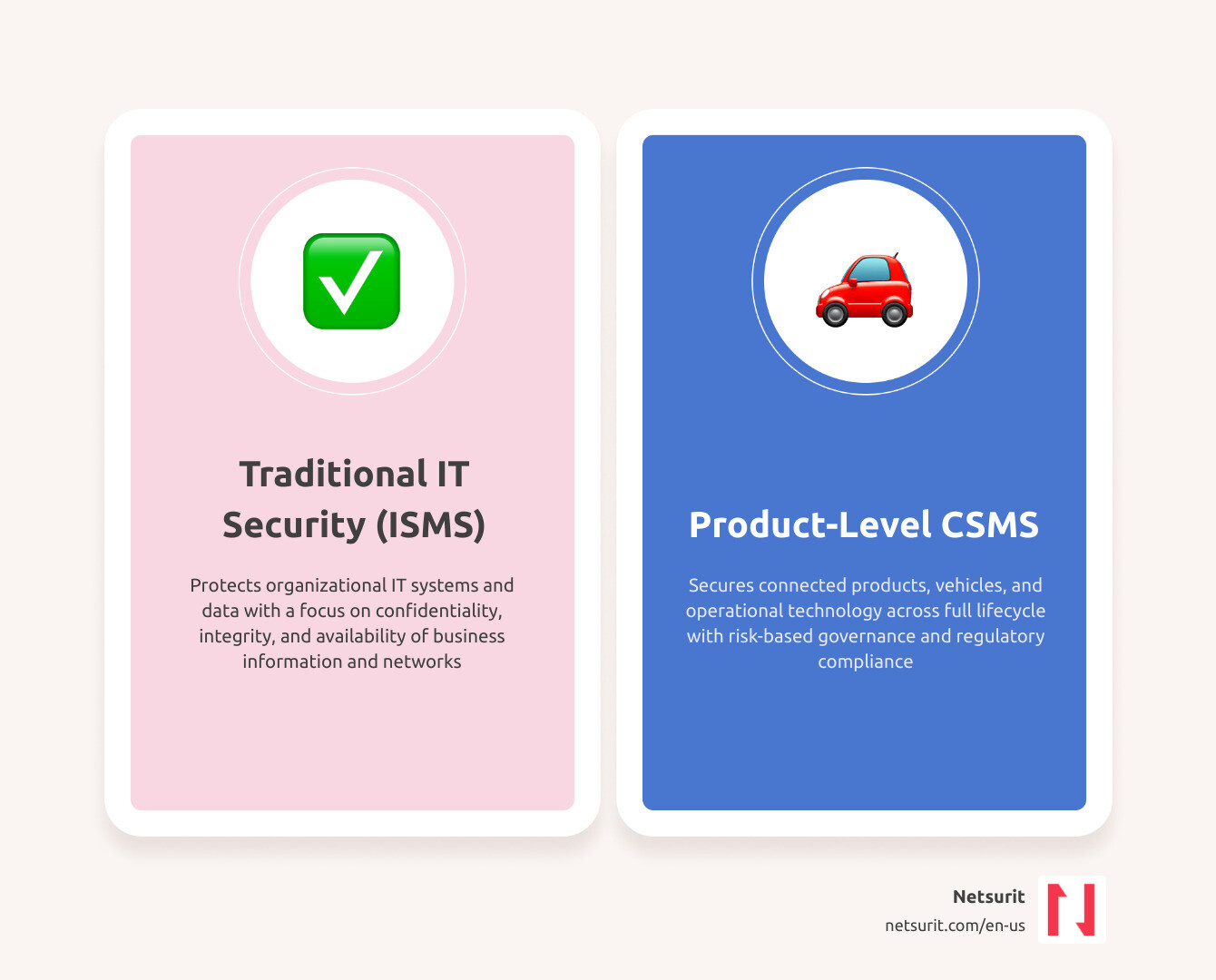
While an Information Security Management System (ISMS)—such as one built on ISO 27001—focuses on protecting an organization’s internal IT systems and data assets, a CSMS focuses on the actual products, operational technology (OT), and vehicles produced or operated by that organization.
| Dimension | Traditional ISMS (e.g., ISO 27001) | CSMS (e.g., UN R155 / ISO 21434) |
|---|---|---|
| Primary Target | Corporate networks, servers, databases, and employee endpoints. | Connected products, vehicle fleets, and operational technology (OT). |
| Core Objective | Maintain confidentiality, integrity, and availability of corporate data. | Ensure physical safety, operational resilience, and product integrity. |
| Lifecycle Scope | Ongoing business operations and enterprise IT systems. | From initial concept, design, and production to active operation and decommissioning. |
| Threat Impact | Financial loss, reputational damage, and regulatory fines. | Physical accidents, loss of life, supply chain disruption, and fleet-wide shutdowns. |
Core Components and Lifecycle Phases of a Modern CSMS
A functional CSMS must cover every phase of a product’s life. You cannot simply build a secure product, ship it, and assume the job is done. The system must actively monitor for new vulnerabilities until the very last unit is decommissioned.
To manage this complex lifecycle efficiently, organizations utilize specialized compliance tools. Platforms like the CyberManager | CSMS | Cyber Security Management System help teams link risk assessments directly to technical controls, tracking tasks across multiple development stages in a single system of record.
The Four Pillars of UN R155 Compliance
To secure regulatory type approval, a CSMS must stand on four distinct pillars defined by UN R155:
- Risk Management: The organization must establish systematic processes to identify, assess, and treat cyber risks. This is achieved through a structured Cyber Risk Assessment that models potential threat vectors and calculates their impact.
- Vehicle and System Safeguarding: Implementing technical defenses throughout the supply chain to protect systems from unauthorized access or manipulation.
- Incident Response: Setting up a dedicated Product Security Incident Response Team (PSIRT) to monitor active threats, analyze security events, and coordinate rapid mitigation.
- Remote Software Updates: Integrating a Software Update Management System (SUMS) to ensure that security patches are delivered over-the-air safely, securely, and without interrupting critical operations.
Managing the Lifecycle: From Concept to Post-Production Operations
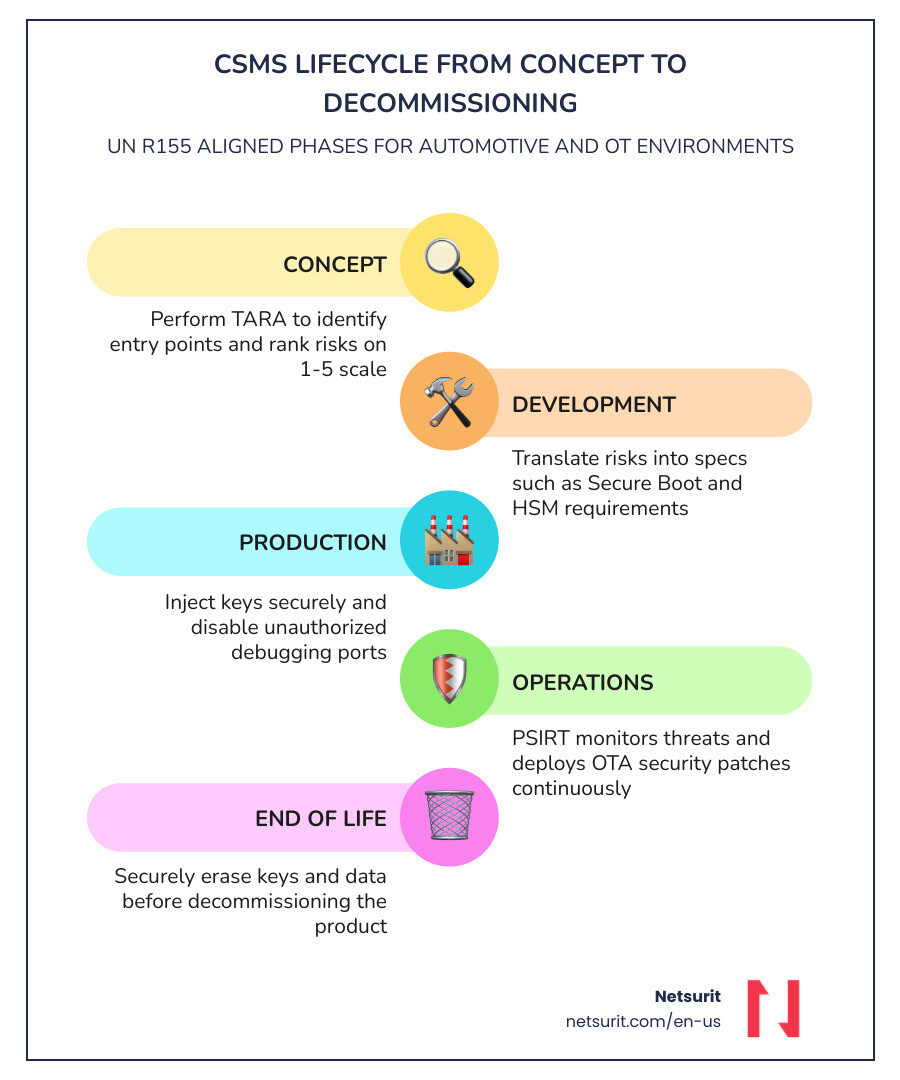
To visualize how these phases work, let’s look at a practical lifecycle breakdown:
- Concept Phase: Engineers perform a Threat Analysis and Risk Assessment (TARA). This process identifies potential entry points—such as cellular connections, Wi-Fi, or physical ports—and ranks risks on a scale of 1 to 5.
- Product Development: This phase translates TARA findings into concrete technical specifications. For example, developers might mandate that all firmware must use a cryptographic Secure Boot process backed by a Hardware Security Module (HSM).
- Production Control: Security measures are integrated into the manufacturing line. This ensures that cryptographic keys are injected securely and that no unauthorized debugging interfaces are left active on the hardware.
- Operations and Maintenance: Once the product is in the field, the PSIRT monitors threat intelligence feeds, handles vulnerability disclosure programs, and deploys security patches.
- End of Life: The product is decommissioned securely, ensuring that stored cryptographic keys and user data are completely erased.
A Local Example: Consider a CPA and advisory firm in Katy, Texas, that develops a proprietary tax planning application for its high-net-worth clients. During the Concept Phase, the firm’s developers identify that the document upload portal is a high-risk entry point. During Product Development, they implement multi-factor authentication and automated malware scanning. During Operations, their security team continuously monitors log files for brute-force attacks, deploying immediate updates when new web-based vulnerabilities are discovered.
Standards Alignment: ISO/SAE 21434, IEC 62443, and NIST CSF
No organization should build a CSMS from scratch. Instead, they should align their processes with established international standards that act as the structural framework for compliance.
To navigate these overlapping requirements, many enterprises rely on strategic frameworks like CSM | Strategic Cybersecurity, Governance & NIS2 Compliance to align their local operational practices with international governance standards.
Implementing a CSMS Cyber Security Management System in Automotive and OT Environments
For automotive manufacturers and their Tier-1 suppliers, ISO/SAE 21434 is the gold standard. Released in 2021, it provides the detailed engineering requirements needed to satisfy UN R155. It defines how to establish a cybersecurity culture, manage project-level risks, and perform continuous verification and validation.
In industrial and operational technology (OT) environments, IEC 62443 serves a similar purpose. It focuses on securing industrial automation and control systems (IACS). Whether you are managing a manufacturing execution system in Conroe, Texas, or a water treatment plant, IEC 62443 provides the framework to segment networks, secure controllers, and manage supply chain risks.
Technology Neutrality vs. Prescriptive Frameworks like PCI DSS
Unlike prescriptive standards like the Payment Card Industry Data Security Standard (PCI DSS)—which mandates specific technical rules like rotating passwords every 90 days—a CSMS is intentionally technology-neutral.
A technology-neutral approach does not tell you how to secure a system; it tells you what objectives your processes must achieve. This design is critical because technology evolves faster than regulations. If a standard mandated a specific encryption algorithm, that standard would become obsolete the moment that algorithm was cracked. A CSMS forces you to continuously assess and update your defenses, making it highly adaptable to emerging threats like quantum computing or AI-driven exploits.
Trade-Offs of Implementing a CSMS Framework
While a CSMS offers unparalleled flexibility, it comes with distinct operational realities:
- Works best when: Organizations have complex, long-lifecycle products or operational environments that must adapt to evolving global regulations.
- Avoid when: You are a small business with basic IT needs that can be fully covered by standard, prescriptive security checklists.
- Risks: The lack of prescriptive rules can lead to “analysis paralysis” or insufficient technical controls if your internal risk assessment processes are weak.
- Mitigations: Partner with experienced cybersecurity consultants to validate your risk-modeling assumptions and audit your engineering workflows against standards like ISO/SAE 21434.
Frequently Asked Questions About CSMS Compliance
Who is required to implement a CSMS?
Automotive OEMs and Tier-1 suppliers selling into UN R155-regulated markets must implement a CSMS. Additionally, maritime operators (under ClassNK and similar guidelines) and critical infrastructure operators managing industrial control systems under NIS2 or IEC 62443 frameworks require these systems to maintain operational compliance.
How often must a CSMS certification be renewed?
Under UN R155, a CSMS certificate of compliance must be assessed and renewed at least every three years. However, the underlying risk assessments and threat monitoring must run continuously to address new vulnerabilities as they emerge in the field.
What are the consequences of non-compliance for suppliers?
Tier-1 and Tier-2 suppliers who cannot demonstrate a mature CSMS lose business to compliant competitors. For OEMs, non-compliance means a denial of vehicle type approval, preventing them from selling their vehicles in 59 major countries.
Securing Your Operational and Compliance Frameworks
Implementing a csms cyber security management system is a complex, multi-departmental challenge. It requires close collaboration between executive leadership, product engineering, supply chain managers, and IT security teams.
At Netsurit, we act as an elite technology partner for mid-market and enterprise organizations across New York, New Jersey, Texas, and Washington. We provide the managed IT, Cybersecurity, and compliance consulting needed to align your operational workflows with modern regulatory standards. Whether you are securing a local supply chain in Houston or managing complex compliance frameworks across multiple states, our team is built to help you mitigate risks, eliminate operational downtime, and scale your business with confidence.
What to watch next: As we move further into 2026, keep a close eye on the integration of AI-driven threat modeling within CSMS workflows, which is expected to automate up to 40% of standard vulnerability analysis by 2028.
If you need help building, auditing, or managing your cybersecurity compliance framework, contact Netsurit today to speak with a senior security advisor.