
What an IT Services and Solutions Provider Actually Does (and Why It Matters)
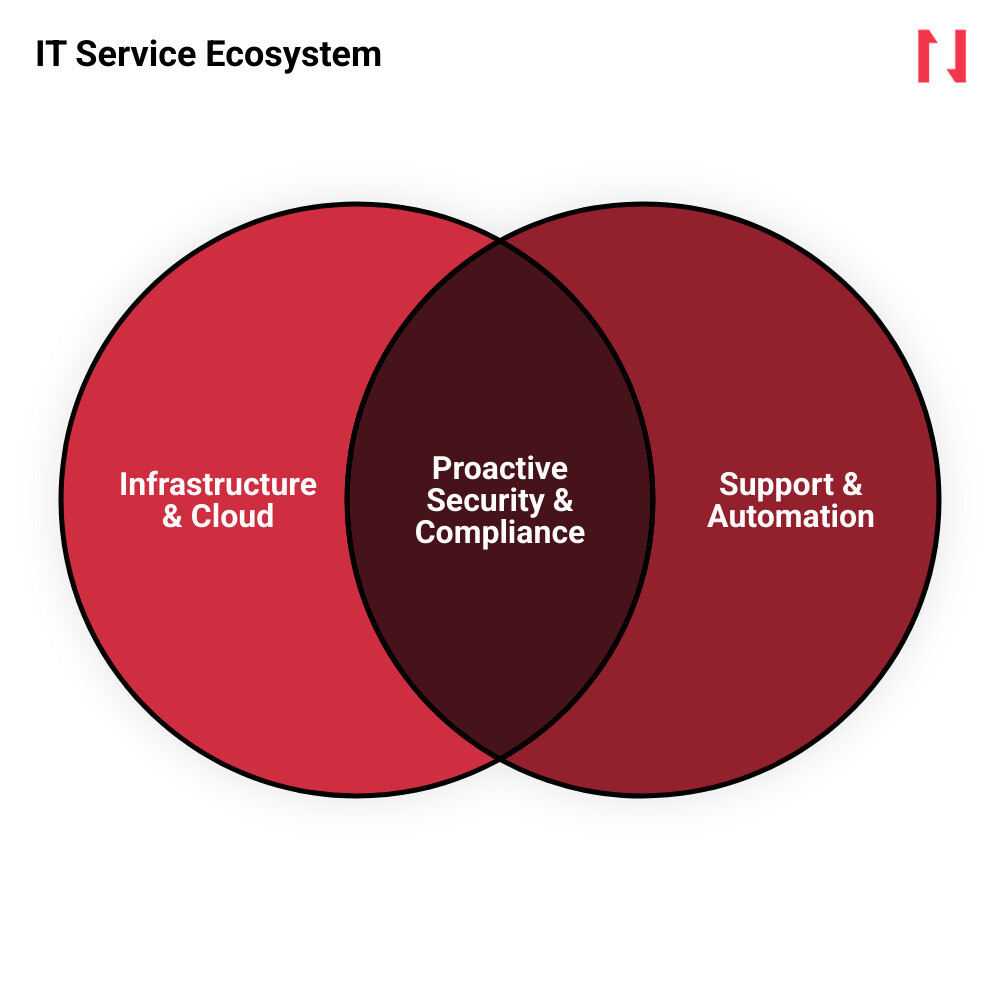
An IT services and solutions provider is a company that manages your technology infrastructure so your team can focus on running the business — not fighting fires.
Here’s a quick breakdown of what they do:
| What They Handle | Why It Matters to You |
|---|---|
| Infrastructure management | Keeps systems running with minimal downtime |
| Cybersecurity monitoring | Detects and stops threats before they cause damage |
| Cloud services | Scales your capacity without large upfront costs |
| Compliance support | Keeps you aligned with regulations like HIPAA, SOX, and GLBA |
| Help desk and end-user support | Resolves employee issues fast so productivity stays high |
| AI and automation integration | Reduces manual work and speeds up decision-making |
| Disaster recovery and backup | Protects your data if something goes wrong |
The core value is simple: stop reacting to IT problems and start preventing them.
Managing IT in-house sounds controllable — until it isn’t. Cyberattacks now occur every 11 seconds. Sixty-one percent of small and mid-sized businesses are hit each year. And 60% of those that suffer a breach close within six months. That’s not a technology statistic. That’s a business survival statistic.
Most mid-market firms don’t have the budget for a full internal security team, a cloud architect, a compliance officer, and a help desk. A qualified IT provider gives you all of that under one accountable partner — without the overhead.
The catch? Not all providers are equal. Some are reactive. Some specialize in one area and patch the rest together. Choosing the wrong one is just as dangerous as having no support at all.
This guide cuts through the noise. It covers what IT providers actually deliver, how to compare support models, what to look for when vetting a partner, and what measurable outcomes you should expect.
I’m Orrin Klopper, CEO and co-founder of Netsurit — a global IT services and solutions provider I started in 1995 and have grown to support over 300 organizations across North America, South Africa, and Europe. Over the past 30 years, I’ve seen what separates providers that stabilize and scale businesses from those that slow them down.
Discover more about it services and solutions provider:
- global it solutions provider
- it managed service providers platform
How Modern IT Providers Streamline Infrastructure and Reduce Downtime
To keep your business running smoothly, you need more than a technician who shows up only when a server crashes. Modern technology management requires ongoing maintenance, rigorous testing, and strategic foresight.
By partnering with an experienced provider, you gain access to comprehensive Professional IT Services. These services begin with a deep evaluation of your existing infrastructure, identifying hidden bottlenecks and security gaps before they disrupt your workflows. From there, your provider handles technology deployment, employee training, and continuous system maintenance. This ensures your hardware, software, and networks operate as a single, cohesive unit.
Defining the Modern IT Partner: Beyond Basic Troubleshooting
The traditional break-fix model is dead. In the past, businesses called an IT guy only when something broke. This model aligns the provider’s financial incentives with your failure—they only make money when your business suffers downtime.
A true it services and solutions provider operates on a proactive model. Instead of waiting for systems to fail, we continuously monitor your technology domains to prevent issues entirely. This shift from reactive support to strategic alignment means we customize software, integrate legacy platforms, and optimize workflows to match your business goals.
By looking at your entire technology stack, we transform IT from a frustrating cost center into a reliable driver of growth. You can explore how these integrated capabilities support your operations by viewing our All Services overview.
Comparing Support Models: Fully Managed, Co-Managed, and Internal IT
Every business has different resource constraints and technical requirements. To help you evaluate which path fits your organization, we have compared the three primary support models below:
| Metric | Fully Managed IT | Co-Managed IT | Internal IT |
|---|---|---|---|
| Cost Predictability | High (Flat monthly fee) | High (Predictable split fee) | Low (Variable hiring, training, and tool costs) |
| Security Coverage | 24/7/365 monitoring | 24/7/365 shared monitoring | Limited to standard business hours |
| Scalability | Instant (Scale resources up or down) | High (Co-managed scaling) | Slow (Requires hiring and onboarding) |
| Strategic Alignment | High (Dedicated virtual CIO) | Collaborative strategic planning | Often bogged down by daily support tickets |
Choosing the right approach depends on your existing staff. For instance, consider a CPA firm in Sugar Land, Texas. During the peak of tax season, their single internal IT administrator is completely overwhelmed resetting passwords and troubleshooting local printer issues. Under a Managed IT Services co-managed model, an external partner steps in to secure their client portals and manage back-end server performance. This setup delivers 99.9% uptime, freeing the internal admin to focus on direct staff support.
Trade-offs: Managed Services vs. Internal IT
- Works best when: You require predictable monthly budgeting, need 24/7/365 security monitoring, and cannot afford unexpected operational downtime.
- Avoid when: Your internal IT department is already fully staffed, possesses deep cybersecurity expertise, and experiences zero coverage or support gaps.
- Risks: Over-reliance on an external partner can lead to communication gaps if clear operational boundaries are not set.
- Mitigations: Establish comprehensive Service Level Agreements (SLAs) and maintain co-owned, transparent system documentation.
Navigating the 2026 IT Landscape: AI, Cloud, and Proactive Security
The technology landscape in June 2026 is defined by rapid AI integration, cloud complexity, and sophisticated cyber threats. To remain competitive, businesses must adapt to these trends rather than relying on outdated software and infrastructure.
Leveraging AI-Driven Automation and Next-Gen Infrastructure for Growth
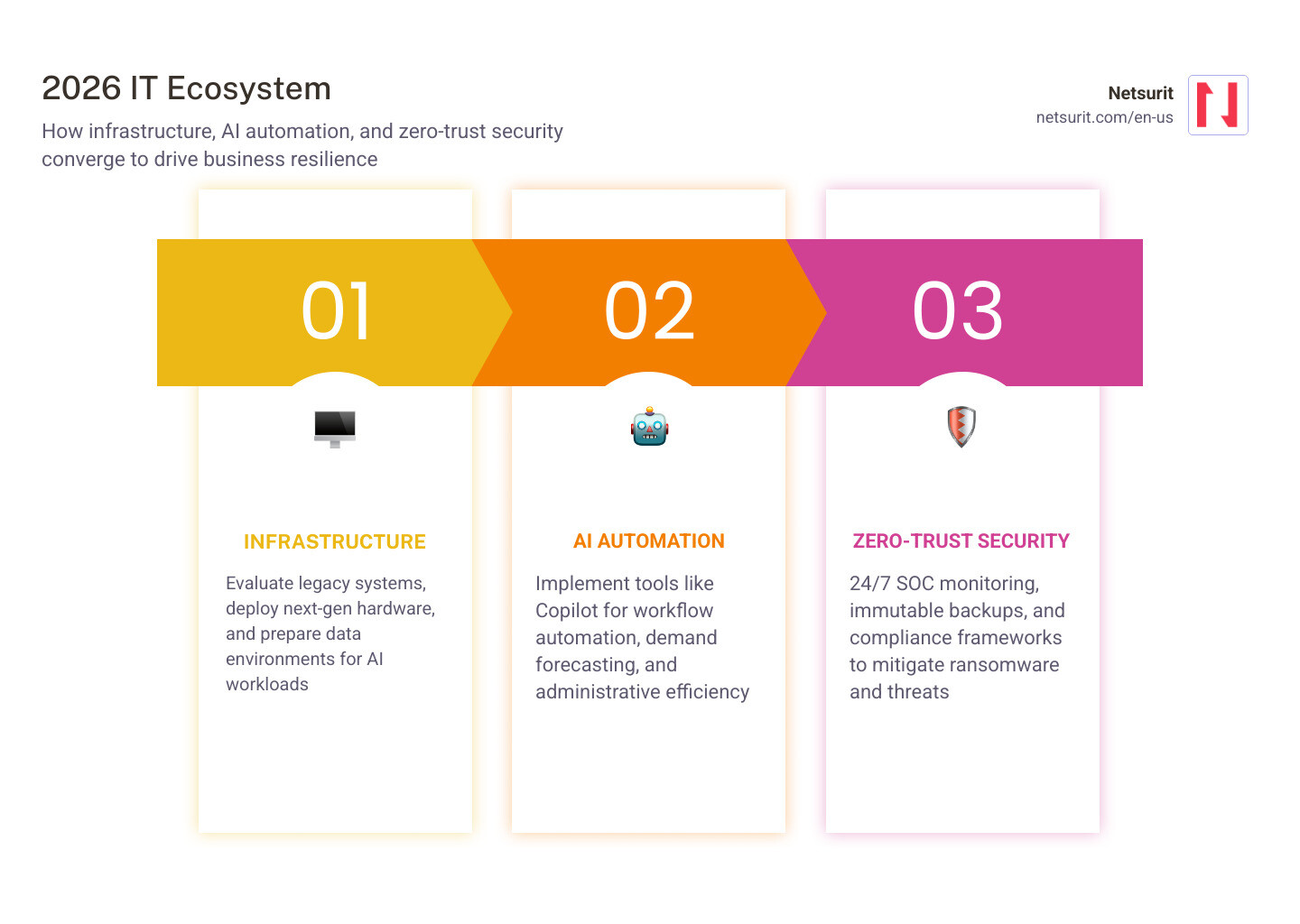
Artificial intelligence is no longer a futuristic concept; it is actively shaping how modern businesses operate. Leading IT providers help organizations cut through the hype to select, deploy, and manage practical AI solutions.
Whether you are deploying Microsoft Copilot to automate administrative work or integrating demand forecasting models to optimize supply chains, we help you build the right foundation. This includes preparing your data environment, securing user access, and deploying next-generation devices optimized for AI workloads.
By utilizing our tailored Cloud Services, you can transition from chaotic manual processes to automated workflows. To see how specialized enterprise platforms can be structured, businesses often look to advanced integrations such as Microsoft Dynamics ERP & CRM Solutions.
Securing Operations with Proactive Threat Detection and Compliance Frameworks
As technology advances, so do the methods used by cybercriminals. Relying on basic antivirus software is no longer sufficient when a cyberattack occurs every 11 seconds. With 61% of small and mid-sized businesses falling victim to attacks annually, and 60% of those businesses failing within six months of a breach, robust security is non-negotiable.
An effective it services and solutions provider integrates security into every layer of your network. This involves maintaining strict cyber hygiene, establishing 24/7 Security Operations Center (SOC) monitoring, and deploying rapid ransomware mitigation tools.
Additionally, we ensure your infrastructure complies with industry regulations like SOX, HIPAA, and GLBA. By combining proactive threat hunting with automated patching and immutable backups, we protect your business from catastrophic data loss.
To safeguard your organization, explore our Cybersecurity Services and establish robust Backup and Disaster Recovery protocols.
For example, an accounting firm in Katy, Texas, managing sensitive financial records, cannot risk a ransomware infection. By partnering with a local specialist to implement 24/7 SOC monitoring and off-site immutable backups, the firm ensures that even if a malicious link is clicked, their data remains secure and recoverable within minutes.
Selecting an IT Partner That Aligns with Your Business Goals
Choosing an IT partner is a critical business decision. The right provider acts as an extension of your team, aligning technology with your long-term growth strategy.
Why Specialized IT Providers Outperform Generalists in Complex Industries
Generalist IT providers often struggle with the unique regulatory and operational demands of specialized industries. A provider with deep technical excellence and industry-specific experience understands how to navigate complex compliance frameworks and integrate specialized software.
By combining national capabilities with a personalized, local touch, we deliver enterprise-grade security without corporate complexity. Whether you need fully outsourced management or co-managed support to assist your internal team, our IT Consulting Services provide the strategic direction you need.
For tax and accounting firms in the Houston metro area, maintaining compliance requires strict adherence to federal standards. Working with a partner who understands these mandates ensures your systems align with the IRS Protect Your Clients; Protect Yourself guidelines, safeguarding taxpayer data from unauthorized access.
Vetting Providers: Key Evaluation Criteria and Red Flags to Avoid
When evaluating potential IT partners, look beyond their marketing claims. Ask for verified client reviews, review their standard Service Level Agreements (SLAs), and ask about their response times. A reputable provider should maintain a standardized technology catalog based on rigorous testing, while still offering vendor-agnostic guidance that prioritizes your business needs over specific software partnerships.
Before signing an agreement, it is wise to conduct comprehensive IT Audits and Assessments to identify existing vulnerabilities. For example, a tax office in Conroe, Texas, should audit its legacy server infrastructure before the busy season begins. This proactive step exposes compliance gaps, outdated software, and network bottlenecks, allowing you to address them before they impact your clients.
Trade-offs: Co-Managed IT vs. Fully Managed IT
- Works best when: You have an existing internal IT team that is capable but needs specialized security monitoring, cloud migration assistance, or help desk relief.
- Avoid when: You have no internal IT personnel, as there will be no internal technical point of contact to coordinate with the provider.
- Risks: Potential overlap in responsibilities, leading to duplicated efforts or missed tasks due to poor communication.
- Mitigations: Establish a detailed RACI (Responsible, Accountable, Consulted, Informed) matrix to clearly define roles for both teams.
Measuring Success: Real-World Cost Optimization and Security Outcomes
Investing in IT services should deliver clear, measurable business value. A successful partnership focuses on reducing complexity, optimizing operational costs, and strengthening your security posture.
Maximizing ROI Through Cloud Cost Optimization and Software Consolidation
Many organizations overspend on cloud infrastructure due to poor configuration and redundant software licenses. A professional IT provider conducts thorough cloud cost assessments to identify waste and optimize compute resources.
By consolidating your software purchasing and streamlining licensing processes, we can significantly lower your operational and compliance costs. These optimizations allow you to transition capital expenditures (CapEx) into predictable operating expenses (OpEx).
If you are planning to modernize your infrastructure, our Cloud Migration services ensure a seamless transition.
- Real-World Impact: In the enterprise space, comprehensive cloud optimization assessments have identified opportunities to reduce compute costs by up to 70%, saving organizations as much as $170,000 monthly. Additionally, consolidating software licensing and purchasing processes has helped large entities lower their compliance and software costs to a structured $5 million.
Eliminating Vulnerabilities Through Infrastructure Modernization
Outdated software and legacy hardware are primary targets for cybercriminals. By modernizing your network infrastructure, you eliminate security vulnerabilities while boosting overall system performance.
Implementing zero-touch provisioning and modern endpoint management allows your team to deploy secure devices to employees in weeks rather than months. To align your technology with your business goals, utilize our strategic IT Strategy Services.
- Real-World Impact: Upgrading legacy network infrastructure can increase system performance significantly, saving organizations up to 30% compared to outdated, high-maintenance solutions. Furthermore, proactive assessments that identify and eliminate end-of-life software have successfully removed hundreds of vulnerabilities—such as purging 689 instances of end-of-life software in a single environment—to secure the network against modern exploits.
Frequently Asked Questions about IT Service Providers
What is the difference between fully managed IT and co-managed IT?
Fully managed IT is a complete outsourcing model where the external IT provider acts as your entire IT department. We handle everything from basic help desk support to high-level cybersecurity and strategic planning.
Co-managed IT is a collaborative model where we partner with your existing internal IT team. Your internal staff typically manages day-to-day tasks like password resets, while we handle complex, high-liability operations such as 24/7/365 SOC monitoring, compliance documentation, and advanced cloud architecture.
How do IT providers structure their pricing?
Most modern IT providers offer predictable, flat-fee monthly pricing models. This approach eliminates unpredictable hourly billing and aligns our goals with yours—since we charge a flat fee, it is in our interest to keep your systems running perfectly. This flat-fee model helps convert unpredictable capital IT expenses (CapEx) into predictable, monthly operational expenses (OpEx).
What are the immediate steps an IT provider takes in the first 30 days?
During the first 30 days, a professional provider focuses on discovery and risk mitigation:
- Comprehensive Security Assessment: We audit your existing network, endpoints, and cloud configurations to find active vulnerabilities.
- Risk Prioritization: We identify and document critical vulnerabilities that require immediate patching.
- IT Roadmap & Strategy: We build an 18-to-24-month technology roadmap and budget aligned with your business goals.
- Technology Catalog Alignment: We begin standardizing your systems to ensure reliable, scalable support.
Conclusion
Selecting the right it services and solutions provider is a strategic business decision, not just an operational one. The right partner protects your business from evolving cyber threats, optimizes your technology spend, and ensures your infrastructure scales alongside your growth.
At Netsurit, we act as an elite tech partner for mid-market businesses. Operating across New York, New Jersey, Texas (including Houston, Sugar Land, Conroe, and Katy), Seattle, Tacoma, Maine, and Albuquerque, we provide managed IT, cybersecurity, and AI solutions designed to eliminate downtime and drive business momentum.
Ready to secure and scale your business infrastructure? Contact us today to explore our Managed IT Services and find the right solution for your organization.