
Your Data Is Worthless Without a Strategy to Transform It
A data transformation strategy is the structured plan that determines how your organization collects, processes, and converts raw data into formats your teams can actually use to make decisions.
If you want the short answer on what it covers:
| Component | What It Means |
|---|---|
| Data alignment | Connecting data goals to business outcomes |
| Technical approach | Choosing ETL, ELT, or hybrid pipelines |
| Governance | Enforcing quality, security, and compliance |
| Culture | Building teams that trust and use data |
| Measurement | Tracking ROI, accuracy, and adoption |
Every second, your business generates data — from client records and transactions to operational logs. But businesses generate 2.5 quintillion bytes of data daily, and 90% of it remains unstructured and unusable. That gap between data volume and data value is where most organizations lose ground.
The cost is real. Research shows that successful data transformations realize only 67% of their financial potential — with value lost during target-setting and execution. Meanwhile, companies that execute well on data-driven transformation are 26% more profitable and carry a 12% higher market valuation than peers who don’t.
This is not a data problem. It is a strategic one.
For business leaders managing complex IT environments — especially those running accounting, finance, or professional services operations — the gap between raw data and reliable intelligence creates direct risks: slow decisions, compliance exposure, and systems that fight each other instead of working together.
This guide walks you through each step of building a data transformation strategy that works in 2026: from choosing the right pipeline architecture to governing sensitive data and measuring real ROI.
I’m Orrin Klopper, CEO and co-founder of Netsurit, and over nearly three decades of helping businesses modernize their IT and data infrastructure, I’ve seen how a well-executed data transformation strategy separates firms that scale confidently from those that stay stuck in reactive mode. I’ll draw on that experience throughout this guide to give you practical, field-tested direction — not theory.
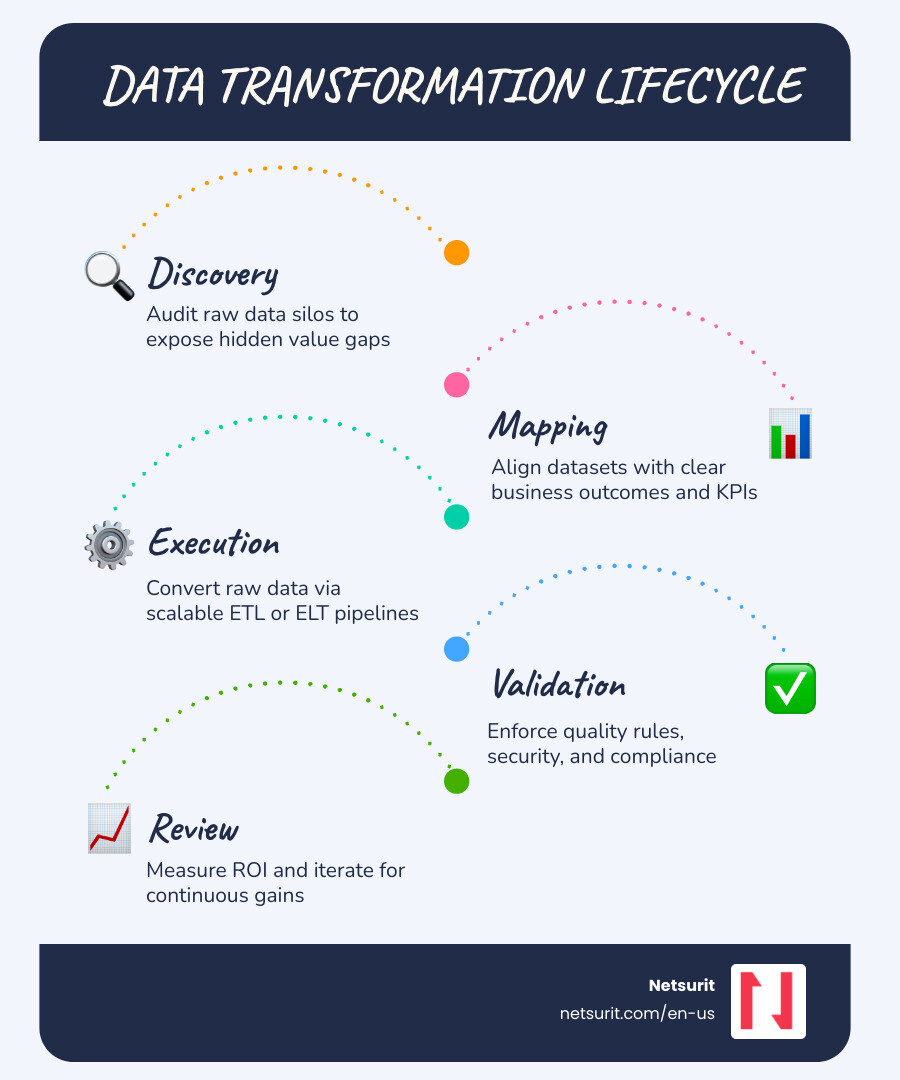
Defining Your Data Transformation Strategy for 2026
In May 2026, a data transformation strategy is no longer just about moving files. It is a comprehensive roadmap covering datasets, technology stacks, and team skills. To succeed, you must move beyond “collecting everything” and start “structuring with purpose.”
A modern Data Platform Modernization Strategy begins with a cold, hard look at your business goals. Are you trying to reduce the time it takes to close monthly books? Or are you looking to use AI to predict client churn? Your technical choices—how you convert raw data and profile your sources—must serve these specific outcomes. Without this alignment, you end up with a “data swamp” that costs money but provides zero clarity.
Why Traditional Management Fails Modern Accounting Firms
Traditional data management often relies on “siloed” data. In this old model, the tax department has its database, the audit team has theirs, and the payroll group uses a separate legacy system. These systems don’t talk to each other, leading to static reporting that is out of date the moment it hits your inbox.
The Houston Scenario: Consider a mid-sized accounting firm in Sugar Land. They are trying to reconcile legacy ERP data with a modern cloud-based tax engine. Because the data structures don’t match—one uses a MM/DD/YYYY date format while the other uses DD/MM/YY—the partners spend four hours every Friday manually fixing Excel sheets instead of advising clients. This is a failure of strategy, not software. Implementing a Digital Transformation Framework allows such firms to automate these reconciliations, turning hours of manual labor into seconds of automated processing.
Bridging the Gap Between Raw Data and AI Readiness
By 2026, the primary “customer” of your data isn’t just a human analyst; it’s an AI agent. AI requires highly structured, clean data to be effective. If you feed an AI “dirty” data, you get “garbage in, garbage out” (GIGO).
A robust data transformation strategy focuses on “feature engineering”—the process of using domain knowledge to create variables that help machine learning models work better. According to the AI Data Transformation Guide, this is the bridge to a competitive advantage. When your data is structured for usability, your firm can deploy AI agents that monitor audit risks in real-time, providing a level of service that legacy firms simply cannot match.
Technical Execution: Choosing Between ETL and ELT
The “how” of your data transformation strategy usually comes down to two acronyms: ETL and ELT. Choosing the wrong one can lead to massive cloud bills or sluggish performance.
| Feature | ETL (Extract, Transform, Load) | ELT (Extract, Load, Transform) |
|---|---|---|
| Process | Data is transformed before reaching the warehouse. | Data is loaded raw, then transformed inside the warehouse. |
| Best For | On-premises systems or sensitive data requiring pre-cleansing. | Large, unstructured datasets and cloud environments. |
| Speed | Slower ingestion; faster querying of clean data. | Faster ingestion; relies on cloud compute for transformation. |
| Flexibility | Rigid; you must define the structure upfront. | High; you can decide how to use the data later. |
For many of our clients in the Houston metro area, a hybrid approach often works best. You might use ETL for sensitive payroll data that must be masked before it hits the cloud, while using ELT for high-volume transaction logs. Referencing a Cloud Migration Checklist is vital here to ensure your staging areas and distributed processing engines are configured for maximum efficiency.
Selecting Tools for a Scalable Data Transformation Strategy
Modern tools have moved beyond manual scripting. We now see widespread use of:
- Apache Spark: For massive, parallel processing of complex data.
- AWS Glue: A serverless integration service that simplifies data preparation.
- Snowflake: A cloud data platform that excels at ELT workflows.
- dbt (data build tool): Allows data analysts to write transformation logic using simple SQL.
According to Snowflake’s guide on techniques and best practices, orchestration is the key. You need a system that automatically triggers transformations as soon as new data arrives, ensuring your dashboards are never more than a few minutes behind reality.
Trade-offs in Pipeline Architecture
Every architectural choice has a “so what?” factor. Here is how to weigh your options:
- Works best when: You are handling high-velocity streaming data (like real-time stock market feeds) or messy, unstructured client records that need AI-driven categorization.
- Avoid when: You are operating on-premises with limited compute resources. ELT will choke your local servers; stick to ETL to do the heavy lifting before storage.
- Risks: “Data drift” occurs when source systems change (e.g., a software update adds a new column), breaking your pipeline. Cloud environments also carry the risk of cost overruns if transformations aren’t optimized.
- Mitigations: Use automated observability tools to alert you the moment a pipeline fails. Implement “FinOps” monitoring to track exactly how much each transformation job costs in cloud credits.
Governance and Security: Protecting Houston’s Financial Data
In the accounting world, data isn’t just information; it’s a liability if mishandled. Your data transformation strategy must include “private-by-default” settings. As noted in our Digital Transformation Report, governance is a precondition for migration, not a “clean-up” task you do later.
Ensuring Quality in Your Data Transformation Strategy
Data quality is the foundation of trust. If a partner doesn’t trust the dashboard, they’ll go back to their “shadow” Excel sheets.
- Normalization: Ensuring “IBM,” “I.B.M.,” and “International Business Machines” are all recorded as a single entity.
- Deduplication: Removing the three different entries for the same client that exist because of a typo in the CRM.
- Validation Rules: Setting up “gatekeepers” that reject any data that doesn’t meet specific criteria (e.g., a tax ID must have 9 digits).
Using best practices for data transformation involves implementing schema registries. These act as a “contract” between your systems, ensuring that if the source data changes, the transformation process doesn’t quietly produce incorrect results.
Compliance Guardrails for Tax and Accounting
For firms in Katy or Conroe, 2026 brings tighter enforcement of HIPAA (for healthcare clients) and PCI DSS (for retail clients).
The Katy Scenario: A local accounting firm automates the ingestion of client medical billing data. Their data transformation strategy includes an automated “masking” step. Before the data is stored for analysis, all Personally Identifiable Information (PII) like social security numbers and names are encrypted or replaced with tokens. This ensures that even if a data breach occurs, the sensitive client information remains unreadable, keeping the firm in compliance with 2026 regulations.
Cultural Shift: Upskilling Teams for Data-Driven Decisions
You can have the most expensive tools in Texas, but if your staff doesn’t know how to interpret a data visualization, the investment is wasted. Building a data-driven culture requires breaking down the silos between the “IT people” and the “business people.”
Fostering Collaboration Between IT and Business Leaders
We advocate for multidisciplinary teams. A tax manager should be in the room when a data engineer builds a pipeline. Why? Because the tax manager knows that “Revenue” in one system might include sales tax, while in another, it doesn’t.
To drive digital transformation in Houston, start with “quick wins.” Don’t try to transform the whole firm at once. Pick one painful process—like 1099 processing—and apply a focused data transformation strategy to it. When the team sees they’ve saved 40 hours of work, they will become your biggest advocates for the next phase.
Training for the 2026 AI-Driven Economy
By 2026, “basic computer skills” include understanding how to prompt an AI and how to spot data bias.
- Apprenticeships: Pair junior staff with data leads to learn hands-on transformation techniques.
- Bootcamps: Short, intensive workshops on SQL or data visualization tools like Power BI.
- Statistical Methods: Teaching staff not just what the data says, but why it might be misleading (e.g., understanding sample sizes).
Measuring ROI and Avoiding the 67% Value Trap
As we mentioned, many firms lose 33% of the potential value of their data projects. This usually happens because they don’t define what “success” looks like before they start.
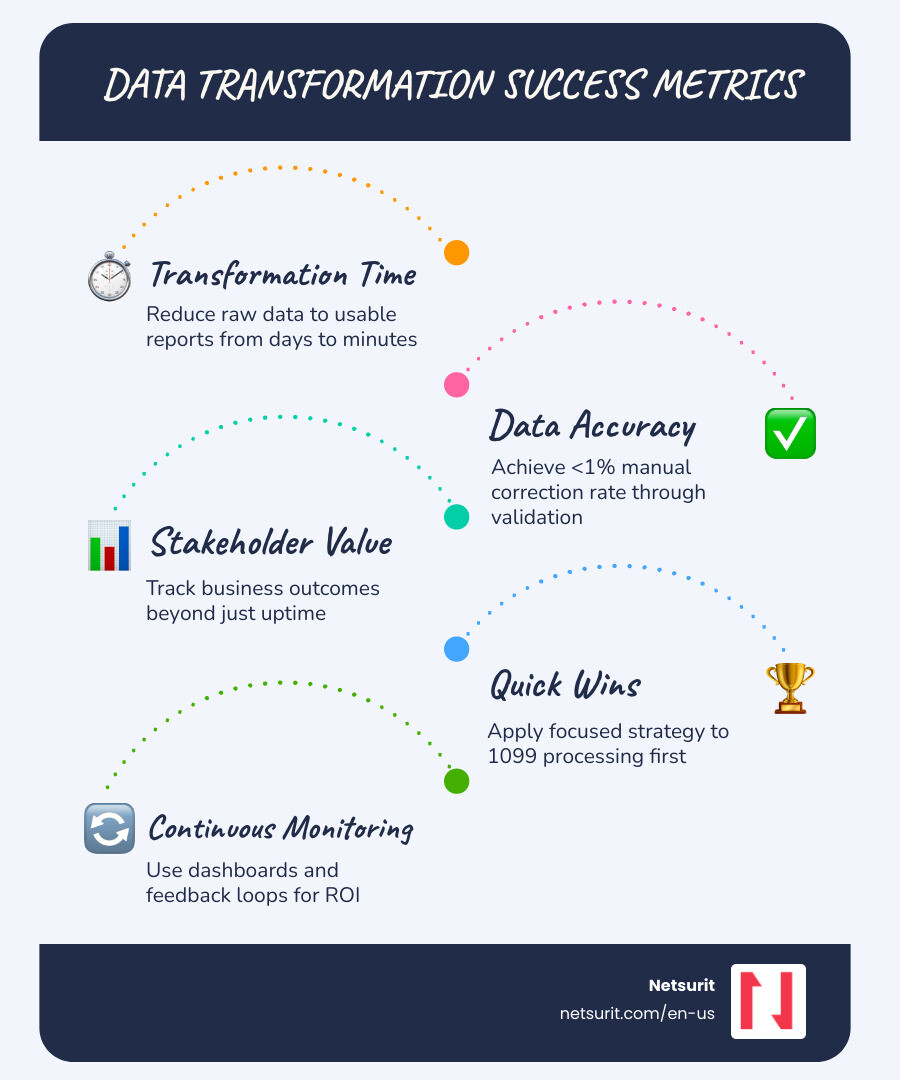
Tracking Metrics That Matter to Stakeholders
Don’t just track technical metrics like “uptime.” Track business outcomes:
- Transformation Time: How long does it take for raw data to become a usable report? (Target: Minutes, not days).
- Data Accuracy: What percentage of records require manual correction? (Target: <1%).
- User Adoption: How many staff members are actually logging into the data platform daily?
- ROI Calculation: Compare the cost of the data platform against the billable hours saved through automation.
According to Number Analytics, firms that track these KPIs enjoy a significantly higher market valuation because their operations are “transparent” and scalable.
Continuous Improvement and Scalability
A data transformation strategy is not a “one and done” project. It is a loop. As your firm grows—perhaps expanding from Houston to Albuquerque—your infrastructure must be ready to scale.
- Infrastructure Readiness: Use cloud-native tools that can handle a 10x increase in data volume without crashing.
- Monitoring Dashboards: Build internal dashboards that track the health of your data pipelines.
- Feedback Loops: Regularly ask your accountants: “Is this data helping you advise your clients better?” Use their answers to refine your transformation rules.
Frequently Asked Questions about Data Transformation
What is the difference between data transformation and data migration?
Data migration is essentially “moving house”—you take your data from System A and put it in System B, usually without changing it much. Data transformation is “renovating the house”—you change the format, clean the records, and restructure the information so it is actually useful for modern analytics.
How long does a typical transformation project take in 2026?
Small, focused pipelines for a single department can be up and running in 2 to 8 weeks. However, an enterprise-wide modernization for a Houston-based accounting firm—covering all departments and legacy systems—typically spans 3 to 6 months to ensure proper governance and testing.
Can data transformation be fully automated?
Mostly, yes. In 2026, AI tools can suggest how to map data from one system to another and even write the transformation code. However, “human-in-the-loop” review is essential, especially for financial firms. A human must still validate that the transformation logic aligns with accounting standards and regulatory requirements.
Conclusion
At Netsurit, we believe that being an “elite tech partner” means more than just fixing broken computers. It means helping you turn your data into a momentum-building asset. A successful data transformation strategy requires a delicate balance: you need the technical “muscle” of ELT pipelines, the “shield” of rigorous governance, and the “brain” of a data-literate culture.
The “what to watch next” for 2026 is the rise of Agentic AI—AI that doesn’t just answer questions but takes actions across your systems. These agents will only be as good as the data transformation pipelines that feed them.
Start your journey by auditing your current data silos. Identify exactly where your firm is losing time to manual data entry or “dirty” records. That is where your financial potential is leaking—and that is where your transformation should begin.
Learn more about digital transformation accounting and how to secure your firm’s future.