
The Best App Development Courses in 2026: A Quick Guide for Business Leaders
If you’re evaluating the best app development courses available right now, here’s a direct answer before we go deeper:
Top App Development Courses in 2026
| Course | Platform | Focus | Level |
|---|---|---|---|
| iOS & Swift Complete Bootcamp (Dr. Angela Yu) | Udemy | Native iOS | Beginner–Intermediate |
| Meta Android Developer Certificate | Coursera | Native Android | Beginner |
| IBM iOS & Android Developer Certificate | Coursera | Cross-platform | Beginner |
| Android Basics with Compose | Native Android | Absolute Beginner | |
| Flutter & Dart: The Complete Guide | Udemy | Cross-platform | Beginner–Intermediate |
| CS50’s Mobile App Dev with React Native | edX/Harvard | Cross-platform | Intermediate |
| Codecademy iOS Developer Path | Codecademy | Native iOS | Beginner |
Mobile apps are no longer a nice-to-have. They’re how your clients, customers, and staff expect to interact with your business. Smartphone users are projected to grow by 1.5 billion — more than 30% — by 2029. That means businesses that build capable, reliable mobile apps now will have a real edge over those that don’t.
But picking the right course to get there is harder than it looks. The options range from free Google training to 14-course professional certificates from IBM and Meta. Some teach native iOS with Swift. Others focus on Android with Kotlin. Many cover cross-platform frameworks like Flutter or React Native. Each path has real trade-offs in time, depth, and career outcomes.
This guide cuts through the noise. It compares the top courses by platform, depth, cost, and what you’ll actually be able to build when you’re done.
I’m Orrin Klopper, CEO and co-founder of Netsurit — a global IT services and digital transformation company — and my 30 years of experience helping businesses modernize their technology has shown me why choosing the right foundation matters when pursuing the best app development courses. Whether you’re developing internal tools, client portals, or customer-facing apps, the course you choose shapes the quality of what you ship.
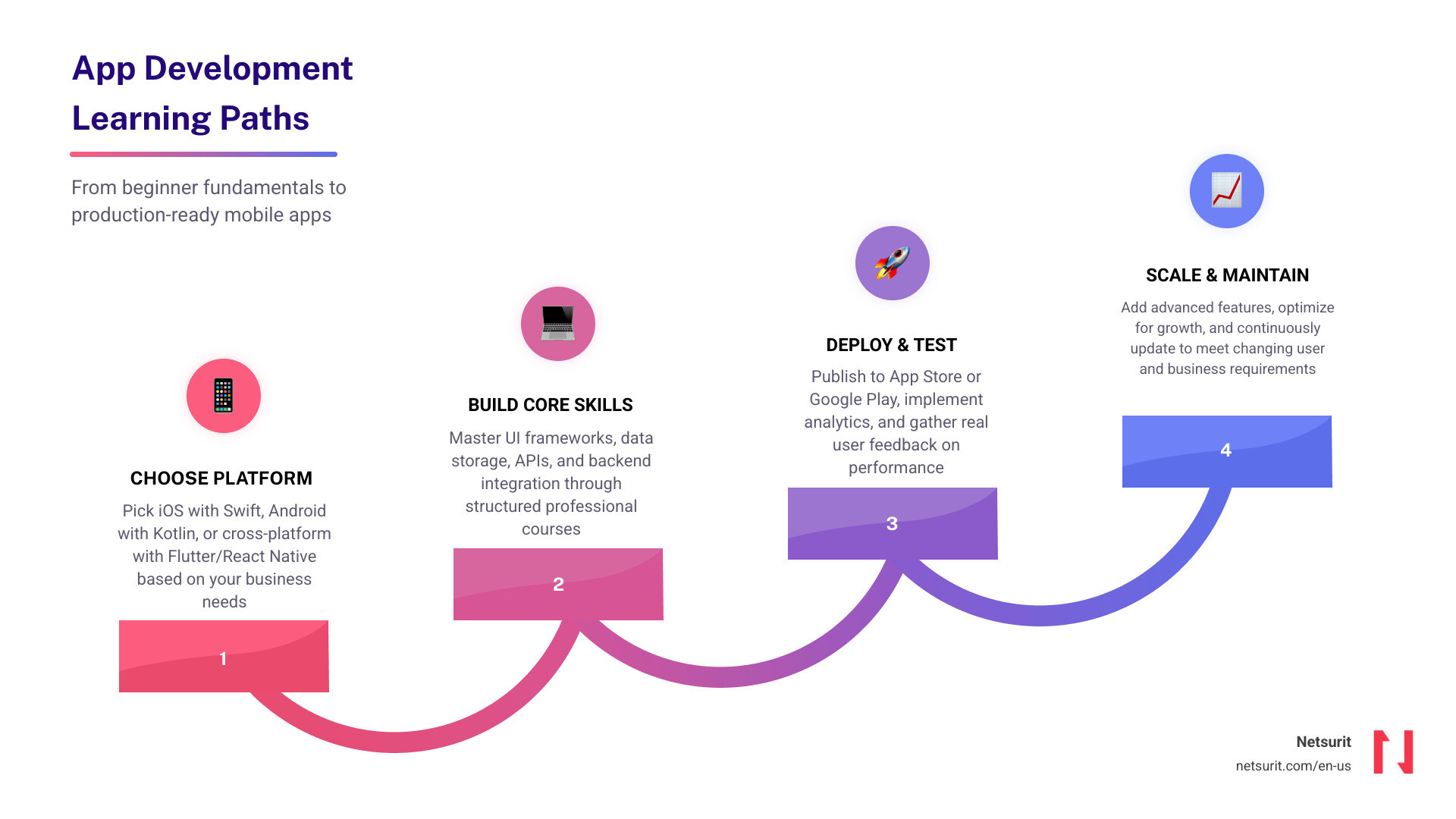
Best app development courses terms you need:
- android game development company
- android system programming
- app development company near me
Build Native iOS Applications with Swift and SwiftUI
To build high-performance software for Apple hardware, native development is your best option. Writing native iOS apps means using Swift 6 and SwiftUI within Xcode, Apple’s integrated development environment (IDE). Native apps run faster, access device hardware more reliably, and adapt naturally to iOS updates.
Consider a practical example. A boutique tax firm in Conroe, Texas, needs a secure mobile client portal. The firm’s clients must upload sensitive tax documents, sign engagement letters, and track their return status in real-time. Building this natively with Swift 6 and SwiftUI ensures that biometric authentication (Face ID) works flawlessly, local document storage uses Apple’s robust file system encryption, and the user interface remains completely responsive during heavy file uploads.
By utilizing native components, the Conroe tax firm avoids the sluggishness often associated with generic, web-packaged containers.
Master Apple Ecosystems with the Best App Development Courses for iOS
If you want your team to master the Apple ecosystem, several structured learning paths stand out:
- The Complete iOS 26 Developer Course : This comprehensive course focuses on iOS development using Swift 6 and SwiftUI. It balances core programming concepts with practical application, guiding you through building functional clones of popular social media platforms. It also integrates modern workflows, such as AI-assisted development using Cursor, Claude, and ChatGPT, which helps developers write, debug, and optimize code faster.
- Dr. Angela Yu’s iOS & Swift Course: Known for its deep instructional clarity, this bootcamp teaches the fundamentals of Swift and UIKit alongside SwiftUI. It is highly regarded for taking absolute beginners and teaching them the architectural patterns required for enterprise-ready applications.
- Codecademy’s 40-Hour iOS Developer Path: For a highly structured, interactive experience, this path provides browser-based coding environments that eliminate initial setup friction. It covers intermediate Swift concepts, Core Data for permanent local storage, and the step-by-step processes required for App Store deployment.
Master Native Android Development Using Kotlin and Jetpack Compose
Android occupies a massive share of the global mobile market. To build native applications for Android, the modern industry standard is Kotlin paired with Jetpack Compose. Jetpack Compose is Google’s modern declarative UI toolkit that replaces older XML layouts, allowing developers to build responsive interfaces with significantly less code.
For example, a financial services firm in Sugar Land, Texas, wants to launch a real-time tax refund tracker app for its clients. The app must fetch live data from internal databases, handle push notifications when a refund status changes, and display interactive charts showing financial projections.
Using Android Studio with Kotlin and Jetpack Compose allows the Sugar Land firm to build a fluid, reactive UI. The app can utilize local SQLite databases via Room to cache user data securely, ensuring the app remains functional even when the client has a weak cellular signal.
Top-Rated Android Training Paths and Professional Certificates
To gain these competencies, consider these highly structured training programs:
- Meta Android Developer Professional Certificate | Coursera : This 12-course series is designed to take learners from zero programming experience to job-ready status. It covers Kotlin fundamentals, Android Studio, UI/UX design principles in Figma, and database management. Crucially, it includes a capstone project where you build a fully functional native Android app from scratch and prepares you for technical coding interviews.
- Google’s Android Basics with Compose: This is Google’s official, free training path for absolute beginners. It requires no prior programming experience. It teaches Kotlin and Jetpack Compose through hands-on codelabs, guiding you through building basic apps that fetch network data and handle user input.
- Kotlin Multiplatform (KMP) Courses: For forward-looking developers, learning KMP is becoming essential. KMP allows your team to share core business logic (such as data serialization and network requests) between iOS and Android while still building completely native user interfaces on both platforms.
Scale Efficiently with Cross-Platform Frameworks
While native development offers maximum performance, building and maintaining two separate codebases (Swift for iOS and Kotlin for Android) can strain smaller development teams and budgets. Cross-platform frameworks solve this by allowing developers to write a single codebase that runs on both operating systems.
Let’s look at a CPA firm in Katy, Texas, that wants to deploy a multi-platform client communication app. The app needs a unified secure chat interface, an appointment scheduler, and a basic document scanner.
Instead of hiring separate iOS and Android developers, the Katy firm can use a cross-platform framework like Flutter (using the Dart language) or React Native (using JavaScript). This approach cuts development and maintenance costs in half. A single developer can manage the entire application, deploy updates simultaneously to both the Apple App Store and Google Play Store, and integrate the app with a unified Firebase backend.
Choose the Best App Development Courses for Multi-Platform Deployment
If cross-platform development aligns with your business goals, these courses offer the most rigorous preparation:
- IBM iOS and Android Mobile App Developer Professional Certificate | Coursera : This comprehensive 14-course program provides a thorough introduction to the entire mobile development lifecycle. It covers native basics but focuses heavily on cross-platform frameworks, specifically Flutter and React Native. You will learn to design interfaces in Figma, manage code with Git and GitHub, and integrate cloud databases and push notifications.
- The Ultimate React Course 2025: React, Next.js, Redux & More : If you choose React Native for your mobile apps, your developers must first master React. This course teaches modern React, state management (Redux Toolkit), and API integration. Because React Native uses the exact same design philosophy as React, this course serves as an exceptional foundation before transitioning into mobile-specific React Native development.
Compare the Best App Development Courses in 2026
Choosing among these options requires balancing your team’s current skill level, your budget, and your specific project requirements.
The table below outlines how the leading courses compare:
| Course / Program | Primary Platform/Language | Estimated Duration | Credential Offered | Best Suited For |
|---|---|---|---|---|
| The Complete iOS 26 Developer Course (Udemy) | iOS (Swift 6, SwiftUI) | ~55 hours | Certificate of Completion | Developers wanting to build native iOS apps with AI-assisted workflows. |
| Meta Android Developer Certificate (Coursera) | Android (Kotlin) | 8 months (7 hrs/week) | Professional Certificate | Beginners seeking a structured, career-focused path in native Android. |
| IBM iOS & Android Developer Certificate (Coursera) | Cross-Platform (Flutter & React Native) | 6 months (10 hrs/week) | Professional Certificate | Teams needing to launch apps on both platforms rapidly using a single codebase. |
| Android Basics with Compose (Google) | Android (Kotlin) | Self-paced | Badges / Play Store Certificate | Absolute beginners looking for a free, official introduction to Android. |
| The Ultimate React Course (Udemy) | Web to Mobile Foundation (React, Next.js) | ~84 hours | Certificate of Completion | Developers who want to master React before building apps with React Native. |
| Codecademy iOS Developer Path | iOS (Swift, SwiftUI) | ~40 hours | Career Path Certificate | Learners who prefer hands-on, interactive coding within the browser. |
Selecting the Right Path for Your Business
When deciding on a training path for your internal team or evaluating the skills of an external agency, keep these selection criteria in mind:
- Project Scope: If your application requires intensive hardware usage (such as AR/VR or high-performance graphics), choose native courses. For standard business utilities, database access, and communication portals, choose cross-platform courses.
- Existing Tech Stack: If your team already writes JavaScript or React for your web applications, React Native is the logical choice. If they are starting fresh, Flutter offers excellent performance and highly consistent UI rendering.
- Foundational Alternatives: If your team needs broader programming skills before diving into mobile specifics, consider foundational bootcamps like The Complete Full-Stack Web Development Bootcamp or 100 Days of Code™: The Complete Python Pro Bootcamp to build strong computational thinking.
Trade-offs: Native vs. Cross-Platform App Development
To help guide your strategy, weigh these structural trade-offs:
- Works best when:
- Native: You need deep integration with device hardware (Apple Watch, Face ID, local file systems) and maximum execution speed.
- Cross-Platform: You have a tight timeline, a single developer, and need to support both iOS and Android with identical feature sets.
- Avoid when:
- Native: You have limited budget and must launch on both platforms simultaneously.
- Cross-Platform: Your app relies heavily on real-time processing, complex animations, or immediate adoption of brand-new OS features.
- Risks:
- Native: Higher long-term maintenance costs because you are managing two independent codebases.
- Cross-Platform: Third-party frameworks can introduce security vulnerabilities or performance bottlenecks if not updated regularly.
- Mitigations: Partner with an experienced IT consultancy to audit your app’s architecture and security protocols before deploying to production.
Local Ecosystem and Regional Resources
If you prefer to work with specialized regional bootcamps, localized training programs, or vetted development agencies, outstanding resources exist across our primary service regions:
- Houston Metro (including Sugar Land, Conroe, and Katy):
- For professional agency partnerships, consult the Top App Developers in Houston – Jun 2026 Rankings | Clutch.co or evaluate Top Mobile App Development Companies in Sugar Land | 2026 .
- If you are looking for local training deals or introductory workshops, you can check Web & App Development in Conroe – Deals Up to 70% Off | Groupon .
- For families looking to introduce the next generation to technology, explore Hands-On Coding Classes & STEM Education for Kids in – Katy, TX .
- Pacific Northwest (Tacoma, Washington):
- If you want to outsource your mobile build to trusted regional engineers, look into the services offered by Mobile App Development Company Tacoma | Binary Studio .
- New England (Maine):
- For structured academic pathways, explore the Online Full Stack Software Developer from Central Maine … .
- Southwest (Albuquerque, New Mexico):
- To find intensive local training programs, review The Best Albuquerque, NM Coding Bootcamps – Course Report .
Conclusion
Building a mobile application is a powerful way to modernize your business, improve client retention, and streamline operations. However, training an internal team or managing a custom software build requires significant time, technical oversight, and strategic planning.
At Netsurit, we act as an elite technology partner for businesses across New York, New Jersey, Texas, and Seattle. We provide managed IT, advanced cybersecurity, and strategic AI solutions to eliminate downtime and accelerate your growth. If you are ready to scale your business with custom mobile applications but want to avoid the common pitfalls of self-taught development, we can help you design, secure, and deploy your software successfully.
Discover how we can support your digital transformation goals by visiting Netsurit IT Services.