Why AI Advisory for CPAs in Texas Is Now an Operational Requirement
AI advisory for CPAs in Texas has moved from a competitive edge to a daily necessity. In May 2026, AI is embedded in tax workflows across Houston, Dallas, and beyond — automating data extraction, flagging audit risks, and freeing CPAs to focus on strategy instead of spreadsheets.
Here is what Texas CPAs need to know about AI advisory right now:
| Area | What AI Does | Why It Matters |
|---|---|---|
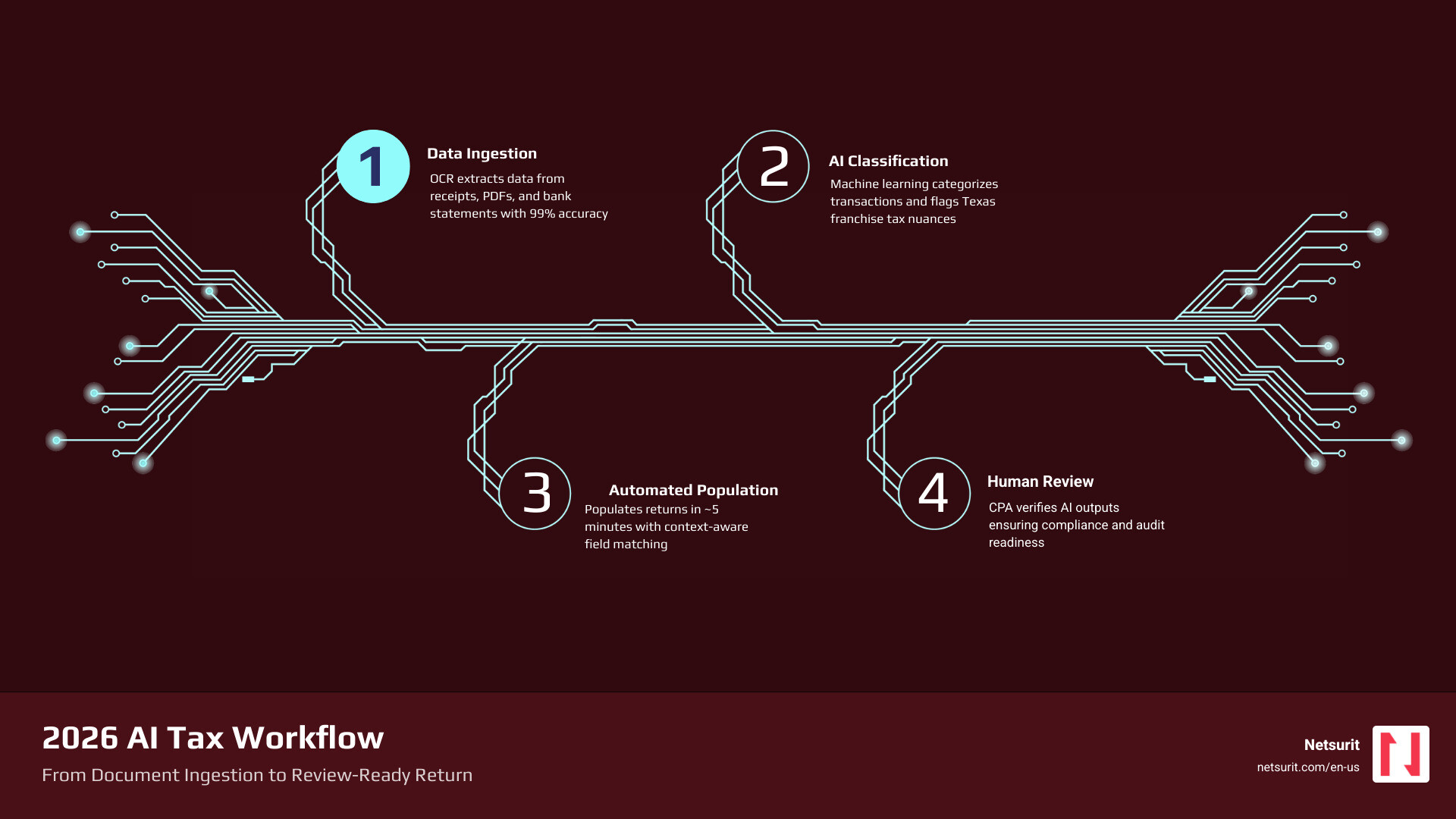
| Tax return prep | Populates returns in ~5 minutes using OCR and context-aware extraction | Cuts preparation costs by up to 50% |
| Routine client inquiries | Automates up to 90% of FAQs via AI chat | Frees staff for higher-value advisory work |
| Sales and use tax | Classifies taxable transactions with 95% accuracy using machine learning | Reduces manual coding hours by ~50% |
| Audit readiness | Flags unusual deductions and runs multi-year consistency checks | Reduces IRS audit exposure |
| Compliance risk | Human review queues catch borderline AI decisions | Keeps the CPA — not the software — accountable |
The shift is real, but it comes with trade-offs. AI tools can hallucinate tax codes, miss Texas-specific nuances like the franchise tax, and create liability gaps when used without oversight. The IRS’s 2025 “Dirty Dozen” list now includes AI-generated tax schemes — a clear signal that AI amplifies both capability and risk.
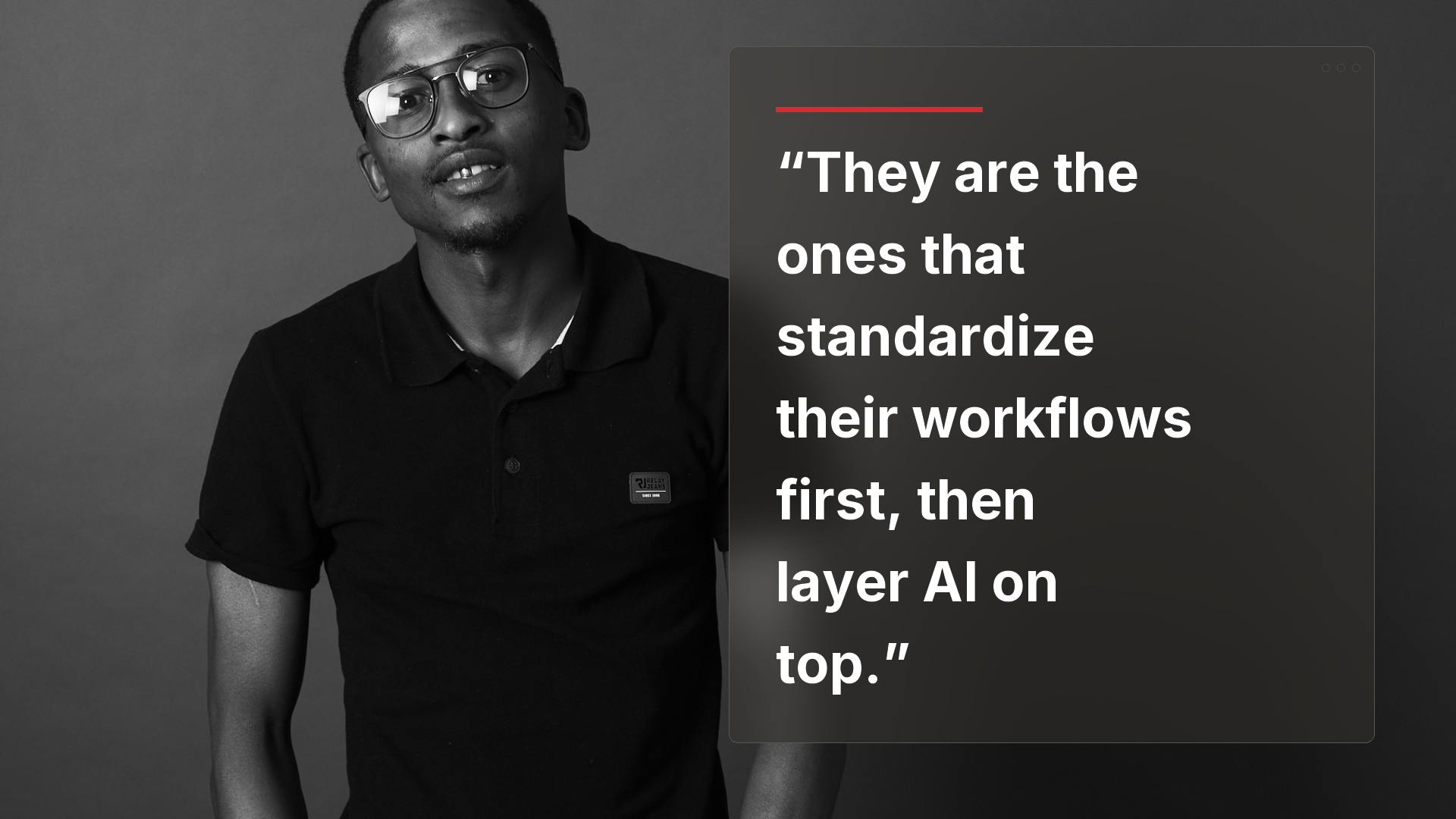
The firms winning in this environment are not the ones with the most AI tools. They are the ones that standardize their workflows first, then layer AI on top.
I’m Orrin Klopper, CEO and co-founder of Netsurit — a global IT services and digital transformation company that has helped 300+ organizations adopt AI securely and strategically, including accounting firms navigating the intersection of AI advisory for CPAs in Texas and enterprise-grade governance. In the sections below, I’ll walk you through the tools, risks, regulatory requirements, and real-world strategies Texas CPAs need to implement AI that actually delivers results.
The Shift from Compliance to AI Advisory for CPAs Texas
In the traditional model, a CPA’s value was often measured by the speed and accuracy of a tax return. By May 2026, that metric has been completely upended. AI advisory for CPAs Texas has shifted the focus from reactive compliance to Stay Ahead of the Curve: Your Guide to AI-Powered Tax Compliance.
Agentic AI—systems that don’t just answer questions but initiate actions—now handles the heavy lifting of data ingestion. This allows Texas firms to act as “Digital Seniors,” professionals who combine deep accounting expertise with the ability to manage automated workflows. Instead of spending 100 hours a year on manual filing, CPAs are using AI to transform tax returns into strategic assets that inform investment and operational decisions.
Scaling CAS through AI Advisory for CPAs Texas
Client Accounting Services (CAS) are the primary beneficiary of this shift. Small firms in Sugarland, for instance, are using AI to provide enterprise-level cash flow forecasting and fraud detection that was previously too expensive to deliver. By automating the reconciliation process—reducing monthly closing times from 12 days to just 4 days—these firms can offer proactive financial advice that drives client revenue. This transition is essential for small firms to compete with larger national players while maintaining the personal relationships that define their practice.
Transitioning from Reactive to Strategic Roles
The “busy work” of the tax season is dying. AI Chat tools now automate 90% of routine inquiries, such as questions about tax deadlines or document checklists. In a Katy-based practice, this means staff who previously spent hours on the phone are now reallocated to high-value advisory roles. They aren’t just filing forms; they are running “what-if” scenarios for business expansion or tax-optimized estate planning.
Trade-offs of Strategic AI Shift:
- Works best when: Your firm has standardized its internal workflows and data formats first.
- Avoid when: You have a “garbage in, garbage out” data problem; AI will only accelerate existing errors.
- Risks: Over-reliance on automation can lead to a “compliance autopilot” where subtle local tax nuances are missed.
- Mitigation: Establish a mandatory human review for any AI output that falls below a 95% confidence threshold.
Navigating the Liability Gap and Texas Regulatory Standards
Texas CPAs operate under some of the strictest professional standards in the country. The Texas State Board of Public Accountancy (TSBPA) and the passage of SB 262 and SB 522 in 2025 have modernized licensure, but they have not lessened the CPA’s responsibility. While AI can draft a return, it cannot sign one.
The “Liability Gap” is a critical concern: AI developers typically disclaim all liability in their terms of service, leaving the firm solely responsible for errors. Don’t Mess with Texas Algorithms: Why You Need AI Audit Assistance is a reminder that the IRS and TSBPA do not accept “the AI made a mistake” as a valid defense.
Professional Skepticism in the Age of Hallucinations
Hallucinations—where AI invents nonexistent tax codes or court cases—remain a threat. A firm in Conroe recently discovered an AI tool citing an outdated threshold for the Texas Franchise Tax, which could have led to significant penalties. This highlights the need for a “human-in-the-loop” protocol. Every AI-generated insight must be treated as a draft that requires verification against the Internal Revenue Code and official Texas guidance. AI Tax Advisors Texas emphasize that expertise is the only safeguard against automated errors.
Audit Readiness and AI Advisory for CPAs Texas
AI is also a defensive tool. The IRS is increasingly using its own AI-powered audit selection strategies to target complex corporate returns. Texas firms can fight fire with fire by using tools like TXF Intelligence to perform forensic-level reviews of client data. These tools identify unusual claims for credits or deductions that fall outside typical ranges for the Houston metro area, ensuring multi-year consistency before the return is ever filed.
| Feature | Manual Process | ML-Powered Process |
|---|---|---|
| Classification Accuracy | 75–85% (human fatigue) | 95% (consistent recall) |
| Manual Coding Time | 100% baseline | 50% reduction |
| False Negatives | High risk of missed deductions | 30–40% reduction |
| Audit Trail | Paper/spreadsheet based | Digital, logged, and verifiable |
High-Impact AI Tools for Texas Tax Practices in 2026
Selecting the right tech stack is the difference between a productive firm and one drowning in “tool sprawl.” In 2026, the Ultimate Guide to Houston AI Accounting Software highlights several key platforms that have become industry standards.
Automating Data Extraction and Return Population
Tools like TruePrep and K1x have revolutionized the front end of tax season. TruePrep can save up to 80% of the time spent on every tax return through automated data extraction. For Texas firms handling complex investment structures, K1x reduces the manual effort for processing K-1s and 1099s by up to 90%. The goal is a “review-ready” return delivered in approximately five minutes, allowing the CPA to focus on the 5% of “tricky” cases that require professional judgment.
Advanced Research and Scenario Modeling
Blue J and similar platforms use predictive analytics to scan legislation and judicial precedent. Instead of spending hours in research databases, a CPA can input a specific fact pattern and receive a prediction on how a tax court might rule. This is particularly useful for “what-if” projections in high-stakes advisory meetings, where clients need to know the potential tax impact of a merger or a major asset sale in real-time.
Implementing a Strategic Roadmap for Houston Firms
You cannot simply “buy” AI; you must deploy it. For Houston-area firms, this means addressing the unique regulatory and security landscape of the Texas market. A Roadmap for Modern Accounting starts with security.
Governance and Data Security Protocols
Data privacy is non-negotiable. IRS Publication 4557 and SOC 2 Type II certification are the benchmarks for any tool you adopt. One of the biggest risks we see at Netsurit is “Shadow AI”—employees using unapproved, public AI tools like ChatGPT to summarize sensitive client documents. To prevent this, firms must implement Zero Trust principles and Multi-Factor Authentication (MFA) across all AI-integrated platforms.
AI Security Checklist:
- Data Classification: Label data as public, internal, or restricted before allowing AI access.
- Shadow AI Discovery: Use monitoring tools to identify unapproved browser-based AI usage.
- Usage Policy: Create a one-page, direct policy on which tools are approved for client PII.
- Role-Based Access: Ensure junior staff can’t prompt AI for high-level firm financial data.
Cost-Benefit and Right-Sizing Strategies
Small and mid-sized firms in the Houston metro area often worry about the cost of these tools. However, the ROI usually appears within 12 to 18 months. Right-sizing involves starting with document-heavy processes where the time savings are easily measurable. By reducing tool sprawl and focusing on integrated platforms, a 10-person firm in Sugarland can achieve the same per-capita output as a Big 4 firm.
Real-World Success: How Texas Firms Use Machine Learning
The most successful firms are those that treat AI as an extension of their team. In 2026, we see diverse examples of AI advisory for CPAs Texas in action.
Optimizing Sales and Franchise Tax Compliance
Texas sales and use tax is notoriously complex due to the sheer volume of jurisdictions. Machine learning (ML) has become the primary tool for taxability classification. Using ML-powered anomaly detection, firms have reduced filing delays by 70%. By achieving 95% classification accuracy on SKUs and contracts, firms are significantly reducing the risk of a “shadow audit” from the state comptroller.
Case Study: From Mechanical Compliance to Strategic Growth
Consider a mid-sized firm in the Houston metro area that transitioned from traditional preparation to an AI-first model. By implementing a hybrid “rules-first + ML-assist” approach, they reduced manual coding hours by 50%. More importantly, they saw a 30–40% decrease in false negatives—missed taxable items that would have triggered penalties. This efficiency gain allowed them to pivot their billing model from hourly rates to value-based advisory fees, increasing their profit margins by 25% within a single tax cycle.
Frequently Asked Questions about AI Advisory
Does the IRS accept AI errors as a valid defense for penalties?
No. The IRS and the Taxpayer Advocate Service have been very clear: the taxpayer and their licensed practitioner bear ultimate responsibility for the accuracy of a return. Citing an AI “hallucination” does not meet the standard for “reasonable cause” to waive penalties.
How can small Texas firms afford enterprise-grade AI tools?
Many AI providers now offer tiered pricing based on the number of returns or “sessions.” Small firms can also leverage managed service providers (MSPs) like Netsurit to gain access to enterprise-grade security and governance frameworks without the overhead of a full internal IT department.
What are the specific TSBPA rules regarding AI-generated workpapers?
The TSBPA requires that CPAs maintain professional skepticism and due diligence. AI-generated workpapers must be reviewable, meaning they should include clear citations or “links” to the source data so a human can verify the logic. Blindly accepting AI output is considered a failure of professional standards.
Conclusion
The future of AI advisory for CPAs Texas is not about replacing the human element; it is about amplifying it. By 2026, the firms that have successfully integrated agentic AI are those that prioritized governance, security, and staff training over the hype of new software. AI handles the data; you handle the strategy.
If you are ready to secure your firm’s data and deploy a strategic AI roadmap that protects your practice and your clients, we are here to help. Contact Netsurit for Managed IT and AI Support in Texas and let’s turn your compliance burden into a competitive advantage.