Texas Just Made AI Compliance Mandatory — Here’s What You Need to Know
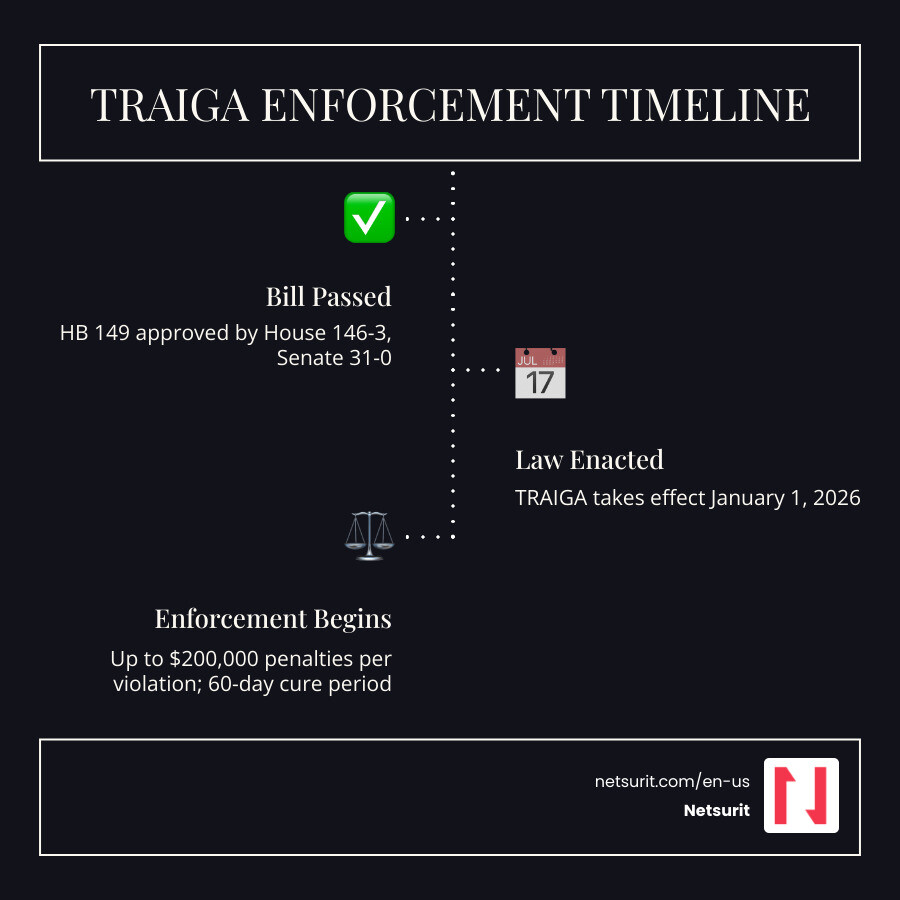
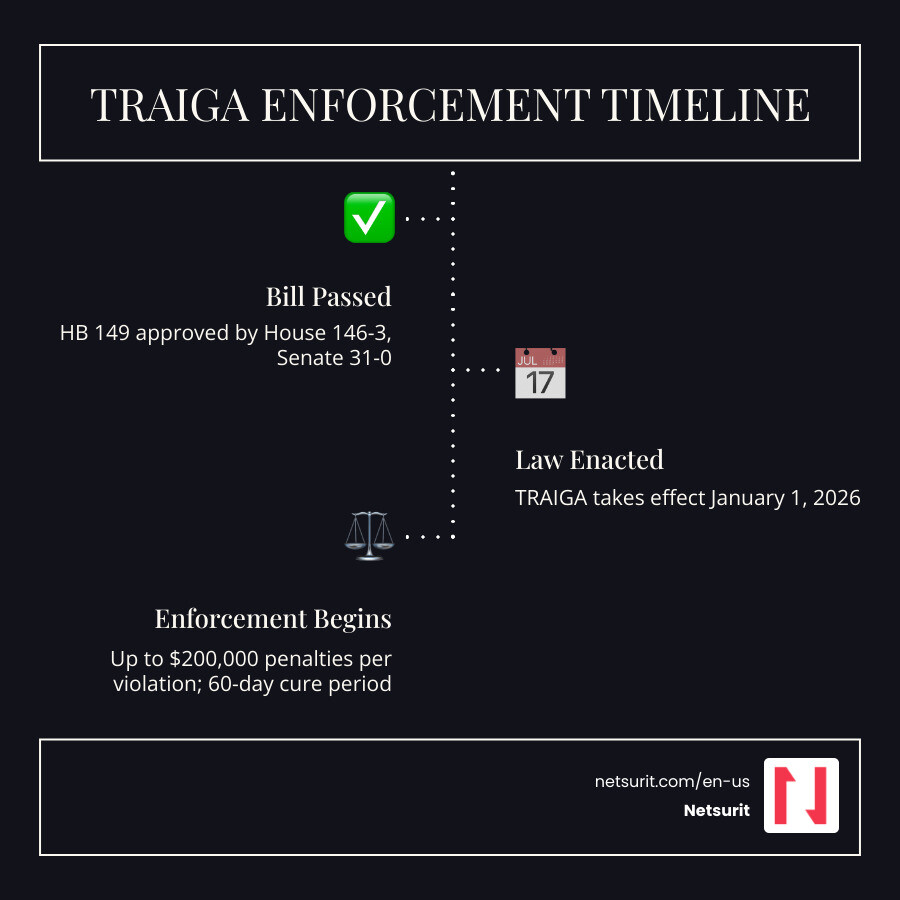
AI compliance tools Texas businesses need are no longer optional. As of January 1, 2026, the Texas Responsible Artificial Intelligence Governance Act (TRAIGA) is in effect — and penalties for violations can reach $200,000 per incident.
Here’s a quick answer to what you’re looking for:
Top AI compliance tools for Texas businesses in 2026:
| Tool | Best For | Key Capability |
|---|---|---|
| TXAIMS | Private businesses, healthcare, government | Prohibited practice screening, NIST alignment, evidence bundles |
| VerifyWise | Multi-regulation coverage | Maps all 26 TRAIGA requirements, impact assessments |
| Adeptiv AI | Deployer risk management | Documentation, safeguard tracking, governance workflows |
What every Texas business must do now:
- Identify every AI system you use or build
- Determine if you are a developer, a deployer, or both
- Screen for prohibited practices (discrimination, manipulation, explicit content)
- Align with the NIST AI Risk Management Framework for safe harbor protection
- Generate documented evidence bundles before the Texas AG comes knocking
TRAIGA applies to any business operating in Texas or serving Texas residents — regardless of company size. There is no small-business exemption. A single uncurable violation costs more than most businesses spend on compliance in a year.
The law passed the Texas House 146-3 and the Senate 31-0. This is not a partisan fight — Texas sees AI governance as a business and consumer protection issue. That broad consensus means enforcement is coming.
I’m Orrin Klopper, CEO of Netsurit, a managed IT and digital transformation company with offices across the US including Texas — and helping businesses navigate AI compliance tools Texas regulations is central to what our team does every day. In the sections below, I’ll walk you through exactly how to make your Texas business audit-proof under TRAIGA.
Navigating the Texas Responsible AI Governance Act (TRAIGA)
The Texas Responsible AI Governance Act, or TRAIGA (HB 149), represents a massive shift in how we handle technology. Unlike other state regulations that only target “high-risk” systems, TRAIGA is broad. If your business uses AI to offer products or services to Texans, you are likely covered. The law distinguishes between two roles: Developers (those who build or substantially modify AI) and Deployers (those who use AI in their operations).
Texas took a unique path compared to Colorado or California. While Colorado focuses on “disparate impact” (statistical differences in outcomes), Texas focuses on intentional discrimination. This means the Attorney General looks for evidence that an AI was designed or used with the intent to discriminate against protected classes. However, don’t let that higher bar for the prosecution make you complacent. The law also prohibits AI behavior that encourages self-harm, facilitates criminal activity, or produces sexually explicit content.
One of the most important features of TRAIGA is the 60-day cure period. If the Attorney General identifies a curable violation, you have two months to fix it before fines kick in. But wait—”uncurable” violations, such as those involving significant harm or prohibited content, don’t get this grace period. They can result in immediate penalties of up to $200,000. For more details on these nuances, refer to the Texas TRAIGA (HB 149) Compliance Guide.
How Texas Compares to Other States
| Feature | Texas (TRAIGA) | Colorado (SB 24-205) | California |
|---|---|---|---|
| Scope | Any AI system | “High-risk” AI only | Focus on privacy/automated decisions |
| Discrimination Standard | Intent-based | Disparate impact | Disparate impact |
| Small Business Exemption | None | Limited exemptions | Varies by revenue |
| Legal Defense | Rebuttable Presumption | Affirmative Defense | Varies |
Example: A tax firm in Conroe using AI to automate audit risk assessments must identify as a “deployer.” Even if they didn’t build the tool, they must ensure it doesn’t intentionally flag taxpayers based on protected characteristics like race or religion.
Essential AI Compliance Tools Texas Businesses Need in 2026
To avoid the “parking ticket” trap—where you only realize you’re in trouble when the fine arrives—you need proactive software. AI compliance tools Texas businesses use most frequently in 2026 include TXAIMS, VerifyWise, and Adeptiv AI. These platforms act as a central nervous system for your governance, providing “evidence bundles” that you can hand to an auditor or the Attorney General to prove you’ve done your due diligence.
TXAIMS, for instance, offers tiered plans that help businesses scale their compliance as they adopt more tools. Whether you are a small accounting office in Katy or a large logistics firm in Houston, these tools automate the grueling task of prohibited practice screening. You can view their structure at TXAIMS Pricing and Plans. These platforms are fundamentally changing how regulated industries operate by moving compliance from a manual checklist to an automated workflow. For a deeper look at this shift, see AI Compliance Tools Transforming Regulated Industries.
Trade-offs box:
- Works best when: Managing 3+ AI systems; operating in high-risk sectors like finance or healthcare; requiring defensible audit trails.
- Avoid when: Using only low-risk, non-consequential tools like basic spellcheck or simple calculators.
- Risks: Relying entirely on the tool without human oversight; a false sense of security if the tool is misconfigured.
- Mitigations: Human-in-the-loop verification; quarterly reviews with your IT partner; regular legal counsel check-ins.
Scaling Governance with AI Compliance Tools Texas
As your business grows, manually tracking every AI interaction becomes impossible. Modern tools map your operations against all 26 TRAIGA requirements, including impact assessments and transparency notices. VerifyWise, for example, provides a comprehensive roadmap for these 26 points, ensuring no requirement slips through the cracks. You can explore their approach in the Texas AI Act (TRAIGA) Compliance Guide | VerifyWise.
Effective governance isn’t just about following the law; it’s about risk management. By mapping your AI usage, you protect your reputation and your bottom line. Learn more about this in our guide on Protect Your Organization How Ai Can Help You Manage Risks.
Screening for Prohibited Practices with AI Compliance Tools Texas
The “Texas Standard” for AI is strict when it comes to harmful behavior. Software like Adeptiv AI helps businesses screen for prohibited practices, such as behavioral manipulation or the generation of unlawful content. This is particularly critical for businesses that use generative AI for marketing or client communication. Detailed requirements are outlined in the Texas Responsible AI Governance Act | Adeptiv AI.
Furthermore, machine learning can actually be your best defense. By using AI to monitor AI, you can catch discriminatory patterns or biometric risks before they become legal liabilities. We’ve seen how Compliance Supercharged How Machine Learning Protects Your Business can turn a reactive “firefighting” culture into a proactive, audit-ready environment.
Sector-Specific Requirements: Healthcare, Government, and Legal Ethics
If you operate in healthcare, government, or legal services, TRAIGA isn’t your only hurdle. Texas has passed several companion bills that add layers of complexity:
- Healthcare (SB 1188): Requires clear, conspicuous disclosures when AI is used in patient interactions. You must also ensure health records are stored in the US and reviewed by medical professionals.
- Government (SB 1964 & HB 3512): State agencies and their contractors must follow specific ethics guidelines. Employees using computers for more than 25% of their duties must undergo DIR-certified AI training.
- Legal & Finance: The State Bar of Texas issued Opinion 705, which mandates human oversight and verification of all AI-generated legal work.
A major risk in these sectors is “shadow AI”—when employees use unapproved tools like ChatGPT to summarize sensitive patient files or financial audits. This bypasses all corporate controls and creates immediate compliance violations. Understanding Staying Ahead Of The Curve Ais Role In Financial Compliance and Ai Compliance Sec Rules Financial Firms is essential for any firm handling sensitive data in the Houston metro area.
Example: A Sugarland accounting firm providing client advisory via generative AI must disclose this interaction clearly. If a client thinks they are talking to a human CPA but are actually interacting with a bot, the firm could face penalties for deceptive practices under TRAIGA and professional ethics guidelines.
Implementation Roadmap: From Shadow AI to Audit-Ready
Getting compliant doesn’t happen overnight, but you can achieve a “defensible” state within 90 days if you follow a structured roadmap.
- Inventory (Days 1-30): You cannot govern what you don’t see. Identify every AI tool in use, from embedded features in your CRM to browser extensions used by your marketing team.
- NIST Mapping (Days 31-60): Align your usage with the NIST AI Risk Management Framework (RMF). This is your “get out of jail free” card (or close to it). Substantial alignment provides a rebuttable presumption of reasonable care.
- Governance & Oversight (Days 61-90): Establish a human-in-the-loop policy. No AI output that affects a consumer or employee should be sent without human review.
We often help clients integrate these steps into their broader Cyber Risk Compliance strategy. AI compliance is an extension of cybersecurity. If your AI is compromised, your data is compromised. Recognizing The Importance Of Cybersecurity Compliance is the first step toward a truly audit-proof business.
Example: A Katy-based CPA firm should conduct a 30-day visibility audit. They might find that staff are using unapproved browser-based AI tools to summarize complex tax codes. While efficient, these tools often lack the data security required by Texas law, making the firm liable for any data leaks.
Frequently Asked Questions about Texas AI Compliance
What is the maximum penalty for a TRAIGA violation?
Uncurable violations can cost up to $200,000 per instance. For curable violations that are not remediated within the 60-day window, fines typically range from $10,000 to $12,000. Additionally, ongoing violations can accrue daily penalties between $2,000 and $40,000 until the issue is resolved.
Does NIST AI RMF compliance provide a safe harbor?
Yes. Under Section 546.103 of TRAIGA, substantial alignment with the NIST AI Risk Management Framework (or an equivalent recognized framework) provides a rebuttable presumption of reasonable care. This means that in a legal dispute, the burden is on the state to prove you didn’t act reasonably, rather than on you to prove you did. It is one of the strongest legal defenses available to Texas businesses.
Who qualifies for the Texas AI regulatory sandbox?
The Texas Department of Information Resources (DIR) manages a regulatory sandbox program. Both developers and deployers can apply if they are testing innovative AI systems that provide a public benefit or significant technological advancement. Participants can receive a 36-month testing period with temporary regulatory relief and legal immunity while they refine their safeguards.
Conclusion
The era of “move fast and break things” is over for AI in the Lone Star State. With the Texas Attorney General now empowered to enforce TRAIGA, the risks of non-compliance are simply too high to ignore. By using the right AI compliance tools Texas offers and aligning with the NIST framework, you can turn a looming regulatory threat into a competitive advantage.
At Netsurit, we specialize in helping businesses in Houston, Sugarland, Katy, and beyond build audit-proof documentation and robust AI governance. Don’t wait for a cure notice to start your journey. Secure your Texas business with elite AI governance and managed IT solutions and ensure your innovation stays on the right side of the law.