What Is SOC as a Service — and Why It Matters for Your Business
SOC as a service is an outsourced security model where a third-party provider runs 24/7 threat monitoring, detection, and incident response across your endpoints, networks, cloud, and identity systems — delivered via subscription, with no on-premises infrastructure required.
If you’re evaluating whether to outsource your security operations, here’s what you need to know upfront:
| Factor | What SOCaaS Delivers |
|---|---|
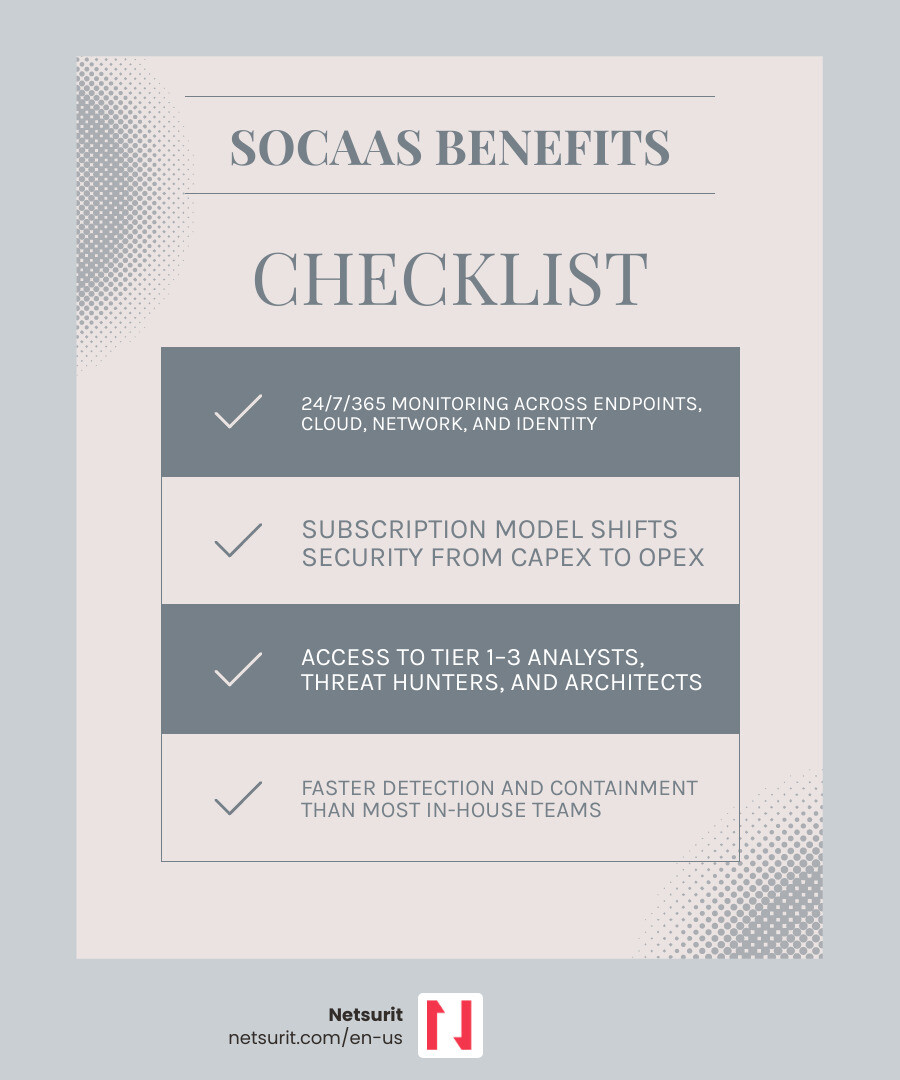
| Coverage | 24/7/365 monitoring across endpoints, cloud, network, and identity |
| Model | Subscription-based; shifts security from capital expense to operational cost |
| Team | Access to Tier 1–3 analysts, threat hunters, and security architects |
| Speed | Faster detection and containment than most internal teams can achieve |
| Fit | Best for organizations without the budget or staff to build an in-house SOC |
Most businesses don’t suffer breaches because they lacked a firewall. They suffer breaches because no one was watching at 2:00 AM on a Sunday.
Building a security operations center (SOC) in-house means hiring 6–12 specialists, investing months in setup, and then managing the very real problem of burnout — 71% of SOC analysts report feeling burned out on the job. The result is gaps in coverage, high turnover, and a security posture that looks strong on paper but struggles under real pressure.
SOC as a service solves this directly. You get a dedicated security team, proven detection tooling, and continuous monitoring — without the hiring headaches or capital outlay of an internal build.
That said, SOCaaS is not a silver bullet. It introduces trade-offs around data visibility, provider dependency, and customization that are worth understanding before you commit.
I’m Orrin Klopper, CEO and co-founder of Netsurit, and over nearly 30 years of delivering managed IT and security services to businesses across the US, I’ve seen how the right SOC as a service model can transform an organization’s security posture — and where the wrong fit causes friction. Let’s break down exactly how it works.
Defining SOC as a Service for Modern Threats
Modern cyber threats do not observe business hours. While your team sleeps, automated bots and state-sponsored actors are scanning your perimeter for unpatched software or leaked credentials. SOC as a service functions as a cloud-delivered extension of your team, providing a high-fidelity “eye in the sky” that monitors your entire digital footprint 24/7/365.
This model is built on a subscription framework, eliminating the need for heavy upfront investments in hardware or proprietary software licenses. Instead of buying a SIEM (Security Information and Event Management) platform and hoping you can find someone to run it, you subscribe to a finished outcome: a secure environment.
The human element is perhaps the most critical component. According to research, 71% of SOC analysts feel burned out on the job, often due to “alert fatigue”—the relentless bombardment of low-priority notifications. By using an outsourced provider, you offload the “noise” to a team of remote experts who use sophisticated threat intelligence to distinguish between a routine system update and a genuine ransomware intrusion.
Why Houston Accounting Firms Need SOC as a Service
For accounting firms in the Houston metro area—from downtown high-rises to offices in Sugarland and Conroe—the stakes are uniquely high. You handle sensitive financial data, Social Security numbers, and corporate tax records that are prime targets for identity theft and wire fraud.
During peak tax season (January through April), your staff is stretched thin, making them more susceptible to phishing attempts. Furthermore, firms must comply with IRS Publication 4557, which mandates the protection of taxpayer data. SOC as a service provides the continuous monitoring required to meet these federal standards without forcing a mid-sized CPA firm to hire a full-time cybersecurity department.
The Financial Reality of SOCaaS vs. In-House Builds
Building an internal SOC is a massive undertaking. Beyond the cost of the technology stack, you face a brutal talent market where 42% of organizations admit they lack the adequate skills for security operations.
According to IDC’s analysis on security outsourcing, many organizations now prefer to outsource specific security functions to focus their internal personnel on strategic initiatives. This shifts security from a Capital Expenditure (CapEx)—buying servers and software—to an Operational Expenditure (OpEx), providing predictable monthly costs and immediate access to a mature security posture.
Operational Mechanics: From Log Ingestion to Incident Response
The “magic” of soc as a service lies in its workflow. It begins with log ingestion, where telemetry from your firewalls, cloud environments (like Microsoft 365 or Azure), and endpoints is streamed to the provider’s platform.
To prevent analysts from drowning in data, providers use AI-driven noise reduction. For example, SentinelOne sets the standard with 100% detection and 88% fewer alerts than the median across vendors in MITRE evaluations. This ensures that when an analyst does call you, it is because of a high-severity event, not a false positive. Even federal entities recognize the efficiency of this model; the DOJ’s cybersecurity shared services catalog highlights how centralized monitoring enables rapid detection and investigation across vast networks.
SOC Tiers and Responsibilities
A professional SOC team is structured into specific roles to ensure no threat is missed:
- Tier 1 Triage: The first line of defense. These analysts monitor the dashboard, validate alerts, and escalate suspicious activity.
- Tier 2 Investigation: Deep-dive specialists who determine the scope of an attack and begin the containment process.
- Tier 3 Threat Hunting: Proactive experts who search for hidden threats that haven’t triggered an alert yet.
- Security Architect: The person who designs the integration between your tools and the SOC platform.
- SOC Manager: Oversees operations and ensures all Service Level Agreements (SLAs) are met.
Real-World Scenario: Containing a Breach in Katy, TX
Imagine a boutique investment firm in Katy. At 2:00 AM on a Tuesday, an attacker uses a stolen identity token to access a partner’s Microsoft 365 account. Within minutes, the soc as a service platform detects the “impossible travel” (a login from an unusual geographic location) and suspicious PowerShell commands being executed.
The Tier 1 analyst validates the threat and escalates it to Tier 2. By 2:15 AM, the SOC has automatically isolated the compromised laptop and locked the partner’s account, stopping the attacker before they could pivot to the firm’s client database. A full forensic report is on the partner’s desk by 8:00 AM, showing exactly what was blocked.
Comparing SOCaaS with In-House SOC and MDR
Choosing the right model requires understanding the nuances of visibility and response.
| Feature | In-House SOC | MDR (Managed Detection & Response) | SOC as a Service |
|---|---|---|---|
| Cost | Extremely High (CapEx) | Moderate (Subscription) | Moderate (Subscription) |
| Visibility | Full Environment | Primarily Endpoints | Full Stack (Logs, Cloud, Network) |
| Setup Time | 6–18 Months | Days to Weeks | Weeks |
| Tooling | You Own/Manage | Provider’s Proprietary Tools | Often Tool-Agnostic |
While MDR is excellent for stopping malware on a laptop, soc as a service provides broader visibility. It looks at your firewall logs, your cloud audit trails, and your network traffic. This holistic view is often required by state policies, such as the California SAM 5335 monitoring policy, which emphasizes continuous security monitoring for all state entities—a standard many private firms now adopt as a best practice.
Trade-offs of Outsourced Security
Outsourcing your “nerve center” is a strategic decision that comes with specific considerations:
- Works best when: You have a cloud-heavy workload (Azure/AWS), a hybrid workforce, and need to satisfy compliance audits quickly.
- Avoid when: You have highly sensitive data that is legally prohibited from leaving a physical, air-gapped on-premise server.
- Risks: You are dependent on the provider’s uptime. If their platform goes down, your visibility may be limited. There is also the risk of “black box” logic, where you don’t know why an alert was suppressed.
- Mitigations: Only partner with providers who offer transparent playbooks and real-time dashboard access. Demand regular SLA audits to ensure they are meeting response time targets (e.g., 15 minutes for high-severity alerts).
The Business Case for Houston Tax and Accounting Firms
For a Houston firm, soc as a service is more than just a security tool; it’s a growth enabler. When you can prove to a high-net-worth client or a corporate partner that you have 24/7 proactive monitoring, you differentiate your firm from competitors who are still relying on basic antivirus.
This level of protection helps satisfy stringent requirements like the Gramm-Leach-Bliley Act (GLBA) and HIPAA if you handle medical-related accounting. By leveraging managed SOC services, you ensure that a single security incident doesn’t result in a reputation-destroying data breach. We focus on crushing downtime so you can focus on your clients’ financial success.
Selecting and Onboarding Your Partner
The process of narrowing your vendor focus should start with an audit of your current “tech stack.” Does the provider integrate with your existing firewall? Can they ingest logs from your specific line-of-business applications?
What to watch next: As we move toward 2026, look for providers who are moving beyond simple detection into autonomous response. This means using AI to not only flag a threat but to actively “heal” the system by reversing unauthorized changes in seconds.
During onboarding, expect a “tuning” phase. For the first 30 days, the SOC team will learn your network’s “normal” behavior to reduce false positives. Clear communication channels—usually a mix of a client portal, email, and emergency phone lines—must be established on day one.
Frequently Asked Questions about SOCaaS
How much does SOCaaS typically cost?
While we don’t list specific prices, costs generally scale based on the number of endpoints (laptops/servers), the volume of data (logs) ingested daily, and the level of response you require. It is significantly more affordable than the $500k+ annual budget required to run a basic 24/7 in-house SOC.
Does SOCaaS replace my existing IT team?
No. Think of it as a partnership. Your IT team handles day-to-day operations, user support, and strategy. The SOC team handles the “eyes-on-glass” monitoring and emergency threat containment. They provide the data your IT team needs to make better infrastructure decisions.
How long does the onboarding process take?
Most organizations can be integrated and “active” within two to four weeks. This includes deploying sensors, configuring log forwarding, and establishing the escalation playbooks.
Conclusion
When threats never sleep, your security shouldn’t either. For businesses in Houston, Sugarland, and Katy, soc as a service offers a shortcut to enterprise-grade security maturity without the enterprise-grade price tag.
At Netsurit, we act as an elite tech partner to help you secure your business and unlock momentum. By combining proactive defense with 24/7 vigilance, we help you crush downtime and stay focused on your aspirations. Reach out to our team today to see how we can protect your firm’s future.