Why AI in Treasury Management Is Now a Business Necessity
AI in treasury management transforms how finance teams forecast cash flow, prevent fraud, and manage liquidity risk — moving them from reactive spreadsheet work to real-time, predictive decision-making.
Here is what AI delivers for treasury operations today:
| Capability | What It Does | Measurable Impact |
|---|---|---|
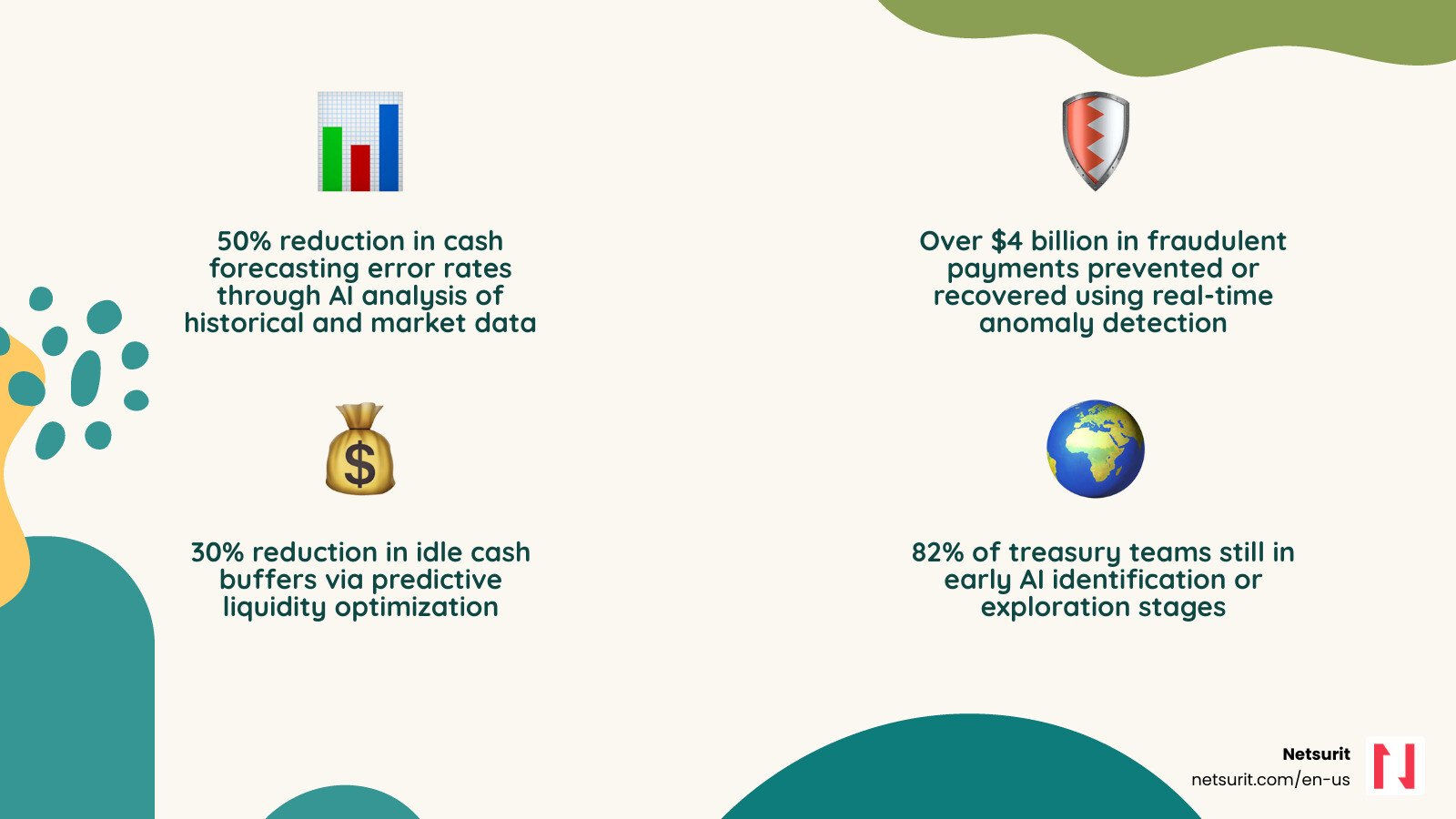
| Cash flow forecasting | Analyzes historical payments, seasonal patterns, and market data | Up to 50% reduction in forecasting error rates |
| Fraud prevention | Flags suspicious transactions and checks in real time | Over $4 billion in fraudulent payments prevented or recovered in fiscal 2024 |
| Liquidity planning | Predicts cash buffer needs and optimizes deployment | 30% reduction in idle cash buffers |
| FX risk management | Simulates currency exposure scenarios automatically | Faster, more informed hedging decisions |
| Sanctions screening | Digitizes signatory data via OCR for real-time compliance | Reduced manual processing and compliance risk |
Traditional treasury relies on lagging data, manual spreadsheets, and fragmented systems. That combination leaves firms exposed — to fraud, to cash shortfalls, and to costly hedging mistakes — especially in volatile markets.
The core problem is not a lack of data. It is that the data arrives too late, in the wrong format, from too many disconnected sources.
Despite AI’s clear potential, adoption is still early. 82% of corporate treasury teams are only in the identification or exploration stage, and just 5% have scaled AI to full production. That gap represents both a risk for laggards and a real competitive opening for firms that move now.
This guide explains how AI works in treasury, which tools lead the market, what barriers to expect, and how to implement AI in a phased, practical way — without replacing the human judgment that treasury still requires.
I’m Orrin Klopper, CEO and co-founder of Netsurit, and over 30 years of leading IT and digital transformation initiatives for hundreds of organizations, I have seen how the right technology foundation — including AI in treasury management — separates firms that scale from those that stall. That experience shapes every recommendation in this guide.
Relevant articles related to AI in treasury management:
- AI-powered financial analysis
- AI for financial planning
- Automate accounts payable
Moving Beyond Excel: How AI in Treasury Management Predicts Liquidity

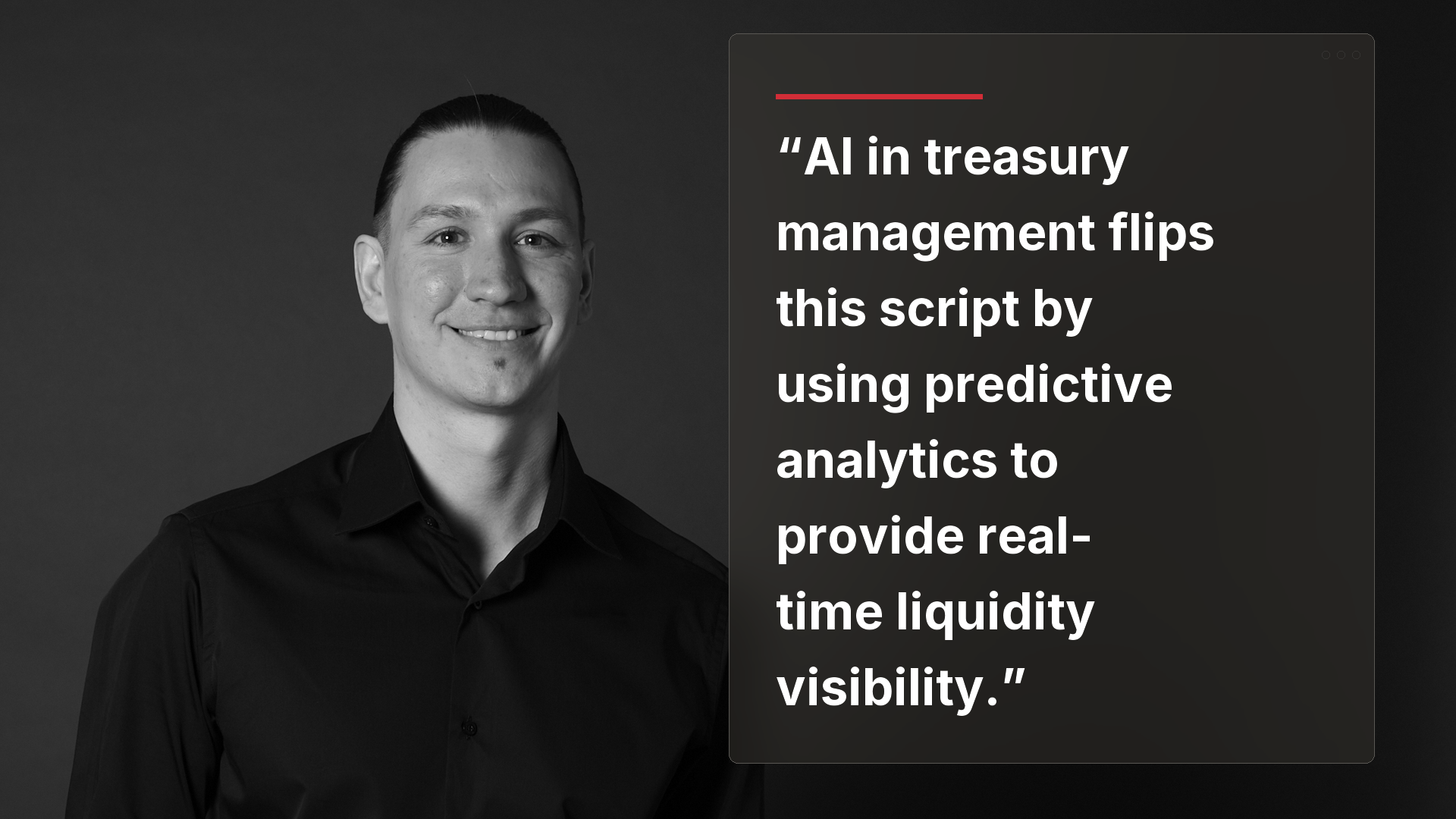
For decades, the “gold standard” for treasury has been a complex web of Excel workbooks. While functional, these models are inherently backward-looking. They rely on what happened last month to guess what might happen next week. AI in treasury management flips this script by using predictive analytics to provide real-time liquidity visibility.
Traditional methods often fail because they cannot account for the sheer volume of unstructured data—news feeds, social media sentiment, or sudden supply chain shifts. AI thrives here. It integrates data from ERP systems, CRM platforms, and market feeds to create a living, breathing model of your firm’s financial health. By reducing manual data entry in accounting, teams can stop chasing numbers and start analyzing them.
Transforming Cash Flow with AI in Treasury Management
The most immediate win for any treasury team is the precision gain in cash flow forecasting. Statistical modeling and machine learning (ML) allow systems to recognize subtle patterns that a human eye—or a standard Excel formula—would miss.
Research shows that AI-powered forecasting models can reduce error rates by up to 50% compared to traditional methods. These models use neural networks and Long Short-Term Memory (LSTM) networks to analyze time-series data. Instead of a flat projection, you get a dynamic curve that adjusts as new invoices are issued or market conditions shift. You can explore these concepts further in our AI in Finance Webinar.
Scenario Analysis and Stress Testing
Volatility is the only constant in modern finance. Whether it is a sudden currency devaluation or a supply chain disruption, treasurers need to know “what if” in seconds, not days. AI enhances Monte Carlo simulations by generating thousands of potential scenarios based on historical data and current market volatility.
This capability is particularly vital for integrating Environmental, Social, and Governance (ESG) factors into liquidity planning. If a major supplier faces a climate-related disruption, AI can simulate the impact on your cash position immediately. It’s about moving from a “best guess” to a ready-to-work smarter posture.
Example: A tax firm in Sugarland, TX, managing high-volume seasonal inflows, uses AI to predict the exact date cash buffers can be moved into high-yield short-term investments, rather than leaving them idle in low-interest accounts. This precision allows them to capture an extra 15–20 basis points of yield that would otherwise be lost to “safety” buffers.
| Trade-offs for AI Forecasting | Details |
|---|---|
| Works best when | Historical data is clean, tagged, and spans at least 24 months. |
| Avoid when | The firm is undergoing a major merger or structural change that renders historical patterns irrelevant. |
| Risks | “Black box” models that provide results without explainable logic. |
| Mitigations | Run parallel Excel models for 90 days to validate AI outputs before full transition. |
Leading AI-Powered Systems and Real-World Impact
Choosing the right Treasury Management System (TMS) is no longer just about bank connectivity; it is about the “intelligence” baked into the platform. Several leaders have emerged, each offering unique AI capabilities.
| Platform | Standout AI Feature | Core Benefit |
|---|---|---|
| GTreasury | GSmart AI | Learning forecasts and intelligent orchestration across $12.5T in volume. |
| Kyriba | OPR Index | Quantifies CFO confidence through Optimism, Preparedness, and Risk pillars. |
| FIS | Neural Treasury | Cloud-native suite with “Treasury GPT” for guided decision support. |
The impact of these systems is not theoretical. For instance, the global giant Bosch utilized AI for predictive liquidity planning and successfully reduced its cash buffer by 30%. This freed up millions in capital for strategic reinvestment. Similarly, Navigating the AI Wave reveals that AI is shifting treasury from a back-office cost center to a strategic innovation hub.
Fraud Prevention and Risk Management
Fraud is becoming more sophisticated, but AI is fighting back. The U.S. Department of the Treasury prevented and recovered over $4 billion in fraudulent and improper payments in fiscal 2024 alone by using machine learning to detect check fraud.
AI uses anomaly detection and behavioral analytics to flag transactions that deviate from established patterns. By employing Optical Character Recognition (OCR) to digitize signatory data, banks and firms can perform real-time sanctions screening and payment security checks. This is a classic case of AI to the rescue, fixing business problems before they hit the bottom line.
Optimizing Liquidity with Intelligent TMS
Beyond fraud, AI streamlines the unglamorous parts of treasury: bank statement processing and automated reconciliation. Modern TMS providers use AI to recognize and categorize transactions automatically, even when the data is messy.
By automating these “quick fix” tasks, firms achieve up to 30% cost savings. However, as discussed in our BDO Webinar, the goal isn’t just a fast patch; it’s a fundamental shift in how the accounting and treasury functions interact.
Example: An accounting practice in Katy, TX, implemented AI-driven anomaly detection to flag duplicate vendor payments across multiple client accounts, reducing manual audit time by 15 hours per week. This allowed their senior staff to focus on high-level tax strategy rather than clerical errors.
Overcoming Barriers to AI Adoption in Treasury
If AI is so effective, why are only 5% of firms optimizing it? The barriers are usually internal rather than technical. 59% of treasury professionals cite limited resources as the top hurdle, followed closely by data quality issues.
Data Governance and Quality Control
AI is only as good as the data you feed it. If your historical cash flows are mislabeled—for example, marking an M&A outflow as “payroll”—the AI will predict a massive payroll spike every year.
To scale safely, firms must implement strict data governance. This includes:
- Sensitivity Labels: Classifying data (Public, Internal, Confidential) so AI assistants don’t expose sensitive info.
- Content Lifecycles: Proactively archiving old data so it doesn’t skew current models.
- Least Privilege Access: Ensuring the AI only accesses the specific ledgers it needs for a task.
Effective automation for accounting firms requires centralizing these data silos first.
The Skills Gap and Mindset Shift
The role of the treasurer is changing. Instead of being an Excel wizard, the modern professional needs to be an “AI Co-pilot.” This requires a shift toward an “AI-first” mindset and new skills like prompt engineering—the ability to ask AI the right questions to get precise financial insights.
Example: A mid-sized firm in Conroe, TX, found that AI adoption stalled not because of the software, but because their data was siloed in three different legacy ERPs. They had to centralize their data architecture before the AI could provide a reliable “single version of truth.” Without that foundation, the AI’s forecasts were consistently 20% off.
A Phased Roadmap for Implementing AI in Treasury
We recommend a four-stage framework to ensure AI delivers ROI without disrupting daily operations. You can find more on driving AI productivity here.
- Identification: Pinpoint repetitive, data-intensive tasks like daily cash positioning or bank reconciliation.
- Exploration: Run a low-risk pilot. Use AI to generate a “second opinion” on your current cash forecast.
- Transformation: Redesign your workflows. If AI handles the data pull, what should your team do with the extra 10 hours a week?
- Optimization: Scale the solution and integrate Agentic AI—systems that can proactively suggest FX hedges or move funds between accounts based on pre-set rules.
The Role of Generative AI in Treasury Management
Generative AI, like “Treasury GPT” or Copilot for Business Central, allows you to query your financial data using natural language. Instead of building a report, you simply ask, “What is our net interest expense this month compared to our forecast?” and get an answer in seconds. This provides a layer of decision support that was previously impossible without a dedicated data science team.
Scaling from Pilot to Production
As you move into production, focus on building feedback loops. AI models need to be validated and refined continuously. This is where “Agentic AI” comes in—moving from a tool that answers questions to a partner that collaborates on strategic execution across the enterprise.
Frequently Asked Questions about AI in Treasury
How does AI improve cash forecasting accuracy?
AI models like LSTM networks analyze thousands of variables simultaneously—including seasonal trends, market volatility, and historical payment behavior—to reduce forecasting error rates by up to 50% compared to manual methods. Unlike linear Excel models, AI can spot non-linear correlations between external market events and internal cash flows.
Is AI going to replace treasury professionals?
No. AI acts as a “co-pilot” that automates repetitive data entry and reconciliation, allowing treasurers to shift from “firefighting” to strategic activities like FX hedging and capital allocation. The goal is to augment human intelligence, not replace the nuanced judgment required for high-stakes financial decisions.
What are the biggest risks of using AI in treasury?
The primary risks include data privacy breaches, “hallucinations” in generative models (where the AI provides a confident but incorrect answer), and a lack of explainability in complex algorithms. These are mitigated through robust data governance, keeping a “human-in-the-loop” for final approvals, and running parallel models during the initial rollout.
Conclusion
AI is no longer a futuristic concept but a necessary operating system for modern treasury departments to maintain liquidity and prevent fraud in an increasingly volatile market. By following a phased implementation roadmap and prioritizing data quality, firms can turn their treasury function into a competitive advantage.
Netsurit provides the specialized AI solutions and cybersecurity guardrails necessary for financial teams to scale these technologies safely and effectively. Whether you are in Houston, Katy, or Sugarland, we are here to help you navigate this transition.
Unlock your momentum with Netsurit’s Digital Transformation for Accounting