
ERP System Integration: What It Is and Why It Matters in 2026
ERP system integration is the process of connecting your core ERP software to the other applications your business runs on — think CRM, e-commerce, HR, payroll, and BI tools — so data flows automatically between them in real time.
If your team re-enters the same order data in three systems, waits 24 hours for inventory numbers to update, or reconciles spreadsheets at month-end because your ERP doesn’t talk to your billing platform, you’re already feeling the cost of poor integration.
Here’s the short version of what ERP integration does:
| What It Connects | What It Fixes |
|---|---|
| ERP ↔ CRM | Eliminates manual order entry; syncs customer data |
| ERP ↔ E-commerce | Keeps inventory accurate across sales channels |
| ERP ↔ HR / Payroll | Automates onboarding, PTO, and payroll feeds |
| ERP ↔ BI / Reporting | Delivers real-time dashboards instead of stale exports |
| ERP ↔ Supply Chain | Triggers alerts for delays and automates reordering |
The business case is clear: IDG research shows that 44% of transactional data in ERP systems comes from external sources. Without integration, that data enters manually — slowly, inconsistently, and with errors.
This is not just an IT problem. Almost half of senior procurement executives name poor integration as one of their top three operational headaches. When systems don’t share data, decisions slow down, errors multiply, and customer experience suffers.
This guide walks you through every dimension of ERP integration — from architecture choices to security requirements to a phased deployment roadmap — so you can make a confident decision about where to start.
I’m Orrin Klopper, CEO and co-founder of Netsurit, and over 30 years of guiding businesses through IT transformation projects — including complex ERP system integration initiatives across North America, South Africa, and Europe — I’ve seen which approaches deliver lasting results and which ones create expensive technical debt. The sections ahead reflect what actually works.
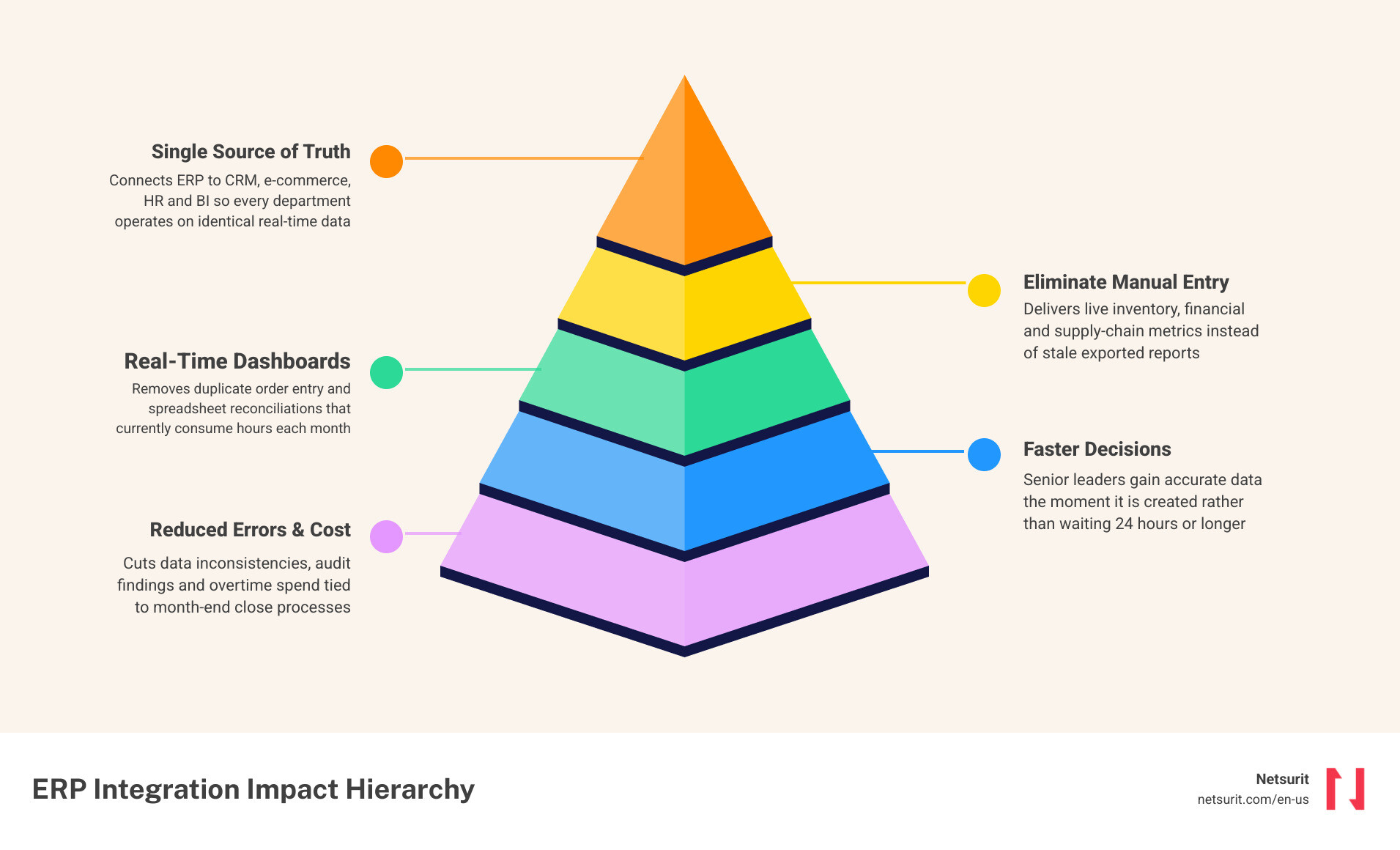
Erp system integration helpful reading:
- global it solutions provider
- it managed service providers platform
- it services and solutions provider
Why ERP System Integration Dictates Mid-Market Growth in 2026
Relying on disconnected software in June 2026 is an active drag on your business growth. In the mid-market, speed and accuracy are the only real differentiators. When your customer-facing tools, inventory ledgers, and financial systems operate in silos, your operational velocity drops.
ERP system integration acts as the central nervous system of your business. It establishes a “single source of truth,” ensuring that every department accesses the exact same data. If a customer changes their billing address in your CRM, the update propagates to your ERP instantly, preventing shipping or invoicing errors.
Relying on manual data transfers to bridge these gaps is a failing strategy. Manual data entry introduces human error, creates processing backlogs, and limits executive visibility to a rearview mirror perspective. To build a resilient operations model, your technology stack must communicate autonomously. Aligning your infrastructure with your long-term expansion goals requires a structured IT roadmap. Our IT Strategy Services help mid-market organizations design integration pathways that scale smoothly as transaction volumes grow.
In highly regulated markets or complex operating environments, custom integration strategies are no longer optional. For example, public sector entities in the Northeast rely on robust managed infrastructure to keep operations running smoothly, as seen in how the CGI Selected to Host/Manage ERP System for State of Maine initiative secures critical public data. Similarly, growing mid-market enterprises across the Southwest utilize specialized expertise to bridge disparate software environments, leveraging local Systems Integration in New Mexico — Hire Experts | FreedomDev teams to streamline complex legacy workflows.
Eliminate Manual Data Entry and Accelerate Financial Reporting
The primary benefit of a successful erp system integration is the immediate elimination of manual data entry. Removing human touchpoints from routine transactions minimizes data transcription errors, decreases invoice cycle times, and frees up your staff for high-value analysis. Real-time data visibility allows leadership teams to make strategic decisions based on live operating metrics rather than month-old reports.
Accounting remains the most critical business function. According to industry surveys, 89% of respondents consider accounting the most critical ERP function. When your financial ledger connects seamlessly with operational applications, month-end closing cycles shrink from weeks to days.
To see this in action, consider a tax and accounting firm in the Houston, Texas metro area. During peak tax season, the firm faces a massive influx of new client registrations, document submissions, and billing updates. By integrating their front-office CRM with their back-office billing ERP, they automate client onboarding and real-time data synchronization. When a new client signs an engagement letter in the CRM, the integration automatically provisions their account in the billing ERP, sets up the correct tax entity structures, and schedules the initial retainer invoice. This eliminates double-entry errors and ensures the firm processes client files without administrative delays.
To successfully implement these workflow improvements, you need a structured approach to change management. We use our Digital Transformation Framework to help organizations systematically map their processes, identifying manual bottlenecks and replacing them with automated, integrated workflows that drive measurable ROI. If you run complex manufacturing or distribution operations alongside your financial systems, working with specialized deployment partners like Epicor Implementation & Business Consulting in Houston-DESSS ensures your shop floor data connects seamlessly with your corporate ledger.
Choosing Your Architecture: Comparing the 4 Main Integration Methods
Selecting the correct architecture is the most critical technical decision in your integration journey. The wrong choice can lead to a fragile network of custom code that breaks during every minor software update.
The four primary integration methods used by mid-market businesses in 2026 are:
- Point-to-Point (P2P): Direct custom connections written between two applications.
- Enterprise Service Bus (ESB): A centralized communication architecture where applications connect to a shared data highway.
- API Management: Utilizing structured application programming interfaces managed through a central gateway.
- Integration Platform as a Service (iPaaS): A cloud-native platform providing prebuilt connectors, visual workflow designers, and managed hosting.
| Feature | Point-to-Point (P2P) | Enterprise Service Bus (ESB) | API Management | iPaaS (Integration Platform) |
|---|---|---|---|---|
| Upfront Cost | Low | High | Medium | Medium |
| Complexity | High (over time) | High | Medium | Low |
| Scalability | Poor | Good (on-premises) | Excellent | Outstanding (hybrid/cloud) |
| Maintenance | High | High | Medium | Low |
| Best Used For | Linking two static apps | Legacy enterprise setups | Developer-led API ecosystems | Rapid cloud-first scaling |
To simplify cloud-first deployments, organizations often look to modern platforms like the NetSuite Integration Platform | NetSuite to establish prebuilt connections. For developers building custom connectors, open-source repositories like virbahu/erp-integration-connectors provide highly valuable foundational code. When evaluating cost-effective options, reviewing the ERP Integration for $99/Month 2026 | SAP, NetSuite, Dynamics, Sage model can help mid-market businesses understand how standardized packages compare to complex custom builds.
Mitigating the Risks of Data Mapping and Legacy System Failures
ERP integrations often stumble due to poor data mapping, security vulnerabilities, or legacy system performance bottlenecks. If your source data is disorganized, integrating your systems will only distribute bad data faster.
Consider a multi-partner accounting firm in Conroe, Texas. The firm decided to migrate from a legacy on-premises database to a modern cloud-based ERP. The primary challenge was mapping twenty years of historical client audit trails, custom tax classification fields, and complex billing histories without disrupting active client accounts.
To mitigate this risk, the firm ran a comprehensive data cleansing project prior to migration. They established strict data translation rules, defining how legacy fields would map to the new cloud database schema. By executing the migration in structured phases, they ensured that active tax preparation pipelines remained entirely unaffected.
For businesses moving away from legacy on-premises infrastructure, a structured Cloud Migration strategy is essential to prevent data loss and preserve system performance. For a deeper dive into how modern automation tools can simplify this process and protect your operational continuity, read our guide on Cloud Transformation: How Automation Turns Your Digital Migration into a Joyride.
Solving Data Translation and API Limit Bottlenecks
Data translation mismatches occur when two systems define the same data point differently. For example, one system might record a date as DD/MM/YYYY while your ERP expects YYYY-MM-DD. Without a translation layer, the transfer fails. Furthermore, SaaS applications impose strict API rate limits to protect their performance. If your integration sends too many requests simultaneously, the host system will block the connection.
Consider a financial services office in Katy, Texas. During high-volume, end-of-month reconciliation cycles, their automated billing sync consistently hit the API limits of their financial ledger, causing synchronization failures. They resolved this bottleneck by implementing queued batch processing. Instead of sending transactions individually in real time, the integration platform groups transactions and pushes them in optimized batches during off-peak hours.
When off-the-shelf integration tools cannot handle these complex API limits or custom business rules, partnering with local experts for Katy Custom Software Development – Custom Information Services ensures your middleware is custom-engineered to handle your specific transactional volumes.
Securing Financial Data and Meeting SOC 2 Standards
Integrating systems expands your attack surface. If an API endpoint is poorly secured, it can expose sensitive financial records, employee data, or client tax documents to unauthorized access. Protecting this data requires end-to-end encryption, multi-factor authentication, and secure credential storage.
For example, a CPA firm in Sugar Land, Texas must comply with strict federal regulations regarding client data privacy. To secure their automated workflows, they implemented secure API gateways with automated credential rotation and role-based access controls. This architecture ensures that only authenticated systems can query the ERP, and every transaction is logged in an immutable audit trail.
For firms handling highly sensitive data, working with specialized developers who understand local compliance landscapes is critical. Utilizing Sugar Land Custom Software Development services ensures that your integration workflows are architected to meet SOC 2, HIPAA, or other industry-specific security standards from day one.
A Phased Roadmap to Deploy Your ERP Integration Without Downtime
To minimize operational disruption, we recommend a phased deployment roadmap. A “big bang” launch where you turn on all integration points simultaneously carries a high risk of system downtime.
A structured integration project follows these four distinct phases:
- Discovery and Scoping: Document all business processes, system endpoints, and data fields that require integration.
- Owner: Business Analyst / Lead Architect
- Data Cleansing and Standardization: Clean and format source data to ensure compatibility with target system schemas.
- Owner: Database Administrator / Data Steward
- Pilot Testing: Deploy the integration in a staging environment using a representative subset of data to validate translation rules and error handling.
- Owner: QA Engineering Team
- Phased Rollout: Deploy the integration to production in waves, starting with non-critical data flows before moving to core transactional pipelines.
- Owner: DevOps Team / Systems Integrator
Once your integration is live, maintaining its performance requires continuous monitoring, security patching, and error resolution. Our Application Managed Services team provides ongoing support to keep your integrated systems running smoothly. For organizations built on Microsoft environments, leveraging Microsoft Solutions ensures your Office 365, Dynamics, and Power Platform applications are natively aligned with your ERP. To explore our full suite of implementation, security, and consulting services, visit Our Services page.
Answering Critical ERP Integration Questions
How long does a typical ERP integration project take?
An ERP integration project can take anywhere from a few weeks to several months, depending heavily on system complexity, data quality, and the number of endpoints. A basic connection using prebuilt iPaaS adapters can go live within 2 to 4 weeks. Conversely, a complex multi-system integration involving legacy on-premises databases and custom business logic typically requires 3 to 6 months of development and rigorous testing.
To accelerate your timeline and reduce risk, we strongly advocate for a phased approach. By deploying high-priority connections first — such as your CRM-to-ERP sync — you can deliver immediate business value while building out more complex workflows over time.
Can we integrate legacy on-premises systems with cloud ERPs?
Yes. You do not need to migrate your entire infrastructure to the cloud to achieve seamless integration. Modern hybrid cloud architectures bridge on-premises databases and cloud applications securely. This is typically achieved by installing a secure, outbound-only local integration agent on your local server. This agent communicates with your cloud ERP via encrypted APIs without requiring you to open inbound ports in your corporate firewall.
For detailed technical guidelines on configuring these hybrid data flows, consult the Administrator’s Guide – SAP ERP, Supply Chain or review prepackaged integration scenarios via the Prepackaged Integration with SAP ERP guide. For manufacturers and distributors seeking to connect legacy shop floor systems, understanding these hybrid setups is simplified by reading the Understanding ERP System Integration Services By WM Synergy FAQ.
How does ERP integration support regulatory compliance?
ERP integration automates compliance reporting by establishing consistent, tamper-proof data flows across your entire software ecosystem. Instead of relying on manual spreadsheet exports — which can be altered or deleted — integrated systems generate immutable audit trails that log exactly when data was created, modified, or transferred.
When your financial ledger connects directly with your operational tools, regulatory reports are generated automatically using live, validated data. If your business operates in highly regulated sectors like medical device manufacturing, aerospace, or industrial distribution, utilizing specialized platforms from vendors like AI Powered Industry Specific ERP and Business Management … ensures your integration workflows natively support strict quality control and traceability standards.
Conclusion
Integrating your ERP system with your broader software ecosystem is the most effective way to eliminate operational friction, secure your financial data, and build business momentum. By replacing manual data entry with automated, real-time data flows, you give your leadership team the clear visibility needed to make confident decisions.
Partnering with an experienced IT strategist ensures your integration is secure, compliant, and architected to scale. To learn how we can help you design and execute a successful ERP integration project tailored to your business, explore Netsurit Our Services.