
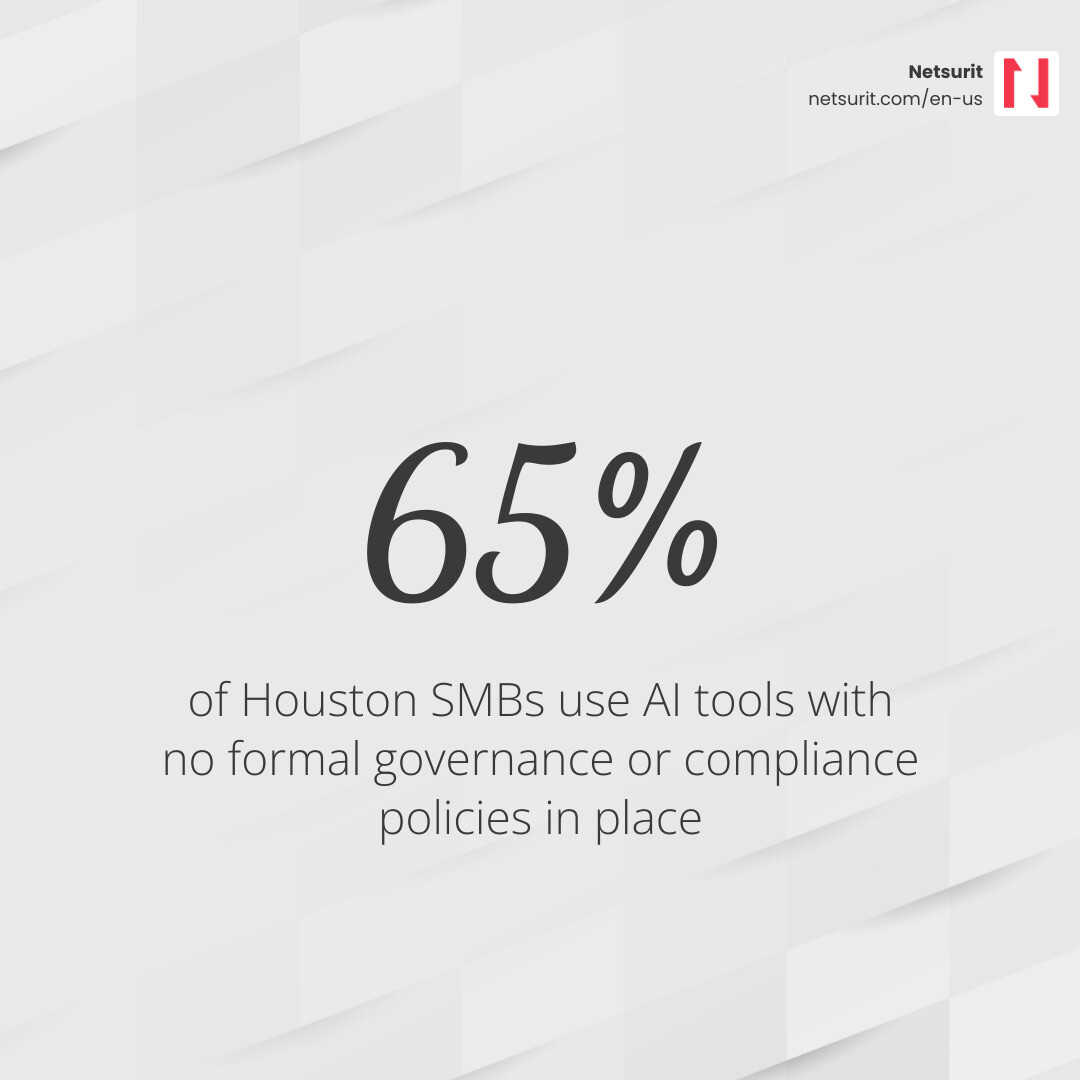
65% of Houston Businesses Use AI Without Governance — Here’s What That Costs You
An AI compliance consultant in Houston helps businesses adopt AI tools without exposing themselves to regulatory fines, data breaches, or legal liability. An AI compliance consultant performs the following functions:
| What an AI Compliance Consultant Does | Why It Matters |
|---|---|
| Audits AI tools already in use across your organization | Uncovers “shadow AI” before it becomes a liability |
| Maps your AI use to frameworks like HIPAA, TDPSA, SOC 2, CMMC | Keeps you compliant with industry-specific regulations |
| Builds usage policies, data governance rules, and access controls | Prevents sensitive data from leaking into public AI models |
| Conducts risk assessments and gap analyses | Identifies your biggest exposures before auditors or regulators do |
| Provides ongoing monitoring and incident response planning | Keeps compliance current as AI tools and regulations evolve |
Houston businesses are adopting AI fast, yet over 65% of local SMBs operate without formal governance. This gap creates direct exposure to regulatory penalties and data leakage that auditors will scrutinize heavily in 2026. The Texas Data Privacy and Security Act (TDPSA) is now in full effect, and HIPAA enforcement is tightening around AI-assisted clinical tools.
For a tax firm in Katy, using an unvetted AI tool to process client returns could lead to a catastrophic data breach and permanent loss of trust. Companies implementing structured AI governance see an average 30% reduction in compliance-related incidents within the first year.
I’m Orrin Klopper, CEO of Netsurit. Since 1995, we have helped over 300 organizations navigate complex technology and compliance challenges. This guide draws on our experience guiding Houston-area businesses through the AI compliance consulting landscape to provide a practical roadmap.
Why Your Business Needs an AI Compliance Consultant in Houston
Houston is a top 10 U.S. metro area for AI and data privacy growth, with a 42% increase in local compliance roles between 2023 and 2025. AI is already inside your business, whether approved or not. When we provide IT Consulting Houston, we often find that “Shadow AI” is the biggest unmanaged risk. An AI compliance consultant Houston bridges the gap between innovation and legal safety by ensuring your growth is sustainable and legally sound.
The Role of an AI Compliance Consultant Houston
An AI compliance consultant builds governance frameworks that define tool usage, data inputs, and output verification. This involves:
- Baseline Readiness: Assessing current infrastructure and data maturity.
- Risk Mitigation: Identifying where AI might produce biased results or leak trade secrets.
- Ethical Oversight: Ensuring AI use aligns with emerging US regulations.
Differentiating AI Compliance from General IT
General IT focuses on performance; AI compliance focuses on fairness, transparency, and legality. Traditional cybersecurity protects your perimeter, while AI compliance protects your data from being absorbed into public training sets.
- Algorithmic Fairness: Auditing models to ensure they don’t discriminate in hiring or lending.
- Data Lineage: Tracking the origin of data used to train or prompt an AI.
- Model Transparency: Explaining how an AI reached a specific conclusion, a 2026 regulatory requirement.
- Risk Management: Using specialized strategies to manage risks.
Example: A Houston Accounting Firm A tax firm in Sugarland wants to use AI to categorize expenses. A general IT consultant might just install the software. An AI compliance consultant Houston ensures the software doesn’t send client Social Security numbers to a public server and verifies that the AI’s logic meets IRS standards.
Navigating the Regulatory Landscape: TDPSA, HIPAA, and Beyond
By May 2026, the regulatory environment requires proactive compliance. The Texas Data Privacy and Security Act (TDPSA) has fundamentally changed how Houston firms handle consumer data. If you serve customers in Texas, you are likely subject to these rules, which mirror the strictest parts of the CCPA and GDPR.
Compliance requires aligning legal and technical strategies. Professionals like Bart Huffman emphasize that AI contracting now involves complex issues of data ownership and enrichment. Understanding The Importance of Cybersecurity Compliance is the first step in avoiding heavy monetary penalties.
Managing SOC 2 and CMMC in the AI Era
For Houston’s defense contractors and SaaS providers, SOC 2 and CMMC 2.0 are the gold standards. AI adds complexity; auditors now want to see how you control AI access and monitor for “model drift.” Our Cybersecurity Services in Houston include continuous monitoring and evidence collection tailored for AI.
Industry-Specific Mandates for Houston Firms
Generic compliance fails in specialized economies.
- Energy Sector: Focuses on protecting critical infrastructure and meeting CMMC requirements.
- Healthcare: With the rise of AI-driven diagnostics, HIPAA compliance is under a microscope. Experts like Cyndi Baily point out that AI tools must be evaluated for clinical accuracy and patient privacy simultaneously.
- Finance: The SEC has introduced AI Compliance SEC Rules to prevent market manipulation.
Example: A Houston Tax Practice A tax practice in the Energy Corridor must comply with TDPSA when processing client data through AI. An AI compliance consultant Houston helps them implement data ownership clauses in their AI vendor contracts, ensuring they retain rights to their proprietary tax strategies while remaining HIPAA compliant for their healthcare-sector clients.
Building a Robust AI Governance Framework
A governance framework is the rulebook for AI in your office. Without it, employees make independent legal decisions for the firm. The goal is to prevent data leakage and eliminate “shadow AI.” Attorneys like Anokhy Desai argue that even strong defenses leave businesses exposed without practical, achievable compliance steps.
| Feature | Public AI (e.g., Free ChatGPT) | Private Enterprise AI |
|---|---|---|
| Data Privacy | Data may be used to train future models. | Data is siloed and private. |
| Compliance | Rarely meets HIPAA or TDPSA standards. | Built for specific regulatory frameworks. |
| Risk | High risk of trade secret leakage. | Controlled via enterprise-grade security. |
| Cost | Free or low-cost. | Requires investment in licenses. |
Strategic Policy Development
Effective policy development focuses on practical, high-impact rules:
- Approved Tool List: Defining which AI tools are vetted and safe.
- Prohibited Use Cases: Restricting the upload of unredacted client contracts to any AI.
- Vendor Risk Management: Ensuring AI vendors absorb their share of the risk.
Data Governance and Access Control
AI compliance relies on Zero Trust principles. Marketing staff should not have AI-powered access to HR payroll data. Implementing MFA and strict data classification ensures that AI tools only see authorized data. As noted in AI Governance and Data Protection, governance allows safe data use without total restriction.
Trade-offs of AI Governance:
- Works best when: Leadership is committed to training and enforcement.
- Avoid when: You are looking for a “set it and forget it” solution; AI requires active management.
- Risks: Over-restriction can lead to employees bypassing controls to stay productive.
- Mitigation: Provide “safe” enterprise alternatives like Microsoft 365 Copilot.
Example: A Conroe CPA Firm A CPA firm in Conroe implements a policy where only redacted documents are used for AI-driven analysis. This allows them to use AI for trend spotting without violating client confidentiality.
The 180-Day Roadmap to AI Readiness and Compliance
While full compliance takes time, businesses see measurable ROI within 90 days. A structured roadmap prevents technical overwhelm and prioritizes immediate risks.
Phase 1: Visibility and Risk Assessment (Days 0–30)
Visibility is the prerequisite for security.
- Tool Discovery: Run network scans to identify AI sites and plugins in use.
- Stakeholder Alignment: Align legal, IT, and department heads.
- Gap Analysis: Compare current state against TDPSA and industry mandates. John P. Tomaszewski suggests a good compliance answer should solve security, efficiency, and legal standing simultaneously.
Phase 2: Controls and Policy Implementation (Days 30–90)
This phase focuses on implementation.
- Technical Guardrails: Configure web filters and data loss prevention (DLP) rules.
- Employee Training: Train teams on safe prompting techniques.
- Model Integration: Ensure any custom tools are compliant by design, focusing on UX/UI and data handling.
Phase 3: Monitoring and ROI Optimization (Days 90–180)
Phase 3 focuses on continuous monitoring.
- Performance Audits: Monitor for accuracy and algorithmic bias.
- Incident Response: Include AI-specific scenarios, such as hallucinations, in breach response plans.
- Refinement: Use AI to monitor your own financial compliance.
Example: A Houston Accounting Firm A mid-sized accounting firm in the Energy Corridor audits its tools in Phase 1 and discovers three different departments using unapproved AI for data entry. By Phase 2, they migrate these teams to a secure enterprise environment, reducing risk while maintaining productivity.
Frequently Asked Questions about AI Compliance
How long does a typical AI compliance assessment take?
Most Houston firms complete an initial assessment within 4 to 10 weeks. If you are a small business in Katy with a simple tech stack, we can often identify your primary risks in under a month. Larger enterprises in the Energy Corridor with custom-built models will naturally take longer to audit.
What are the biggest risks for Houston SMBs using AI?
The “big three” are:
- Invisible Data Leakage: Employees pasting sensitive client data into public LLMs.
- Vendor Risk: Using AI startups that don’t have robust security or may go out of business, taking your data with them.
- TDPSA Non-Compliance: Failing to provide Texas consumers with the required disclosures about how their data is used in automated decision-making.
How does AI compliance differ for the energy and healthcare sectors?
In Houston, these are our two pillars. Healthcare compliance is driven by patient outcomes and HIPAA; if an AI makes a diagnostic error, the liability is massive. Energy compliance is driven by national security and uptime; if an AI-driven maintenance tool fails, it could lead to physical infrastructure damage or CMMC de-certification.
Conclusion
Effective AI adoption requires balancing rapid deployment with a “governance-first” mindset to avoid long-term legal and operational liabilities. You don’t have to choose between being fast and being safe. By partnering with an AI compliance consultant Houston, you can build a framework that protects your data while empowering your team to use the most advanced tools available. Netsurit provides the specialized expertise Houston businesses need to implement secure, audit-ready AI frameworks that drive measurable ROI within 90 days.