
Why a Compliance Vulnerability Assessment Audit Is Non-Negotiable in 2026
A compliance vulnerability assessment audit is a structured process that identifies security weaknesses in your IT environment and maps them to regulatory requirements — so you can fix real risks and satisfy auditors.
Here are the top tools evaluated in this guide:
| Tool | Best For | Key Compliance Frameworks |
|---|---|---|
| Tenable Nessus / Tenable.io | Deep vulnerability coverage, config auditing | PCI DSS, HIPAA, ISO 27001 |
| Qualys VMDR | Asset management, patch orchestration | SOC 2, NIST, PCI DSS |
| Rapid7 InsightVM | Risk scoring, endpoint visibility | HIPAA, SOC 2, NIST |
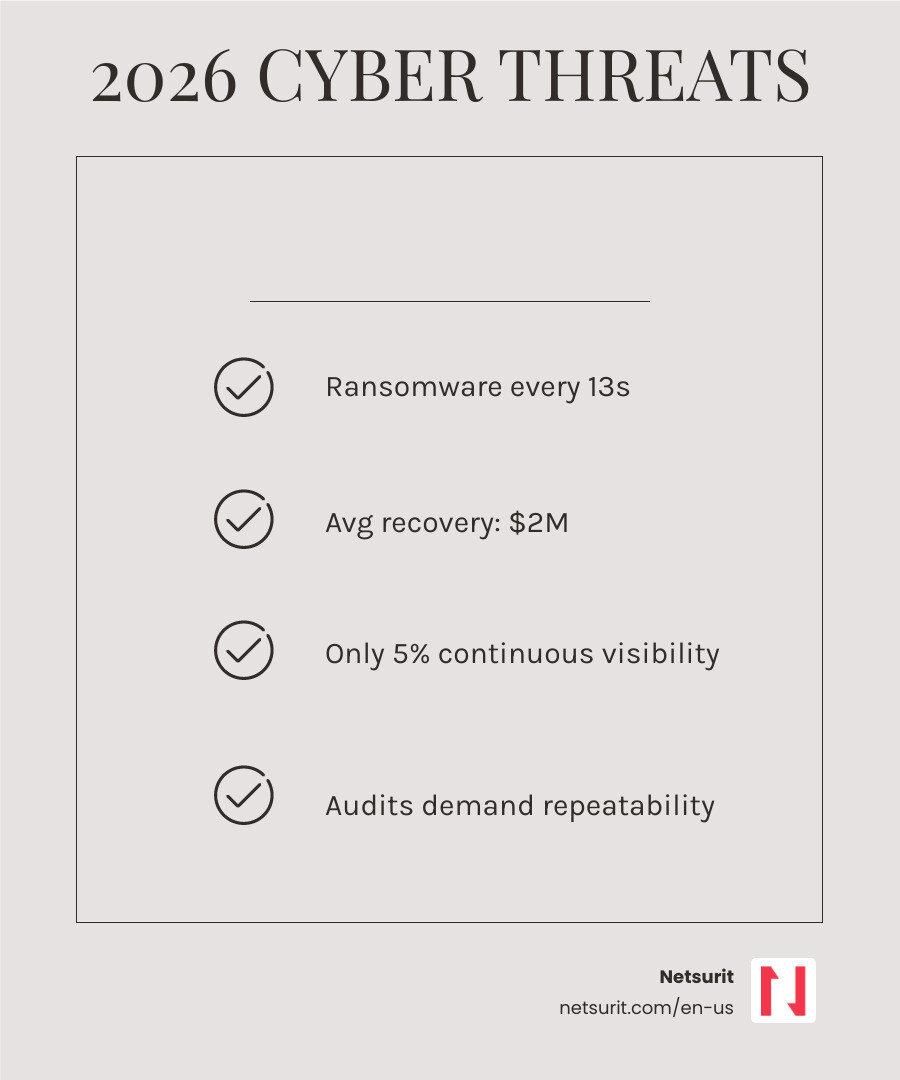
Vulnerabilities remain one of the top methods attackers use to breach organizations. The numbers are stark: ransomware hits a business every 13 seconds, and the average recovery cost runs close to $2 million. Yet only 5% of organizations achieve near-continuous vulnerability visibility — the level most frameworks actually demand.
The gap between scanning occasionally and running an audit-ready program is where most breaches happen.
Most organizations scan. Far fewer govern. A compliance audit adds the layer that turns raw scan data into documented evidence — remediation logs, risk decisions, policy mappings — that holds up under auditor scrutiny. Without that layer, you’re reactive. With it, you’re defensible.
The stakes in April 2026 are higher than ever. Regulatory bodies under PCI DSS, HIPAA, SOC 2, and NIST frameworks are tightening enforcement. Auditors no longer accept a single annual scan as proof of due diligence. They want evidence of repeatable processes, tracked remediation, and continuous improvement.
I’m Orrin Klopper, CEO of Netsurit — a managed IT and cybersecurity firm that has helped over 300 organizations build audit-ready security programs, including compliance vulnerability assessment audit processes that satisfy regulators across multiple industries. Over the next sections, I’ll walk you through the tools and practices that actually move the needle.
Handy compliance vulnerability assessment audit terms:
Core Components of a Compliance Vulnerability Assessment Audit
A successful compliance vulnerability assessment audit moves beyond simple bug hunting. It is a governance activity designed to prove that your security controls are functioning as intended. Unlike general vulnerability management, which focuses on technical remediation, a compliance audit focuses on the process and the proof.
The NIST SP 800-53A Rev. 5 provides the gold standard for these procedures, emphasizing that assessments must be tailored to the organization’s risk tolerance. At its core, an effective program requires:
- Comprehensive Asset Inventory: You cannot secure what you cannot see. This includes cloud resources, IoT devices, and remote endpoints.
- Risk-Based Prioritization: Using business context to decide what to fix first.
- Remediation Workflows: Documented steps showing who fixed what and when.
- Continuous Monitoring: Moving away from “point-in-time” snapshots toward real-time visibility.
For many of our clients in Houston and Tacoma, the biggest hurdle isn’t finding the vulnerabilities—it’s proving to an auditor that they have a repeatable system for managing them. You can learn more about how these pieces fit together in our guide to IT audits and assessments.
Defining the Scope of a Compliance Vulnerability Assessment Audit
Scope creep is the enemy of a clean audit. If your scope is too narrow, you miss critical risks; if it’s too broad, you drown in false positives. A proper audit scope should include:
- Network Scanning: Both internal and external perimeters.
- Host-Based Agents: To catch vulnerabilities on laptops that aren’t always on the office network.
- Application Security: Particularly for customer-facing portals or proprietary software.
- Database Integrity: Ensuring that the “crown jewels” of your data are not exposed by misconfigurations.
For businesses in the Texas area, specialized services like Sugar Land Vulnerability Assessment can help define these boundaries based on local regulatory pressures and industry-specific threats.
Evidence Collection for a Compliance Vulnerability Assessment Audit
In an audit, if it isn’t documented, it didn’t happen. Auditors will ask for more than just a PDF export of a scan. They look for:
- Scan Reports: Historical records showing consistency over time.
- Remediation Logs: Proof that “Critical” vulnerabilities were patched within your defined SLA (Service Level Agreement).
- Exception Documentation: Valid business reasons for why a specific vulnerability cannot be patched (and what compensating controls are in place).
- Audit Trails: Logs showing who accessed the scanning tools and when policies were changed.
Organizations in Conroe seeking Vulnerability Assessment services often find that the “paper trail” is the most time-consuming part of the process to build from scratch.
Top Tools for Executing a Compliance Vulnerability Assessment Audit
Choosing the right tool depends on your infrastructure’s complexity and your specific regulatory requirements. We’ve compared the three market leaders below:
| Feature | Tenable Nessus/io | Qualys VMDR | Rapid7 InsightVM |
|---|---|---|---|
| Primary Strength | Deepest vulnerability library | All-in-one asset & patch management | Risk scoring & exploit integration |
| Cloud Native? | Yes (Tenable.io) | Yes | Yes |
| Best For | Configuration & Compliance | Large, distributed environments | Modern DevOps/IT workflows |
| Local Support | Houston Network Audit | Houston Network Audit | Houston Network Audit |
Tenable Nessus and Tenable.io
Tenable is often considered the industry standard for a compliance vulnerability assessment audit due to its massive library of over 70,000 plugins. It excels at configuration auditing—checking if your servers match the CIS Benchmarks required by frameworks like SOC 2 or HIPAA.
- Works best when: You need highly granular configuration checks and have a dedicated security team to manage the data.
- Avoid when: You have a very small team that needs the tool to handle the patching for them.
- Risks: Can be resource-intensive on older network hardware during deep scans.
If you are looking for a baseline check, our Vulnerability Test services often utilize these enterprise-grade engines to provide clear, actionable results.
Qualys VMDR
Qualys VMDR (Vulnerability Management, Detection, and Response) is a cloud-native platform that integrates asset discovery, vulnerability management, and patch orchestration into a single console. It is particularly strong for organizations that need to prove “closed-loop” remediation to auditors.
- Works best when: You want a “single pane of glass” for both finding and fixing vulnerabilities.
- Avoid when: You prefer best-of-breed tools for each individual security function.
- Risks: The complexity of the full suite can lead to a steep learning curve.
To see how this fits into your broader security strategy, refer to our Cyber Security Assessment Checklist.
Rapid7 InsightVM
Rapid7 focuses on “Risk Scoring.” Instead of just telling you a vulnerability is “High,” it calculates a score based on how likely it is to be exploited in the real world. This is invaluable for meeting the “risk-based” requirements of the newer NIST and PCI DSS 4.0 standards.
- Works best when: You need to prioritize remediation based on actual attacker behavior.
- Avoid when: You are in a highly static environment where simple CVSS scores are sufficient.
- Risks: Requires an agent on endpoints for maximum visibility, which might not be feasible for all legacy systems.
Explore more about Network Vulnerability Assessment to understand how Rapid7 integrates with your existing infrastructure.
Prioritizing Vulnerabilities for Regulatory Adherence
Not all vulnerabilities are created equal. A “Critical” vulnerability on a guest Wi-Fi network is rarely as dangerous as a “Medium” vulnerability on a database containing patient records. In a compliance vulnerability assessment audit, prioritization must be documented and defensible.
We recommend using a risk heat map that combines:
- CVSS Score: The technical severity of the bug.
- Asset Criticality: How important that machine is to your business.
- Exploitability: Is there an active “exploit in the wild” being used by hackers right now?
Our Cyber Risk Assessment services help organizations move beyond the “patch everything” mentality, which is often impossible, and focus on the 10% of vulnerabilities that pose 90% of the risk. This approach is central to The Importance of Cybersecurity Compliance.
Mapping Vulnerabilities to Frameworks (PCI DSS, HIPAA, SOC 2)
Each framework has its own “flavor” of vulnerability requirements:
- PCI DSS: Requires quarterly external scans by an Approved Scanning Vendor (ASV) and internal scans after any significant change.
- HIPAA: Focuses on “Technical Safeguards” and requires a formal risk analysis that includes vulnerability identification.
- SOC 2: Expects you to monitor for unauthorized changes and have a process for identifying and correcting security deficiencies (Criteria CC7.1).
For those operating in the cloud, Cloud Security Assessments are essential to ensure that your AWS or Azure configurations meet these specific control mappings.
Remediation SLAs and Tracking
An auditor will look for your Service Level Agreements (SLAs). For example, a common policy is:
- Critical: Patch within 48 hours.
- High: Patch within 14 days.
- Medium: Patch within 30–90 days.
If you miss these deadlines, you must document why and what “compensating controls” (like a firewall rule or Web Application Firewall) are protecting you in the meantime. You can Uncover Hidden IT Infrastructure Risks Now by reviewing your current patch lag.
Common Pitfalls and Quick Wins in Audit Preparation
The most common failure in a compliance vulnerability assessment audit isn’t a technical bug—it’s a process failure.
Common Pitfalls:
- Shadow IT: Scanning only the servers you know about while an old, forgotten dev server in the corner remains unpatched and exposed.
- False Positives: Failing to “tune” your scanner, leading to 500-page reports that no one reads.
- Stale Data: Presenting a scan report from six months ago to an auditor in April 2026.
Quick Wins:
- Automate Discovery: Set your tools to automatically find new devices as they join the network.
- Credentialed Scanning: Always use “authenticated” scans. Unauthenticated scans only see the “surface,” while authenticated scans look inside the OS for missing patches.
- Use a Checklist: Follow a standardized Cybersecurity Checklist to ensure no stone is left unturned.
Integrating Penetration Testing with Assessments
A vulnerability assessment finds the “open windows,” but a penetration test tries to “climb through” them. While a compliance vulnerability assessment audit is usually automated, a pen test is a manual, human-led simulation of an attack.
Most frameworks, like PCI DSS and SOC 2, require both. The assessment provides the broad coverage, while the pen test provides the deep validation. You can learn more about how we handle this at Penetration Testing Services.
Moving Toward Continuous Monitoring
The “Diligent” 5% of organizations have moved away from annual audits toward continuous monitoring. This means:
- Real-time alerts when a new “Critical” vulnerability is released.
- Automated asset discovery.
- Dashboards that show compliance status at any given second.
This maturity level is the best way to ensure you don’t have to “scramble” when an auditor calls. It’s the ultimate strategy for How to Audit Your Way Out of a Data Breach Disaster.
Frequently Asked Questions about Compliance Audits
How often should we conduct vulnerability scans for HIPAA or PCI DSS?
For PCI DSS, you must conduct internal and external scans at least quarterly and after any significant change to your network. HIPAA is less prescriptive but requires regular risk analyses; most healthcare organizations in our Katy and Houston markets move to monthly or continuous scanning to meet the “reasonable and appropriate” standard.
What is the difference between a vulnerability scan and a penetration test?
A vulnerability scan is an automated “list” of potential weaknesses. A penetration test is a manual “attack” that proves those weaknesses can actually be used to steal data or take over a system. Scans are for breadth; pen tests are for depth.
Can small accounting firms in Houston skip formal vulnerability audits?
No. In fact, small businesses are often prime targets because attackers assume they have weaker controls. If you handle client financial data or tax records, you are likely subject to FTC Safeguards or SOC 2 requirements, making a compliance vulnerability assessment audit a legal and professional necessity.
Conclusion
Building a compliance vulnerability assessment audit program is about more than just checking a box for an auditor. It’s about building a resilient organization that can withstand the evolving threats of 2026. By choosing the right tools—whether it’s the deep configuration checks of Tenable, the orchestration of Qualys, or the risk-scoring of Rapid7—and backing them with solid governance, you move from being a target to being a fortress.
At Netsurit, we specialize in helping businesses in Houston, Seattle, and beyond navigate these complexities. Whether you need a one-time Network Vulnerability Assessment or a fully managed cybersecurity posture, we are here to help you crush downtime and unlock your business momentum.
Next Action: Review your last vulnerability scan. If it’s more than 30 days old, schedule an automated discovery scan today to see what has changed in your environment.