
Why Your Firm Needs Professional AI Audit Assistance Houston
AI audit assistance Houston is the process of using automated tools and expert analysis to find security gaps, compliance failures, and workflow inefficiencies in your AI systems — before regulators or attackers find them first.
Quick answer — what AI audit assistance covers:
| Area | What Gets Audited |
|---|---|
| Shadow AI | Unauthorized tools employees use without IT approval |
| Data security | PII exposure, encryption gaps, access controls |
| Compliance | HIPAA, SOC 2, Texas Identity Theft Laws |
| Workflow efficiency | Manual bottlenecks, automation opportunities |
| SEO & web performance | Page speed, broken links, local keyword gaps |
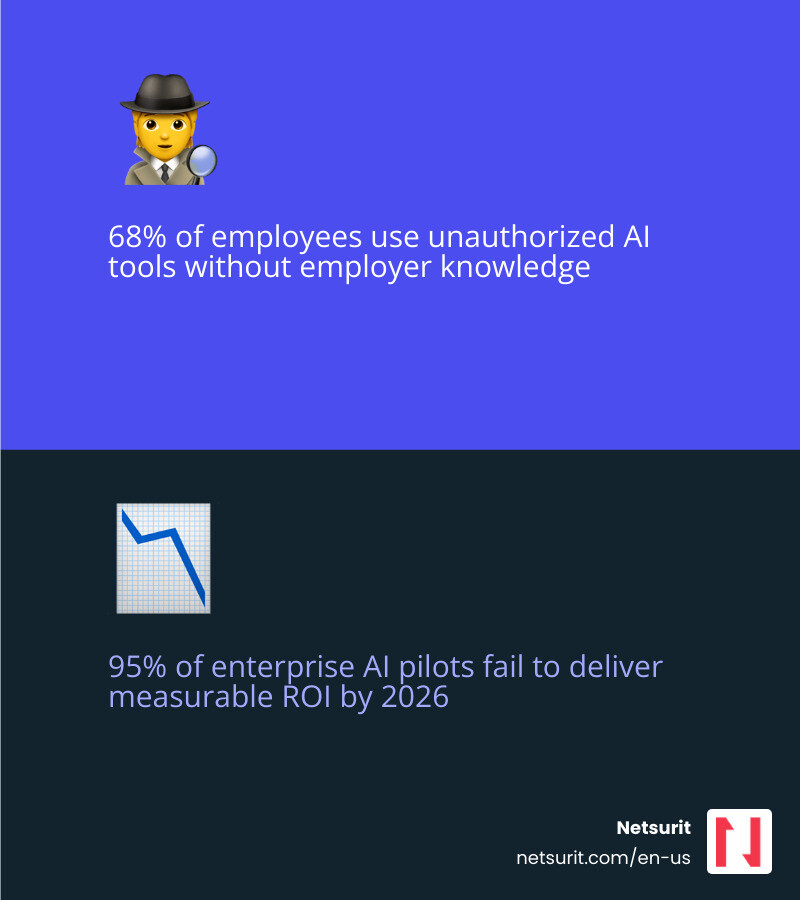
Here is the problem in plain numbers: 68% of employees use AI tools without their employer’s knowledge. Meanwhile, 95% of enterprise AI pilots fail to deliver measurable ROI. And only 8% of organizations have a governance framework actually embedded in their operations.
That gap — between AI adoption and AI control — is where real damage happens.
For Houston businesses, the stakes are higher than average. The city sits at the center of energy, healthcare, and professional services — all data-rich, heavily regulated industries. A single compliance miss in a Sugar Land accounting firm or a Katy medical practice can trigger federal investigations, client loss, or worse.
An AI audit does not just find problems. It tells you which problems matter most and what to fix first.
The good news: you do not need to figure this out alone.
I’m Orrin Klopper, CEO of Netsurit — a global IT services company with deep roots in Houston, where I’ve spent years helping regulated businesses navigate exactly this kind of AI audit assistance Houston challenge. With five Microsoft Solution Partner designations and hands-on experience across energy, finance, and healthcare sectors, our team has seen what separates firms that scale AI safely from those that don’t.
The Step-by-Step Process for AI Audit Assistance Houston
Effective auditing requires a structured approach. We move from discovery to remediation in a way that minimizes disruption to your daily operations.
- Inventory & Visibility: We identify every AI tool currently interacting with your data. This includes “Shadow AI”—apps like ChatGPT or Midjourney that employees use on personal browsers to draft client emails or summarize sensitive tax documents.
- Risk Assessment: We categorize tools based on their data access. A tool used for generating social media captions carries less risk than one used to analyze PII (Personally Identifiable Information) for a Sugar Land accounting firm.
- Data Classification: We map how data moves. If a staff member pastes a client’s financial record into a public AI model, that data is no longer private. We set boundaries to prevent this.
- Roadmap Development: We build a 90-day action strategy. This prioritizes high-risk vulnerabilities first, such as securing Microsoft Copilot permissions or implementing IT audits and assessments to ensure your infrastructure can handle automated workflows.
Scenario: A mid-sized accounting firm in Sugar Land discovered through an audit that 40% of their staff used unapproved AI browser extensions to “clean up” spreadsheet data. The audit allowed them to transition these users to a secure, enterprise-grade version of Copilot with strict data boundaries, eliminating the risk of data leakage.
Identifying High-Impact Automation Opportunities
An audit isn’t just about saying “no” to risky tools; it’s about finding where AI can actually make you money. Many Houston firms struggle with manual data entry—a notorious time-sink that leads to burnout and human error.
By conducting a Houston AI Automation Audit for Smarter Workflow Optimization, businesses can pinpoint exactly where friction exists. Common “quick wins” include:
- Lead Handling: Automatically capturing form submissions and assigning them to the right partner.
- Invoice Reconciliation: Using AI to match receipts to bank statements without manual typing.
- Document Summarization: Reducing the time spent on initial research for complex tax codes.
Example: A Conroe-based tax firm implemented automated document sorting following an AI audit. They saved over 15 hours per week during peak tax season, allowing senior partners to focus on high-value advisory work rather than administrative filing.
AI SEO Audits vs. Traditional Methods: Detecting Hidden Risks
In the competitive Houston market, being on the second page of Google is effectively being invisible. Traditional SEO audits often rely on monthly manual checks. AI audit assistance Houston provides real-time, granular detection of issues that human eyes often miss.
| Feature | Traditional SEO Audit | AI-Powered SEO Audit |
|---|---|---|
| Speed | Manual, periodic checks | Real-time, continuous monitoring |
| Scope | Sample of top pages | Scans every single page instantly |
| Detection | Broken links, basic keywords | Intent analysis, page speed bottlenecks |
| Mobile | Basic layout check | Real-time usability & speed simulation |
AI-driven audits excel at auditing smarter, not harder. They can detect if a large image on a Katy service business’s mobile site is slowing down load times, directly hurting their local search ranking.
Trade-offs of Automated Auditing
While AI is powerful, it is not a “set and forget” solution. Understanding the limits of automation is key to financial assurance.
- Works best when: Scanning for technical errors (404s, slow scripts, missing metadata) across thousands of pages.
- Avoid when: Evaluating brand voice or the “human feel” of high-stakes thought leadership content.
- Risks: AI tools can sometimes “hallucinate” data or flag non-issues as critical errors.
- Mitigations: Always maintain human oversight. An audit report is a guide, not a mandate. Use a local Houston partner to interpret the results through the lens of your specific business goals.
Navigating Texas Compliance: From UTHealth Policies to HIPAA
Texas has specific, stringent expectations for AI use. For instance, UTHealth Houston’s Policy 235 (HOP 235) establishes a framework for “Heightened Scrutiny AI Systems” (HSAIS). These are systems that make or control “consequential decisions”—decisions that impact a person’s legal rights, health, or financial status.
If your Houston business uses AI for hiring, credit scoring, or medical diagnostics, you likely fall under these heightened requirements. This involves:
- Mandatory Inventory: Registering all AI systems in a central database.
- Impact Assessments: Proving the tool isn’t biased before it goes live.
- Transparency: Disclosing to the public when they are interacting with an AI system.
Our managed IT services Houston ensure that your AI implementation doesn’t just work—it complies with the Texas Department of Information Resources (DIR) ethics standards and HIPAA requirements for PII protection.
Governance for Houston Tax and Accounting Firms
For firms handling sensitive financial data, “good enough” isn’t an option. You need a mature governance strategy. Currently, only 20% of companies have a mature governance plan for generative AI.
To bridge this gap, firms must focus on:
- SOC 2 & PCI DSS: Ensuring AI tools meet the same rigorous security standards as your accounting software.
- Vendor Due Diligence: Auditing the AI provider’s own security. Do they use your data to train their public models? If the answer is “yes,” your firm is at risk.
- Liability Management: Identifying who is responsible if an AI tool provides an incorrect tax calculation.
Consulting your guide to AI in tax and accounting helps define these boundaries early, protecting your firm from reputational damage and legal liability.
Maximizing ROI: What Houston Business Owners Should Ask
Investing in an AI audit can range significantly in cost, typically between $10,000 and $100,000 depending on the complexity of your systems and the size of your data footprint. However, the cost of not auditing is often much higher.
95% of AI pilots fail to deliver ROI because they lack a strategic foundation. By making financial statements smarter with AI, businesses can see measurable results—like a 30% increase in lead generation or a 20% reduction in operational overhead—within the first 30 to 90 days.
Questions for Your AI Audit Provider
Before hiring a service for AI audit assistance Houston, ask these critical questions:
- How do you handle data boundaries? Ensure your data stays within your private tenant and isn’t leaked to public models.
- What is your experience with Microsoft Copilot deployment? Copilot is powerful but can expose sensitive files if your SharePoint permissions aren’t audited first.
- Do you provide technical controls or just advice? You need a partner who can actually implement the fixes, not just hand you a PDF of problems.
- How do you conduct due diligence on financial scrutiny? Ensure the audit covers the accuracy and explainability of AI-generated financial outputs.
Frequently Asked Questions
How much does AI audit assistance Houston cost?
Pricing varies based on your needs. A one-time initial assessment might start at a few thousand dollars, while ongoing compliance management typically ranges from $1,000 to $5,000 per month. The ROI is found in preventing breaches (which average $4M+ globally) and recapturing lost billable hours.
Can AI audits help with local Houston SEO?
Yes. AI audits analyze local keywords (like “Sugar Land CPA” or “Katy tax prep”) and check your Google Business Profile for completeness. They also ensure your mobile layout is optimized for Houstonians searching for services on the go, which is a major ranking factor in April 2026.
Is AI safe for handling sensitive client tax data?
It can be, provided you use an “identity-first” security approach. This includes Zero Trust architecture, end-to-end encryption, and strict data boundaries. Public AI tools are generally not safe for sensitive data; you need an enterprise-grade solution configured by experts. For those building their own tools, following the Lone Star guide to AI chatbot development is essential for maintaining HIPAA and state-level compliance.
Conclusion
The “Wild West” era of AI adoption is ending. In April 2026, regulators, clients, and competitors expect your Houston business to use algorithms responsibly. Whether you are looking to secure your data, automate your tax firm’s workflows, or dominate local search results, professional AI audit assistance Houston is your best defense.
At Netsurit, we act as your elite tech partner to crush downtime and unlock business momentum. We don’t just find the gaps; we close them.
Ready to secure your algorithms? Contact our Houston team for AI support and let’s start your audit today.