
Defining the Role and Scope of Global IT Services
A global IT solutions provider runs the systems that keep multi-site businesses operating without interruption. Unlike a local repair shop, these firms handle high-impact work such as Professional IT Services, ERP implementation, Product Lifecycle Management (PLM), and cloud architecture.
By May 2026, the role has expanded well beyond maintenance. These providers design the platforms, controls, and support models that let a firm in Houston access the same systems as its office in London, with consistent performance and security. The practical benefit is simple: you replace fragmented IT with one operating model that scales.
Distinguishing Providers from Local MSPs
A local Managed Service Provider (MSP) is useful for on-site support and day-to-day hardware issues. A global IT solutions provider solves a different problem: complexity across locations, platforms, and compliance regimes.
- Follow-the-sun support: Teams across the U.S., India, and Europe can provide continuous coverage. When your Houston office closes, another team picks up Managed IT Services work without a handoff gap.
- Specialized engineering: Large global providers can staff niche expertise in cloud, ERP, AI, and integration work that smaller local firms usually cannot maintain full time.
- Global reach: They manage connectivity, vendor coordination, and regulatory requirements across multiple countries at once.
For example, a tax and accounting firm with offices in Houston and Sugar Land may need secure access to client files after hours during filing season. A local MSP can support desktops and printers. A global provider is better suited to run the cloud environment, enforce access controls, and keep support available around the clock.
Trade-offs of Global Engagement
| Works best when… | Avoid when… |
|---|---|
| Scaling operations across multiple states or countries. | You only have one office and need a technician to physically move cables. |
| Requiring deep expertise in SAP, AI, or complex ERPs. | Your budget is extremely limited and your IT needs are basic. |
| Needing 24/7 proactive security monitoring. | You prefer a “break-fix” relationship over a strategic partnership. |
Risks & Mitigations: The biggest risk is cultural or communication misalignment. We mitigate this at Netsurit by providing localized account management in hubs like Houston and Seattle, so you get a local point of contact backed by broader delivery capacity.
Core Services of a Global IT Solutions Provider
The best providers focus on one outcome: less downtime and fewer surprises. That means building an IT Strategy that ties security, infrastructure, and application support into one operating model instead of a set of disconnected tools.
Core offerings typically include:
- Cybersecurity and managed SOC: Continuous monitoring through a Security Operations Center (SOC) to detect and contain threats early. The practical advantage of a global SOC is shared threat intelligence. If analysts identify a new ransomware pattern in Europe, your Houston environment can be protected before your staff logs in.
- Application development: Building and supporting custom software that fits your workflows. In 2026, that often includes AI-assisted development, integration work, and modernization of aging internal tools.
- Business continuity: Keeping data available and staff productive during outages, storms, or office disruptions. This usually includes geo-redundant backups and tested recovery procedures across multiple secure locations.
Scenario: International Tax Compliance in Houston
Consider a mid-sized accounting firm headquartered in Houston with satellite offices in Sugar Land and Conroe. It manages tax filings for clients with international assets and must align reporting with both US GAAP and international standards.
- The problem: Staff manually reconcile data across jurisdictions, which slows close cycles and increases error risk. The internal IT team also struggles to secure cross-border data transfers.
- The global solution: A global provider implements automated IFRS reporting, cutting document processing time by 20%. The provider also sets up encrypted data tunnels and policy controls that support both Texas privacy requirements and international data sovereignty rules.
- The result: The firm handles more client work without adding headcount, using Large Business IT Services in a way that fits a mid-sized operation.
Maximizing ROI with a Global IT Solutions Provider
Many mid-sized businesses underestimate the cost of a small internal IT team. One or two in-house specialists can become a single point of failure, especially during tax season, audits, or employee turnover.
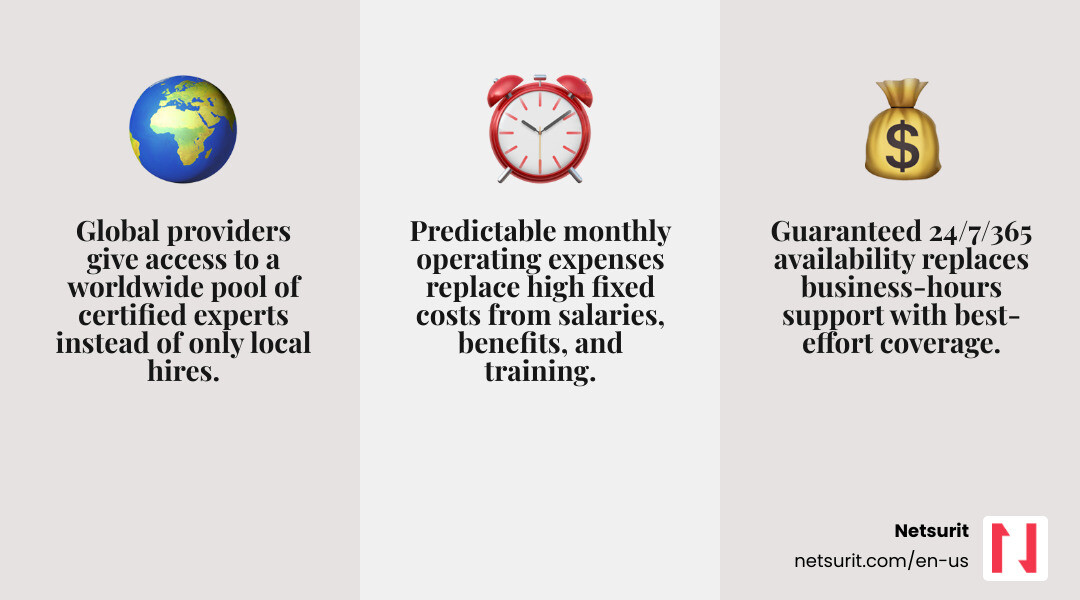
| Factor | Internal IT Team | Global IT Provider |
|---|---|---|
| Talent Access | Limited to local hires | Global pool of certified experts |
| Availability | Business hours + “Best effort” | Guaranteed 24/7/365 |
| Cost | High (Salary, benefits, training) | Predictable monthly OpEx |
| Scalability | Slow (Must hire/onboard) | Resources on demand |
| Security | Reactive (Firefighting) | Proactive (Managed SOC) |
A Katy-based boutique tax firm is a good example. Hiring one security engineer, one cloud admin, and one support lead may be unrealistic. A provider spreads those skills across many clients, which often gives you broader coverage for a lower and more predictable monthly cost.
Accelerating Digital Transformation with AI and Cloud
By May 2026, digital transformation is no longer optional for firms with distributed teams, compliance exposure, or tight reporting cycles. A global it solutions provider uses Cloud Services and AI to automate routine work, improve visibility, and reduce the drag of legacy systems.
One clear shift is toward agentic AI, which means AI systems that complete defined tasks instead of only generating responses. For example, an AI agent can monitor cloud spend across Azure and AWS, flag anomalies, and resize underused resources automatically based on policy. The value is operational, not theoretical: lower waste, fewer manual reviews, and faster decisions.
Modernizing Legacy Systems for Accounting Firms
For a tax practice in Conroe, TX, the main blocker is often an old ERP that does not connect cleanly to newer apps. That creates data silos, duplicate entry, and audit headaches.
- The solution: Migrate to Microsoft Solutions such as Azure and Microsoft 365, with the provider handling data mapping, security controls, and cutover planning.
- The impact: The firm gains real-time audit trails and stronger document control, both of which matter during reviews and filing periods. Low-code tools can also reduce application development effort by 45%, which helps the firm launch client portals and workflow apps faster.
A Sugar Land accounting firm can use this model to connect tax prep, document storage, and approval workflows in one environment. That shortens turnaround times and reduces the manual handoffs that usually cause delays.
Future Trends: What to Watch in 2027
As 2027 approaches, three shifts are worth watching:
- Nearshoring evolution: More delivery work is moving closer to U.S. time zones, including Mexico and Canada. That can improve collaboration speed for firms in Houston, Tacoma, or Seattle.
- 5G-enabled edge computing: Businesses that need low-latency processing, especially in logistics or manufacturing, will process more data locally instead of sending everything back to centralized systems.
- Quantum-resistant encryption: Providers are starting to test post-quantum cryptography now. If your provider has no roadmap for it, ask why.
The trade-off is that newer platforms need governance. AI agents, low-code apps, and multi-cloud environments save time only when you define access rules, approval steps, and rollback plans upfront.
Selection Criteria and Risk Management
Choosing a global it solutions provider is a risk decision as much as a technology decision. You are selecting a partner that will influence your Cyber Risk Compliance, uptime, and recovery speed when something goes wrong.
A weak provider can create two expensive problems: vendor lock-in and uneven security across regions. A strong one gives you clear controls, measurable service levels, and a practical path to scale.
Evaluating a Global IT Solutions Provider for Security
Security should be visible and testable. A reputable provider explains which frameworks it follows, how it enforces policy, and what happens during an incident.
- Zero Trust architecture: Every user and device must be verified, whether they work in a Houston office or from home in Katy. This limits lateral movement if an account is compromised.
- Multi-factor authentication (MFA): A baseline requirement for all Security Services. In 2026, stronger options include biometrics or hardware keys for higher-risk users.
- Incident response: Ask for a documented process with named responsibilities and response targets. You need to know how quickly the provider can isolate affected systems, preserve evidence, and restore operations.
For example, a Houston-area CPA firm handling payroll and tax records should ask for proof of logging coverage, endpoint controls, and backup testing. If the provider cannot show recent reports or explain the escalation path in plain English, that is a warning sign.
Trade-offs in Provider Selection
| Works best when… | Avoid when… |
|---|---|
| Compliance (HIPAA, SOC 2) is a legal requirement for your firm. | You are looking for the “cheapest possible” option without regard for risk. |
| You want a long-term roadmap and IT Strategy. | You have a highly proprietary, non-standard tech stack you refuse to modernize. |
| You need to scale rapidly across new geographic regions. | You prefer to manage all IT decisions at a granular, daily level. |
Risks & Mitigations: The main risk is vendor lock-in, where switching becomes costly or disruptive. To reduce that risk, use Microsoft 365 and multi-cloud approaches where appropriate, and require clear contract terms for data ownership, export rights, and transition support.
Frequently Asked Questions about Global IT
How do global providers handle local compliance like HIPAA?
Global providers use specialized compliance-as-a-service models. They map international standards to local requirements (like HIPAA for healthcare firms in Texas or GDPR for European branches), ensuring that data storage and access meet US federal laws regardless of where the support team is located. This includes signing Business Associate Agreements (BAAs) and ensuring all support staff are trained on specific US privacy regulations.
What is the typical onboarding timeline for enterprise solutions?
For standard Managed IT Services, onboarding typically takes 30 to 90 days. This period includes a full audit of your existing infrastructure, security hardening, and staff training. Complex ERP migrations or global cloud deployments can take 6 to 12 months, depending on the volume of data and the number of global locations involved. A phased approach is usually recommended to minimize business disruption.
Can a global provider support small boutique firms in Katy, TX?
Yes. Many global providers offer Small Business and Non-profit IT Services that provide “enterprise-grade” security and cloud tools at a scale that fits a smaller headcount. This allows boutique firms to “punch above their weight class” technologically, using the same AI and cybersecurity tools as Fortune 500 companies without the Fortune 500 price tag.
What happens if the global provider’s international office goes offline?
Top-tier providers use a redundant delivery model. If a service center in one region experiences an outage (due to weather, political instability, or technical failure), traffic is automatically rerouted to another global hub. This is the core benefit of the “Follow-the-Sun” model—your support is never dependent on a single geographic location.
Conclusion
Partnering with a global it solutions provider is about more than just outsourcing; it’s about gaining a strategic ally that can help you scale, secure your assets, and innovate with AI. At Netsurit, we focus on helping you achieve your “Dream 20” — your most ambitious business goals — by removing the technical friction that holds you back.
Whether you are an accounting firm in Houston or a growing mid-sized business in Seattle, the right technology partner will turn IT from a cost center into a momentum-builder. The checklist is clear: prioritize security, demand scalability, and ensure your provider has the global reach to match your aspirations. Explore Our Services to see how we can support your journey toward a more resilient and innovative future.