
Hiring an Android Game Development Company: What You Need to Know Before You Sign Anything
Choosing the right android game development company is one of the most consequential decisions you’ll make for your game project — and one of the easiest to get wrong.
Quick answer: How to find the right Android game development company
| What you need | What to look for |
|---|---|
| Full game from scratch | Full-cycle studio with Unity/Unreal experience and post-launch support |
| Specific feature (AR, multiplayer) | Niche specialist with proven shipped titles in that area |
| Extra dev capacity | Staff augmentation or co-development model |
| Budget confidence | Fixed-milestone contracts, not open-ended hourly billing |
| Quality signal | Verified reviews on Clutch or GoodFirms + live store links in portfolio |
Here is why this decision matters right now. The global mobile gaming market is on track to reach $211.8 billion in 2026, and Android drives the majority of that — holding over 70% of the global mobile OS market share. That scale means more studios competing for your budget, more marketing claims to sort through, and more risk if you pick the wrong partner.
The core problem isn’t finding a studio. There are over 1,190 listed on major directories alone. The problem is shortlisting one that fits your specific scope, timeline, and technical requirements — without getting dazzled by a polished pitch deck and a portfolio that doesn’t match your genre.
This guide cuts through that noise. It gives you a practical framework to evaluate studios by service depth, technical discipline, review quality, and contract structure — so you make a decision you can defend.
I’m Orrin Klopper, CEO and co-founder of Netsurit, a global IT services and digital transformation company, and I’ve spent over 30 years helping business leaders make smarter technology decisions — including evaluating external development partners in the mobile and android game development company space. In the sections ahead, I’ll walk you through exactly how to build a shortlist, score your options, and avoid the mistakes that derail most projects before a single line of code ships.
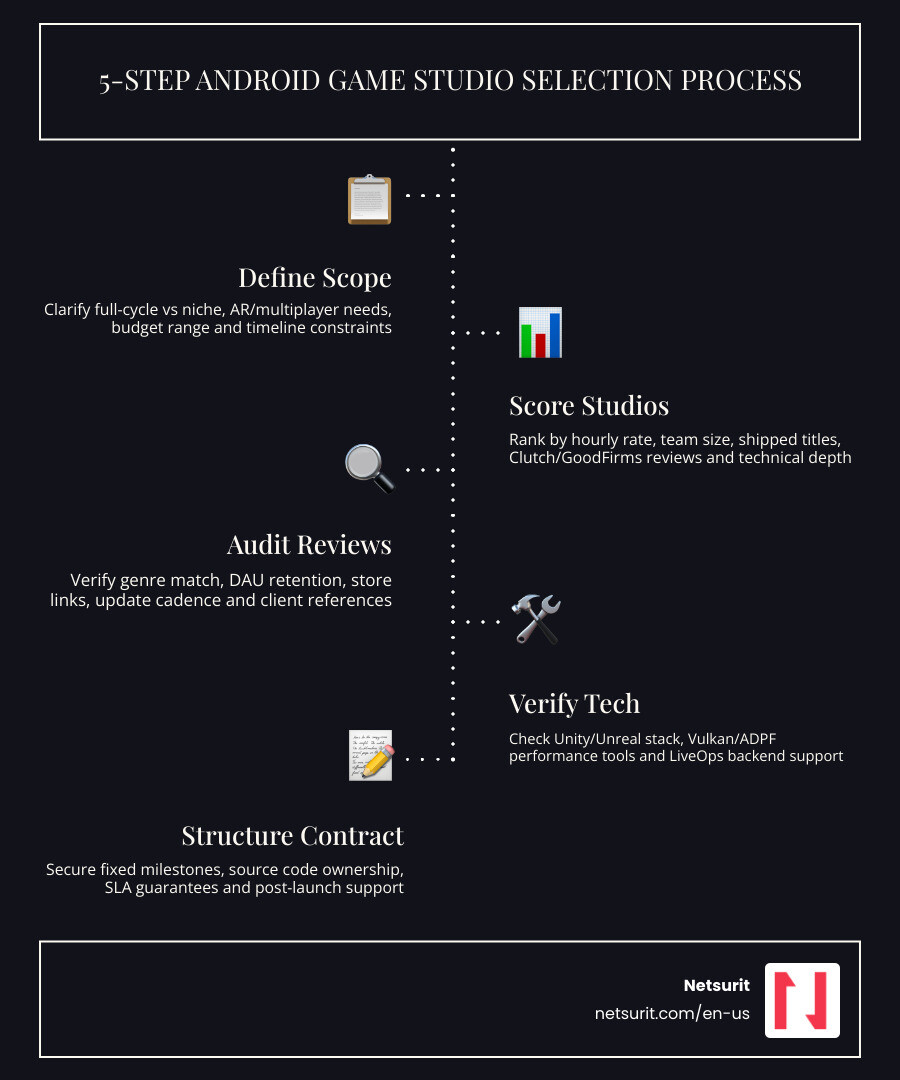
Start with the right hiring model, not the flashiest portfolio
We often see businesses get distracted by a studio’s high-fidelity trailers before defining how that studio will actually work with their team. The “flashiest” portfolio does not guarantee a smooth delivery. You need to decide if you are hiring a partner to handle the entire project lifecycle or if you just need a few expert hands to fill a gap.
When an android game development company is the right choice
A full-cycle android game development company is your best bet when you have a vision but lack an internal production team. These partners handle everything: concept art, engineering, Quality Assurance (QA), and even the labyrinthine process of Google Play Store submission.
For example, a tax firm in Sugar Land, Texas, looking to build a gamified “Tax Prep Academy” app would benefit from a full-cycle partner. They don’t just need code; they need game designers to make the learning fun, artists to create a friendly UI, and LiveOps experts to update content as tax laws change. A full-cycle partner ensures these elements talk to each other from day one.
When to choose a niche studio or staff augmentation instead
Sometimes, you don’t need a whole village. If you already have a core team but lack specific expertise—say, in ARCore for an augmented reality feature or Unreal Engine 5 for high-end graphics—a specialized niche studio or staff augmentation is more efficient.
Imagine a mid-sized accounting practice in Conroe, Texas, that already has a mobile app but wants to add a 3D data visualization “mini-game.” Hiring a full-cycle studio would be overkill. Instead, they should look for a team of Unreal Engine specialists who can “bolt on” to their existing project.
Works best when, avoid when, risks, mitigations
- Works best when: Your project scope is well-defined, and you have clear milestones for delivery.
- Avoid when: You have no internal product owner to manage the vendor relationship, leading to “ship and forget” syndrome.
- Risks: Vendor lock-in (where only they can update the code) and timeline creep due to poor communication.
- Mitigations: Ensure you own the source code in the contract and insist on using industry-standard tools like Unity or Unreal Engine so another team can take over if needed.
Compare companies using a scorecard you can defend
Choosing a partner shouldn’t be a gut feeling. You need a scorecard. We recommend weighting your criteria based on what actually drives success: technical depth, communication, and post-launch stability.
| Criteria | Full-Cycle Partner | Specialized Studio |
|---|---|---|
| Project Ownership | High (Handles Concept to Launch) | Low (Focuses on specific tasks) |
| Technical Depth | Broad (Art, Code, Backend, QA) | Deep (Experts in one niche) |
| Cost Structure | Usually Milestone-based | Often Hourly or T&M |
| Post-Launch | Full Support & LiveOps | Limited to handoff |
How top firms are ranked in 2026
In 2026, rankings are no longer just about who has the biggest marketing budget. Verified review platforms like GoodFirms and Clutch now prioritize “Retention Outcomes” and “Google Play Readiness.” A company that has 200+ completed projects and over 1.5 billion total installs is a safer bet than a newcomer with one viral hit. You can find detailed rankings for regional experts here: Top 10+ Game Development Companies in Texas – 2026 Reviews.
Shortlist examples: Cubix, SDLC Corp, Juego Studios, iLogos
Several names consistently rise to the top of the android game development company market.
- Cubix is known for its massive scale, having delivered over 1,300 projects globally since 2008.
- SDLC Corp offers a broad range of services, making them a “one-stop shop” for enterprise-grade mobile solutions.
- Juego Studios differentiates itself through technical optimization, using tools like Unity’s DOTS to ensure games run smoothly on older Android hardware.
- iLogos Game Studios brings a massive track record, with over 1.5 billion installs across their portfolio.
A CPA firm in Katy, Texas, looking to build a high-stakes “Financial Simulator” would likely look at Juego Studios for their optimization depth or SDLC Corp for their enterprise-focused security standards.
How to audit reviews and portfolios without getting fooled
Don’t just look at the screenshots. Follow these steps to audit a portfolio:
- Check Live Links: If the game isn’t on the Google Play Store anymore, ask why.
- Verify DAU Claims: Use third-party tools to see if the “millions of downloads” claim holds up.
- Look for Genre Match: If you want a multiplayer strategy game, don’t hire a studio that only builds hyper-casual puzzle games.
- Reference Calls: Ask to speak with a current client, not just a past one.
Check service depth before you check price
Price is a vanity metric; service depth is a sanity metric. If an android game development company can’t explain their QA automation or how they handle Android’s massive device fragmentation, their low price will eventually cost you double in bug fixes.
Services every serious android game development company should offer
A professional studio must provide more than just coding. They should offer:
- Game Design & Prototyping: Validating the “fun factor” before building.
- Art Pipeline: 2D/3D modeling using Blender or Maya.
- Multiplayer Backend: Using AWS, Firebase, or PlayFab for stable connectivity.
- Compliance: Ensuring the game meets the latest Google Play safety and privacy standards. For a deeper dive into what these services look like, check out Android Game Development Services.
How companies differentiate beyond “we build 2D and 3D games”
Top-tier firms differentiate through their process. Some, like Cubix, focus on sheer scale and speed. Others, like Juego Studios, focus on “aggressive memory management” to ensure a game runs at a stable 60 FPS even on mid-tier devices.
A Houston-based CPA firm might value a partner that offers “transparent delivery processes”—meaning they get access to the Jira board and can see daily progress—over a studio that works in a “black box” and only emerges every two months with a build.
Full-cycle partner vs specialist studio: what changes after launch
The real work starts after the “Publish” button is pressed. A full-cycle partner usually stays on for LiveOps—managing content updates, balance tuning, and responding to store reviews. A specialist studio might hand off the code and wish you luck. If you don’t have an internal team to handle crashes and player feedback, the full-cycle model is the only way to protect your investment.
Verify the technical stack and performance discipline
Android development is harder than iOS because of fragmentation. There are thousands of different screen sizes, chipsets, and RAM configurations. Your android game development company must have a rigorous technical discipline to handle this.
The tools top Android studios use in 2026
In 2026, the standard stack includes:
- Engines: Unity (Universal Render Pipeline) and Unreal Engine 5.
- AI Assistants: Using Claude, GitHub Copilot, and ChatGPT to speed up boilerplate coding and asset generation.
- Backend: Firebase for analytics and PlayFab for multiplayer lobbies.
- Performance: Vulkan API for high-end graphics and ADPF (Android Dynamic Performance Framework) for thermal management.
How studios prevent lag, crashes, and thermal throttling on Android
To prevent your game from turning a user’s phone into a space heater, studios must use:
- Android GPU Inspector (AGI): To find where the graphics bottlenecks are.
- LOD (Level of Detail) Scaling: Reducing polygon counts for objects that are far away.
- ASTC Texture Compression: Keeping file sizes small without losing visual quality.
- Thermal Management: Using ADPF to tell the game to scale back performance before the device throttles the CPU. You can see Google’s official stance on these tools at the Develop Android games Developer center.
What to watch next: AI workflows and Google Play Games on PC
The biggest shift in 2026 is the expansion of Android games to the PC via Google Play Games. This requires developers to optimize for mouse and keyboard input, not just touch. Furthermore, AI is now being used for “Procedural Content Generation”—meaning a studio can build a game with 1,000 levels for the price of 100.
An accounting app in Sugar Land could use these AI workflows to create personalized “Financial Quests” for users, dynamically generating challenges based on their specific spending habits.
Price the project by risk, not just hours
We recommend looking at project costs through the lens of complexity. A “simple” game with a buggy backend is more expensive in the long run than a well-architected game with a higher upfront cost.
Typical pricing ranges and what changes the budget
While we won’t list specific dollar amounts, the primary cost drivers are:
- Genre: A multiplayer RPG is significantly more expensive than a 2D puzzle game.
- Art Scope: 3D high-fidelity assets take much longer to produce than 2D sprites.
- Backend Load: Real-time matchmaking and global leaderboards require ongoing server costs and complex engineering.
- Region: Studios in Texas will have different overhead than offshore teams, though local partners often provide better communication and legal protection.
Questions to ask before you sign a statement of work
Before you sign, get clear answers on these:
- Who owns the IP? (It should be you).
- What is the device support matrix? (Which specific Android phones will be tested?).
- What is the SLA for post-launch bugs?
- Do I have access to the source code repository (Git)?
Red flags that usually predict missed deadlines
Watch out for “Yes Men.” If a studio says they can build a “Call of Duty” clone in three months for a tiny budget, they are lying. Other red flags include:
- No dedicated Project Manager or Producer.
- Vague QA plans that don’t mention physical device testing.
- A “Conroe tax practice” example: If a studio can’t explain how they’ll handle high-traffic periods (like tax season), they likely haven’t thought about backend scalability.
Make the final decision with a practical shortlist
Your final decision should be based on a weighted scoring system. Give points for technical fit, cultural alignment, and their performance on a “Paid Discovery” phase.
Your 30-day process to choose the right android game development company
- Days 1-7: Define your Requirements Brief and send out RFPs.
- Days 8-14: Review vendor demos and shortlist the top three.
- Days 15-21: Conduct technical interviews with their lead developers.
- Days 22-30: Run a “Pilot Sprint” or paid prototype phase to see how they work in real-time.
Final recommendation for businesses that need reliability over hype
Choose the partner that talks more about your business goals and less about their “revolutionary” engine. A reliable android game development company will be honest about what can’t be done within your budget and will offer a roadmap that prioritizes a stable Minimum Viable Product (MVP) over a feature-bloated failure.
Next step if you need outside technical guidance
At Netsurit, we don’t just fix servers; we act as an elite tech partner to help you navigate complex digital transformations. If you are struggling to vet an android game development company or need a second set of eyes on a technical architecture, we can help. We provide the cybersecurity, AI strategy, and managed IT oversight that ensures your external projects don’t create internal headaches.
For more information on how we help businesses in Houston, New York, and beyond scale their technology safely, visit our managed IT services page.