Why Understanding Audit Risk Is Your First Line of Defense
To reduce audit risk, you must strengthen internal controls, maintain meticulous records, and use modern technology to automate compliance and detect anomalies. This combination of process discipline and IT solutions is your best defense against scrutiny from the IRS and financial statement auditors.
Quick Answer: How to Reduce Audit Risk
- Accuracy First – E-file returns (0.5% error rate vs. 21% for paper) and report all income from W-2s, 1099s, and K-1s.
- Document Everything – Keep receipts, travel logs, and detailed records for every deduction.
- Strengthen Controls – Separate duties, enforce access controls, and implement regular reconciliations.
- Use Technology – Deploy AI-powered analytics and automated monitoring to catch errors in real-time.
- Avoid Red Flags – Be cautious with large deductions, Schedule C losses, and unusually round numbers.
Recent studies show most Americans fear an IRS audit more than identity theft. This fear is understandable but manageable. The stakes are real: in 2021, the IRS sent nearly 16 million notices for math errors alone. For businesses, a failed financial statement audit can trigger regulatory penalties and reputational damage. For example, Kraft Heinz paid $62 million to settle SEC charges over improper accounting, with executives facing personal penalties.
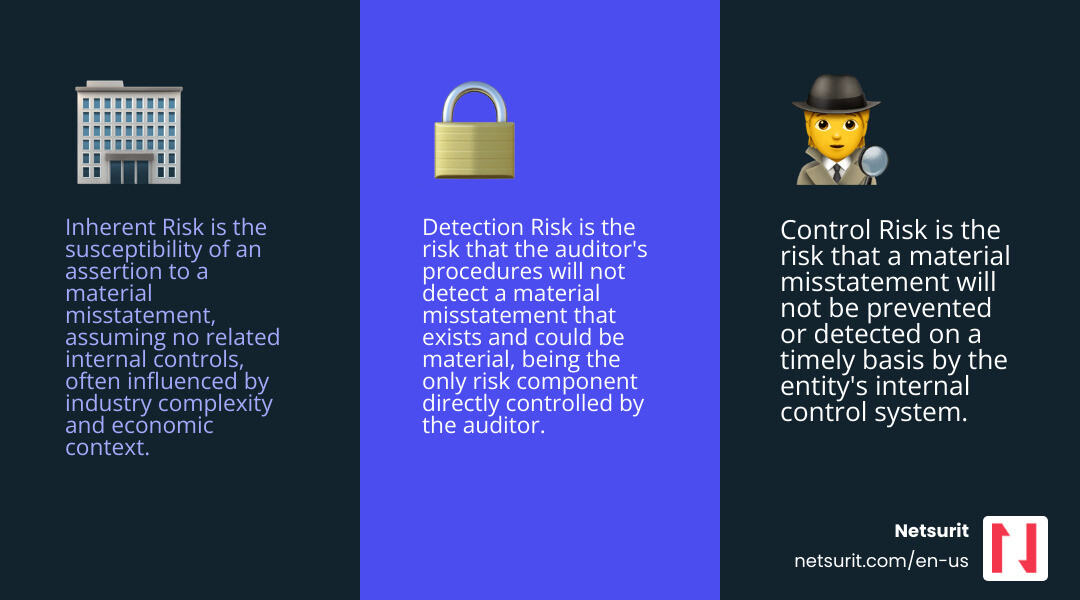
Audit risk comprises inherent risk (business complexity), control risk (internal safeguard effectiveness), and detection risk (what an auditor might miss). You can’t change inherent risk—a Houston firm serving oil and gas clients faces more complexity than one serving retail shops—but you can minimize control and detection risk with disciplined processes and clean data.
This article provides a concrete playbook for reducing your exposure. I’m Orrin Klopper, CEO of Netsurit. For 29 years, I’ve helped over 300 organizations in high-stakes industries like accounting and healthcare build secure IT infrastructures that reduce audit risk by ensuring data integrity and automating financial controls.
Deconstructing the Threat: The Three Pillars of Audit Risk
To reduce audit risk, you must understand its components. The audit risk model is a formula: Audit Risk (AR) = Inherent Risk (IR) x Control Risk (CR) x Detection Risk (DR). The auditor’s goal is to reduce this overall risk to an “appropriately low level.”
Audit risk is the danger of an auditor issuing a clean opinion on financial statements that are materially misstated. A “material misstatement” is an error significant enough to influence a user’s economic decisions. Understanding these components is key to managing them. You can find more details about IT audits and assessments in our dedicated resources here.
Inherent Risk: The Dangers You’re Born With
Inherent risk is the raw probability of a material misstatement in your financial statements, assuming no internal controls exist. It’s intrinsic to your business and industry. Factors include:
- Industry-specific risks: Some industries are naturally more complex or volatile.
- Transaction complexity: Intricate financial transactions are more prone to error.
- Economic context: Changing markets or economic downturns increase risk.
- Susceptibility to misstatement: Accounts involving significant estimates carry higher inherent risk.
For example, a Houston accounting firm serving oil and gas clients faces high inherent risk from volatile asset valuations and complex regulations. You can’t control inherent risk, but knowing it helps you focus on what you can control.
Control Risk: When Your Safety Nets Fail
Control risk is the chance that your internal controls will fail to prevent or detect a material misstatement. Weak or absent controls mean high control risk. Common causes include:
- Ineffective policies: Controls are poorly designed or outdated.
- Lack of oversight: Management fails to review transactions or reports.
- Human error: Employees fail to follow procedures.
- Fraud prevention failures: Controls are not robust enough to deter fraud.
A CPA firm in Sugarland, TX, that skips mandatory multi-factor authentication on its client portal has high control risk. This single failure point invites data breaches and unauthorized access, risking client data integrity and legal trouble. Strengthening internal controls is one of the most effective ways to reduce audit risk.
Detection Risk: What the Auditor Might Miss
Detection risk is the chance an auditor’s procedures will miss a material misstatement. Unlike the other two risks, this one is primarily influenced by the auditor’s work, which includes:
- Auditor procedures: The specific tests and analyses they perform.
- Substantive testing: Detailed examination of transactions and account balances.
- Sampling errors: The risk that a selected sample isn’t representative.
If your inherent and control risks are high, auditors must perform more rigorous testing to lower their detection risk. If your risks are low, they can accept a higher detection risk. As a business, your role is to provide clean, well-supported data, which makes the auditor’s job easier and helps them lower detection risk, as guided by standards like the PCAOB’s AS 1101.
Fortifying Your Defenses: Practical Steps to Reduce Audit Risk
This section focuses on proactive measures any business can take, with a focus on IRS audit triggers and preparation.

IRS audits are statistically rare but stressful. Proactive preparation and attention to detail are your best defense.
Master Your Numbers: Accuracy and Honesty Above All
The most powerful way to reduce audit risk is to ensure your tax returns are accurate and honest. Most IRS notices stem from basic errors.
- Double-check figures: Manual data entry is a common source of errors. Paper returns have a 21% error rate versus just 0.5% for e-filed returns.
- Report all income: The IRS automatically cross-references income from W-2s, 1099s, and K-1s. A mismatch triggers a CP-2000 notice. If a 1099 is wrong, get it amended; don’t omit the income.
- Avoid math errors: The IRS sent nearly 16 million automated notices for simple arithmetic mistakes in 2021.
- E-file your returns: Built-in checks in e-filing software drastically reduce errors, making an audit less likely. We help Houston accounting firms streamline this with our managed IT services for accounting firms.
Substantiate Everything: The Power of Good Records
The IRS mantra is: “If it’s not documented, it didn’t happen.” Good record-keeping is your best defense, especially for deductions.
- Document deductions: Back every deduction with clear documentation like receipts, invoices, and bank statements. For non-cash charitable contributions, follow IRS Publication 526 for substantiation rules.
- Use a record-keeping system: Cloud-based expense tracking apps, synced with accounting software, can automate much of this process.
- Keep business expense receipts: If you file Schedule C, have a receipt for every business deduction. The IRS scrutinizes Schedule C filers, particularly those with consecutive losses, which may suggest a hobby, not a business.
- Maintain travel logs: If you split time between states like Texas, keep detailed travel logs, calendars, and utility bills to defend your tax residency if challenged.
For example, a consultant in Katy, TX, uses a cloud expense app to auto-categorize and store receipts for business expenses, making substantiation effortless and reducing the risk of disallowed expenses.
Avoid Red Flags and Scams
Certain actions can increase your chances of an IRS audit.
- Unusually large deductions: Deductions that are disproportionately high compared to your income are a red flag. Claiming a charitable deduction for 40% of your income will get a closer look.
- Schedule C losses: Reporting losses for three consecutive years on Schedule C can signal to the IRS that your “business” is a hobby, leading them to disallow your expense deductions.
- High income-level scrutiny: High-income earners (over $1 million) are audited more often due to complex returns. Some low-income earners claiming certain credits also face higher scrutiny.
- “Dirty Dozen” tax scams: Avoid any schemes on the IRS’s annual “Dirty Dozen” list.
- Unsigned tax preparer returns: A reputable tax preparer always signs your return and provides their Preparer Tax Identification Number (PTIN). An unsigned return is a major red flag.
Common IRS Red Flags:
- Significant income jump or drop
- Large, unsubstantiated deductions relative to income
- Claiming 100% business use of a vehicle
- Multiple years of business losses on Schedule C
- Round numbers for major expense categories
The Corporate Playbook: Strengthening Internal Controls and Processes
This section details how to build a resilient internal framework to minimize financial statement audit risk.

Beyond individual tax returns, businesses face financial statement audits. Here, the focus shifts to the reliability of your internal systems. Strengthening these controls is paramount to managing your overall audit risk.
How to build a fortress of internal controls to reduce audit risk
Internal controls are the processes that ensure your financial data is accurate, reliable, and compliant. They are your first defense against errors and fraud.
- Segregation of duties: No single employee should control a transaction from start to finish. The person who authorizes payments should not be the one who records them.
- Access controls: Restrict access to sensitive systems and data with strong passwords, multi-factor authentication, and role-based permissions.
- Regular reconciliations: Periodically compare internal records with external statements (e.g., bank reconciliations) to catch discrepancies early.
- Management review: Key financial reports and transactions should be reviewed and approved by management for oversight and accountability.
For example, a Conroe manufacturing company requires different employees to approve purchase orders and process payments. This segregation of duties reduces the risk of fraudulent payments. We offer cybersecurity consulting to help businesses design these critical controls.
The Role of Internal vs. External Audits
Internal and external audits have distinct but complementary roles in managing risk.
- Internal audits (in-house or outsourced) improve operations by focusing on process improvement, internal compliance, and risk management. They aim to find weaknesses before external auditors do.
- External audits provide an independent opinion on the fairness of financial statements for outside users like investors and creditors, building trust in your financial reporting.
A strong internal audit function reduces external audit risk by ensuring controls are effective and data is reliable, leading to a more efficient external audit. Our IT strategy services can help integrate these audit functions with your IT infrastructure.
Using a Risk Matrix to Prioritize Threats
A risk matrix is a tool for visualizing and prioritizing risks based on their likelihood and potential impact. It helps you focus audit resources on the areas of highest concern.
| Impact \ Likelihood | Low | Medium | High |
|---|---|---|---|
| Catastrophic | Medium | High | Critical |
| Major | Medium | High | High |
| Moderate | Low | Medium | Medium |
| Minor | Low | Low | Low |
This mapping helps identify critical risks that need immediate attention. For instance, a Houston firm might classify a ransomware attack as ‘Critical’ (High Likelihood, Catastrophic Impact), justifying significant investment in cybersecurity.
The Tech Advantage: Using Automation and AI for Risk Mitigation
Manual processes are inefficient and increase audit risk through human error. Automation and artificial intelligence (AI) are now essential for proactive risk management and to reduce audit risk.
Automating Compliance and Monitoring
Technology allows for continuous monitoring, catching issues in real-time before they escalate.
- Continuous monitoring: Automated systems scan transactions and data for anomalies and policy violations, providing an ongoing assessment of controls.
- Automated reconciliations: Software automatically reconciles bank statements and invoices, reducing manual effort and the risk of errors.
- AI-powered data analytics: AI tools analyze vast datasets to find hidden patterns, potential fraud, or errors that humans would miss.
- Anomaly detection: AI learns your normal financial behavior and flags deviations, such as unusual spending or duplicate payments.
- Fraud detection: Advanced analytics can identify fraud indicators, like altered invoices, much faster than traditional methods.
For example, a Houston financial services firm uses an AI tool to analyze expense reports in real-time, flagging non-compliant spending or duplicates before approval. This reduces control risk and the chance of issues appearing in an external audit. Our Microsoft Azure services can help you build the infrastructure for these solutions.
Securing the Foundation: IT Infrastructure and Cybersecurity
Data integrity is foundational to reducing audit risk. Compromised, inaccurate, or inaccessible data skyrockets this risk. A robust IT infrastructure and strong cybersecurity are non-negotiable.
- Data integrity: Protect financial data from unauthorized alteration, corruption, or loss to ensure it is accurate and reliable.
- Unauthorized access prevention: Implement strong access controls, firewalls, and intrusion detection systems.
- Ransomware protection: Protect against ransomware with robust backups, employee training, and advanced endpoint detection.
- Written Information Security Plan (WISP): A formal WISP documents your security policies, demonstrating due diligence and ensuring regulatory compliance.
For a Houston CPA firm, strong cybersecurity protects client data and maintains the integrity of financial records. A system compromise calls all financial data into question, increasing audit risk. Our managed firewall services are designed to protect your network perimeter.
- Works best when… Your firm handles sensitive data (PII, financial records) and must comply with regulations like GLBA or HIPAA. Essential for accounting, healthcare, and financial firms in the Houston area.
- Avoid when… You have no digital records. This is a rare and risky scenario; outdated practices increase audit risk.
- Risks… Misconfigured tools can create vulnerabilities, and employee resistance can lead to risky workarounds. Implementation costs can be significant.
- Mitigations… Partner with an MSP like Netsurit for expert configuration. Conduct regular employee security training to build a security-conscious culture.
Conclusion
Proactive risk management is about control, not fear. The most effective strategy to reduce audit risk is integrating sound financial practices with a secure, modern IT framework. This approach protects assets, ensures compliance, and lets you focus on growing your business.
By managing inherent, control, and detection risks through accuracy, documentation, strong controls, and technology, you create an environment where audits become routine checks, not dreaded investigations.
Netsurit provides the expert IT strategy and cybersecurity foundation that allows Houston-area firms to operate with confidence. Ready to fortify your defenses? Speak to an expert about your IT strategy today.